
Twenty minutes lying still with your eyes closed. No sleep. No phone. Just deliberate rest. That either sounds like the most unproductive thing you have done all week, or you have read the Kjaer study.
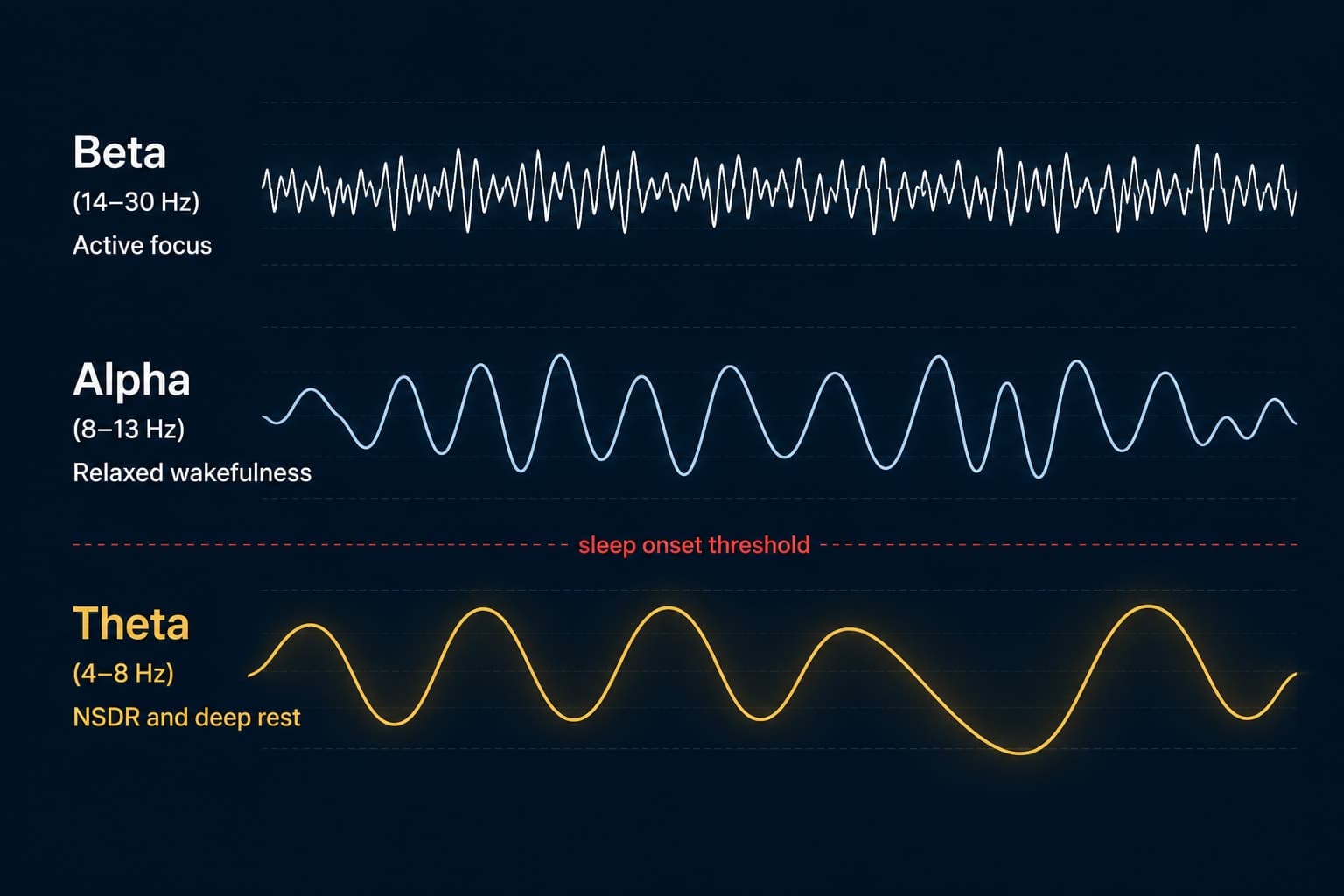
NSDR (Non-Sleep Deep Rest) is a 10 to 20 minute practice of eyes-closed wakeful rest, typically guided by a body scan. During NSDR, the brain enters a theta-wave state that activates the default mode network, supports hippocampal replay of recent material, and allows norepinephrine systems to reset. A 2002 PET study found 65% striatal dopamine release during yoga nidra, the practice NSDR derives from. NSDR is not a nap: it does not produce slow-wave memory consolidation, but it does accelerate learning consolidation and reduce cognitive fatigue through mechanisms sleep cannot deliver in the same timeframe.
Twenty minutes lying still has two possible explanations. Either you are extremely boring, or your prefrontal cortex has temporarily stood down and handed control to a brain network that cannot operate while you are paying attention to anything. The second explanation turns out to be more interesting than most people who dismiss NSDR as a productivity myth have bothered to investigate.
NSDR was not invented by Andrew Huberman. The practice is yoga nidra reframed through a neuroscience lens: a deliberate labeling choice that makes the mechanism the entry point rather than the tradition. Whether that trade is useful or reductive depends entirely on how much you understand about what the brain is actually doing during those twenty minutes. Most popular coverage, for or against, skips that question.
Not a nap. Not meditation. Something the brain does by default.
When you close your eyes, lie still, and stay awake, your brain shifts into a specific operational mode. Executive control from the prefrontal cortex reduces. External input drops below a threshold. And a distributed network called the default mode network activates.
The default mode network was identified in 2001 by neurologist Marcus Raichle at Washington University. His team noticed something unexpected: when subjects were given no task, specific brain regions consistently activated rather than going quiet. Raichle's inference was counterintuitive. These regions were not switching off during downtime. They were switching on.
Using PET imaging, Raichle's team identified consistent activation of medial prefrontal, posterior cingulate, and angular regions during passive rest, suppressed during externally focused tasks and restored during quiet wakefulness. The DMN became understood as the brain's infrastructure for autobiographical memory, prospective thinking, and consolidation of recent experience. The discovery reframed what doing nothing means neurologically: it is metabolically expensive and purposeful.
NSDR deliberately creates the conditions for DMN activation. You are not trying to focus on anything. You are not attempting to fall asleep. You are removing external stimulation long enough for the brain to shift into the mode it defaults to when nothing else is demanded of it.
This matters because NSDR is mechanistically distinct from meditation. Focused-attention meditation, concentrating on the breath, a mantra, or a sensation, consistently suppresses DMN activity. The two practices produce opposite brain states. NSDR activates the default network. Focused meditation quiets it. Neither is superior; they do different things.
The dopamine question: what the 2002 study actually found
The dopamine claim is where the science gets interesting, and where most popular coverage gets imprecise.
In 2002, Troels Kjaer and colleagues at the Neurobiology Research Unit in Copenhagen used PET imaging to measure dopamine during yoga nidra. They focused on the ventral striatum, the brain region central to motivation, learning readiness, and reward anticipation. The question was whether deliberate wakeful rest produced any measurable neurochemical signature distinct from ordinary resting baseline, or whether the dopamine system remained unchanged during the practice.
“Yoga nidra induced a 65% increase in endogenous dopamine release in the ventral striatum, associated with reduced cortical activation and significantly increased theta activity, suggesting a specific neurochemical signature distinct from ordinary rest.”
The 65% striatal dopamine increase was measured not during pleasure or reward, but during deliberate wakeful rest with no external stimulation. The brain's motivation system activates when you stop demanding things of it.
The striatal dopamine system is not simply a pleasure circuit. Dopamine here signals salience and readiness: what is worth learning next, what motivation is available, what cognitive resources are on reserve. Low striatal dopamine is associated with anhedonia, difficulty initiating action, and the flat cognitive state that follows hours of sustained output. High striatal dopamine is associated with increased motivation, learning readiness, and drive.
The honest caveat: Kjaer's study used yoga nidra with specific guided attentional protocols. Huberman's NSDR is similar but has not been scanned under PET conditions. The extrapolation from yoga nidra to NSDR is scientifically reasonable, since both share the same foundational structure of guided body awareness in a theta-dominant state, but should be held as inference, not established equivalence. What the data confirms is that the underlying neurochemical mechanism is real and measurable.
What rest does to your hippocampus in ten minutes
The dopamine finding is striking. The hippocampal replay finding is arguably more immediately actionable.
In 2012, Michaela Dewar and colleagues at the University of Edinburgh ran a straightforward experiment: participants encoded sequences of unfamiliar spoken words, then either rested quietly in a darkened room for ten minutes or completed a visual interference task. Memory was tested immediately after, then again one week later.
The design allowed the researchers to separate two distinct effects: immediate protection of fragile memories from interference, versus active consolidation that continues strengthening over time. These are not the same mechanism. Rest might simply prevent forgetting, or it might do something more durable. Subsequent replications extended the experiment to visual material, spatial information, and patients with hippocampal lesions.
Participants who rested quietly for ten minutes after encoding new verbal material showed significantly higher recall rates than those engaged in a distracting task, an effect that persisted and strengthened at one-week follow-up. The researchers attributed this to hippocampal replay: the spontaneous reactivation of newly formed memory traces during quiet wakefulness, a process disrupted by subsequent cognitive activity. The findings held across age groups and material types.
The mechanism is hippocampal replay. The hippocampus encodes new information rapidly but in a fragile, labile form. During quiet rest, it spontaneously reactivates these new representations in compressed sequences that strengthen the synaptic trace and begin the transfer to neocortical storage. This process does not require sleep. It requires the absence of competing cognitive input.
The critical constraint is what comes after encoding. Checking your phone immediately after a meeting, opening a new document, or switching to a different cognitive task can interrupt the replay window. The interference does not need to be significant to be disruptive. Any novel sensory or cognitive input competes with the spontaneous reactivation process. Three minutes of scrolling may be enough.
This finding matters because it is actionable in a way that most sleep science is not. You cannot sleep on demand after every learning event. You can sit quietly for ten minutes. The return on those ten minutes, in terms of what you retain from the preceding hour, is measurable and documented.
Theta waves: why almost asleep is exactly where you want to be
EEG recordings during both yoga nidra and NSDR-style practices consistently show a shift toward theta wave dominance: brain oscillations in the 4 to 8 Hz range. Theta is the characteristic frequency of two specific states: the hypnagogic threshold (the transition from wakefulness into sleep) and certain meditative rest states. Both involve reduced prefrontal inhibition, expanded associative processing, and the neurochemical conditions for memory consolidation.
The hypnagogic threshold has a productive reputation that most people have never exploited deliberately. It is the moment at which the prefrontal cortex relaxes its filtering function and the brain begins forming connections that task-focused cognition suppresses. Edison famously napped in a chair holding steel balls, waking when they dropped. Dalí used the same technique. The target was not sleep. It was the edge of it.
What happens if you cross that edge and fall asleep? The mechanism changes. Sleep produces its own consolidation through slow-wave architecture and REM cycling, processes that require full sleep entry and are not available in the wakeful rest state. A 20-minute NSDR session that becomes sleep typically does not produce enough slow-wave activity to replicate those benefits. It is not a failure. It means your brain has redirected to what it most needs. But it is a different process, with different outputs.
NSDR (wakeful rest)
- Activates default mode network
- Hippocampal replay of recent material
- Theta-wave dopamine release (Kjaer 2002)
- Norepinephrine system reset
- No sleep inertia on waking
- Effective immediately after learning
- 20 minutes sufficient for full cycle
Nap (sleep entry)
- Sleep architecture cycling required
- Slow-wave declarative consolidation
- REM emotional and procedural processing
- Adenosine clearance (reduces sleep pressure)
- Risk of sleep inertia beyond 30 minutes
- Better for genuine sleep deficit recovery
- Stage 2 sleep minimum required for benefit
The distinction most often missed: NSDR does not clear sleep pressure. Adenosine accumulates throughout the day and is only cleared by sleep. A 20-minute NSDR session provides no adenosine relief. What it provides, hippocampal replay, striatal dopamine, DMN activation, is not available once you cross into sleep, because the theta-wave hypnagogic state passes the moment sleep begins.
NSDR is a productivity hack that recovers energy.
NSDR is a consolidation window that recovers cognition.
The reframe shifts what NSDR is for. Not energy, which requires sleep. Consolidation, which requires the absence of interference. Once you see it this way, the placement of the practice changes: not when you feel tired, but immediately after learning or dense cognitive work.
Norepinephrine and the cost of sustained alertness
Norepinephrine is the alertness signal: the neuromodulator that narrows attention, raises signal-to-noise ratio, and prepares the brain for task execution. It is essential for effective focused work. The cost of sustained norepinephrine elevation is that broad associative processing, insight, synthesis, creative connection, becomes progressively unavailable. The brain that is always alert is a brain that can no longer think loosely enough to connect distant concepts.
Susan Sara's 2009 review in Nature Reviews Neuroscience examined the dual role of the noradrenergic system across the full learning cycle. The intuitive assumption was that more norepinephrine means better cognition. The review asked whether that holds across both phases of memory formation: the initial encoding of new information and the subsequent consolidation that stabilises it.
“While noradrenergic activation during encoding facilitates the acquisition of new information, sustained high noradrenergic tone may interfere with subsequent consolidation processes that require reduced alerting signals and increased hippocampal-neocortical dialogue.”
NSDR is, among other things, a norepinephrine management protocol. By removing external stimulation and allowing the brain to shift into a theta-dominant default-mode state, it provides the neuromodulatory conditions for consolidation to proceed. This is one explanation for why cognitive performance often measurably improves in the afternoon following a midday NSDR session. The recovery is not purely about energy. It is about giving the consolidation process the biochemical conditions it requires.
Which type of tired are you?
NSDR is not a universal fatigue fix. It is a specific tool for a specific class of tired. Identifying which type of depletion you are in changes whether NSDR is the right lever or the wrong one.
Learning fatigue
You have just finished dense material, a training, a meeting with new information, a study block. You feel mentally full but not physically exhausted. New tasks feel harder than they should for the next hour.
The hippocampus is holding fragile new memory traces that have not yet consolidated. Any new cognitive input competes with the replay process. This is exactly the pattern Dewar 2012 measured.
Ten minutes of NSDR immediately after the session preserves more of what you learned than an hour of continued work. This is the highest-return NSDR use case.
Decision fatigue
You have made dozens of small decisions across the morning. By early afternoon, choices feel harder. You default to whatever is easiest. Motivation for anything requiring initiation feels absent.
Sustained prefrontal activity has depleted the neuromodulatory conditions for effortful choice. Striatal dopamine has flattened. Norepinephrine has elevated past the useful range.
A 20-minute NSDR in the 1 to 3 PM window addresses both. Dopamine rises, norepinephrine drops. Post-NSDR decision quality often improves within the first hour.
Genuine sleep debt
You have slept under six hours for multiple consecutive nights. Physical exhaustion is present. Focus fails. Emotional regulation is fragile. You feel tired in your body, not just your mind.
Adenosine has accumulated past baseline and only sleep clears it. Slow-wave and REM debts are compounding. Wakeful rest does not touch either.
NSDR will not solve this. A nap will. If you consistently need NSDR to survive the afternoon, the actual intervention is more nighttime sleep, not more daytime rest practice.
The protocol: how to actually do it
NSDR is not technically complex. The errors that reduce its effectiveness are not precision failures; they are structural ones that undermine the specific mechanisms it depends on.
Timing: two windows that matter
The highest-return NSDR window is immediately after a cognitively demanding session, a meeting, a study block, intensive reading. This is when hippocampal replay is most active and most vulnerable to interruption. The second effective window is the early-to-mid afternoon circadian dip, typically 1 to 3 PM. Avoid within two hours of intended sleep: the theta-state activation and dopamine release can delay sleep onset in sensitive individuals.
High impactPosition and environment
Lie down or recline at an angle. Full horizontal position facilitates DMN activation and theta-state transition more reliably than seated posture. A cool, darkened room reduces visual cortex activity. Remove active notifications, not because silence is required, but because notification anticipation creates a low-level alertness state that prevents full default-mode entry. Ambient background sound is compatible with NSDR.
High impactWhat to do with your attention
A guided body scan provides just enough attentional anchor to prevent active thought without triggering task-focused processing. The guidance keeps you awake while releasing executive control, the precise balance NSDR requires. The Huberman Lab NSDR recording and Yoga Nidra Network protocols are the most validated formats. Silence works for experienced practitioners. The target state is passive awareness: you notice sensations without engaging with them.
High impact
The 20-minute guided body scan
You do not need an app for this. You need twenty minutes and the following sequence. Any external recording is an optional scaffold that provides the pacing your attention would otherwise have to track.
The full 20-minute NSDR protocol
20 min- 1Lie flat on your back, arms slightly away from your body, palms up, legs uncrossed. Close your eyes. Set a timer for 20 minutes but face it away from you.
- 2Take three slow breaths: inhale four seconds through the nose, exhale eight seconds through the mouth. The extended exhale signals the vagal shift into parasympathetic dominance.
- 3Bring attention to your feet. Notice temperature, weight, contact with the surface below. Do not analyze. Do not fix anything. Notice, then move on.
- 4Move slowly up the body: ankles, calves, knees, thighs. Same protocol at each site. Twenty to thirty seconds per zone. If your mind wanders, that is the point, notice and continue.
- 5Continue upward: hips, lower back, abdomen. Include the sensation of breath rising and falling. This is where DMN activation often deepens.
- 6Chest, upper back, shoulders. Deliberately soften the shoulders. Most adults hold significant tension here without noticing.
- 7Arms, hands, fingertips. Then neck, jaw (unclench), face. Soften the forehead. Let the tongue rest.
- 8Full body awareness. Feel the whole body breathing as one system. Rest here for the remaining minutes. Do not chase thoughts. Do not push them away. Let them arrive and pass like weather.
- 9When the timer sounds, wiggle fingers and toes first. Do not sit up immediately. Open eyes to soft focus. Take one full minute before standing.
The goal is not to think about nothing. The goal is to stop demanding that your brain do anything at all.
Who benefits most and when the return is highest
NSDR is not universally optimal. Understanding which situations produce the highest return shapes where to invest the twenty minutes.
- After dense learning: Students, researchers, anyone in intensive training. The hippocampal replay window makes post-learning rest disproportionately high-value. The Dewar findings are most applicable here.
- Knowledge workers with sleep inertia sensitivity: People who wake from even short naps feeling significantly impaired gain the cognitive reset of NSDR without the post-sleep grogginess that stage 2 or slow-wave entry produces.
- People in chronic stress states: Elevated cortisol disrupts both sleep architecture and hippocampal encoding. NSDR provides a daily window of HPA quieting that cortisol-burdened sleep may not reliably deliver.
- Shift workers and jet-lagged travelers: When sleep timing is disrupted, NSDR preserves daytime cognitive function without deepening circadian misalignment the way irregular napping can.
Sleep inertia (the grogginess that follows waking from a nap) is caused by slow-wave sleep entry in as little as 20 minutes. NSDR produces the consolidation benefits of rest without triggering slow-wave entry, which is why you wake up clear rather than foggy. The price of that advantage: it does not clear adenosine. You wake sharp, but the sleep pressure you carried in is still there.
The population least likely to benefit from NSDR over a nap are those in genuine sleep debt. If consistent nightly sleep has been below six hours, the question is not which rest practice is most efficient: it is whether wakeful rest can substitute for sleep-specific consolidation processes at all. The Diekelmann and Born review mapped precisely which memory operations depend on sleep architecture and which remain accessible during quiet wakefulness.
“Sleep is critical for the consolidation of hippocampus-dependent memories, particularly through slow oscillations coordinating hippocampal-neocortical dialogue during slow-wave sleep; a process distinct from, and complementary to, hippocampal replay during quiet wakefulness.”
NSDR complements sufficient sleep. It does not replace insufficient sleep.
What most people get wrong about NSDR
- Treating it like meditation and trying to concentrate. Focused attention suppresses the DMN, the exact opposite of what NSDR requires.
- Doing it seated at a desk to save time. Full horizontal position matters more than most guides suggest, because it accelerates theta transition.
- Using it as a substitute for real sleep debt. If you sleep five hours a night, no amount of NSDR will close that gap.
- Checking the phone the moment the timer ends. This wipes out the hippocampal replay window you just built.
- Doing it within two hours of bedtime. The theta activation and dopamine release can delay sleep onset in sensitive people.
What to expect over four weeks of consistent practice
A realistic timeline with daily practice
- Week 1Expected
Sessions feel long. You may fall asleep or feel restless. Do not judge the practice by the first three days. Your nervous system is unfamiliar with deliberate stillness.
- Week 2Patience
Body scan becomes more natural. Some afternoon clarity noticed after sessions. If you were falling asleep every time, that signals sleep debt is the real intervention.
- Week 3 to 4Visible result
Consolidated benefit becomes measurable: sharper afternoons, less severe 3 PM crash, better retention of morning learning. Sessions feel shorter subjectively even though duration is unchanged.
- Month 2 and beyondVisible result
Practice becomes an integrated cognitive tool. Not something you do because a podcast recommended it, but something you reach for when the specific problem it solves (consolidation, decision reset, norepinephrine downregulation) is what you actually need.
When NSDR is the wrong tool
→If you are exhausted but cannot fall asleepTired but Can't Sleep: Your Body Is Exhausted. Your Brain Didn't Get the Memo.→For the 3 PM crash mechanismThe Cortisol Reset Protocol: An Evidence-Based Approach to HPA Axis Recovery→For the sleep cycle mathWhy You Wake Up Tired After 8 Hours of SleepSleep science, explained without the wellness jargon
GetClariSync covers what the research actually shows about sleep, cognitive performance, and recovery. Peer-reviewed and editorially independent.
Get the newsletterGetClariSync Sleep Desk
Editorial Research · Sleep Science
The GetClariSync Sleep Desk reviews peer-reviewed research in sleep science, chronobiology, and circadian medicine. We focus on journals indexed in PubMed — including Sleep, Sleep Medicine Reviews, Nature Communications, the Journal of Sleep Research, and the Journal of Clinical Sleep Medicine. Each article cites its primary sources, distinguishes correlational findings from causal evidence, and is reviewed for accuracy before publication. We update articles when stronger evidence emerges and post a correction note when we change a substantive claim. We are editorial researchers, not clinicians — for medical concerns, sleep disorders, or persistent insomnia please consult a board-certified sleep physician or your primary care provider.