Your body repairs itself during sleep. But not during all of it.
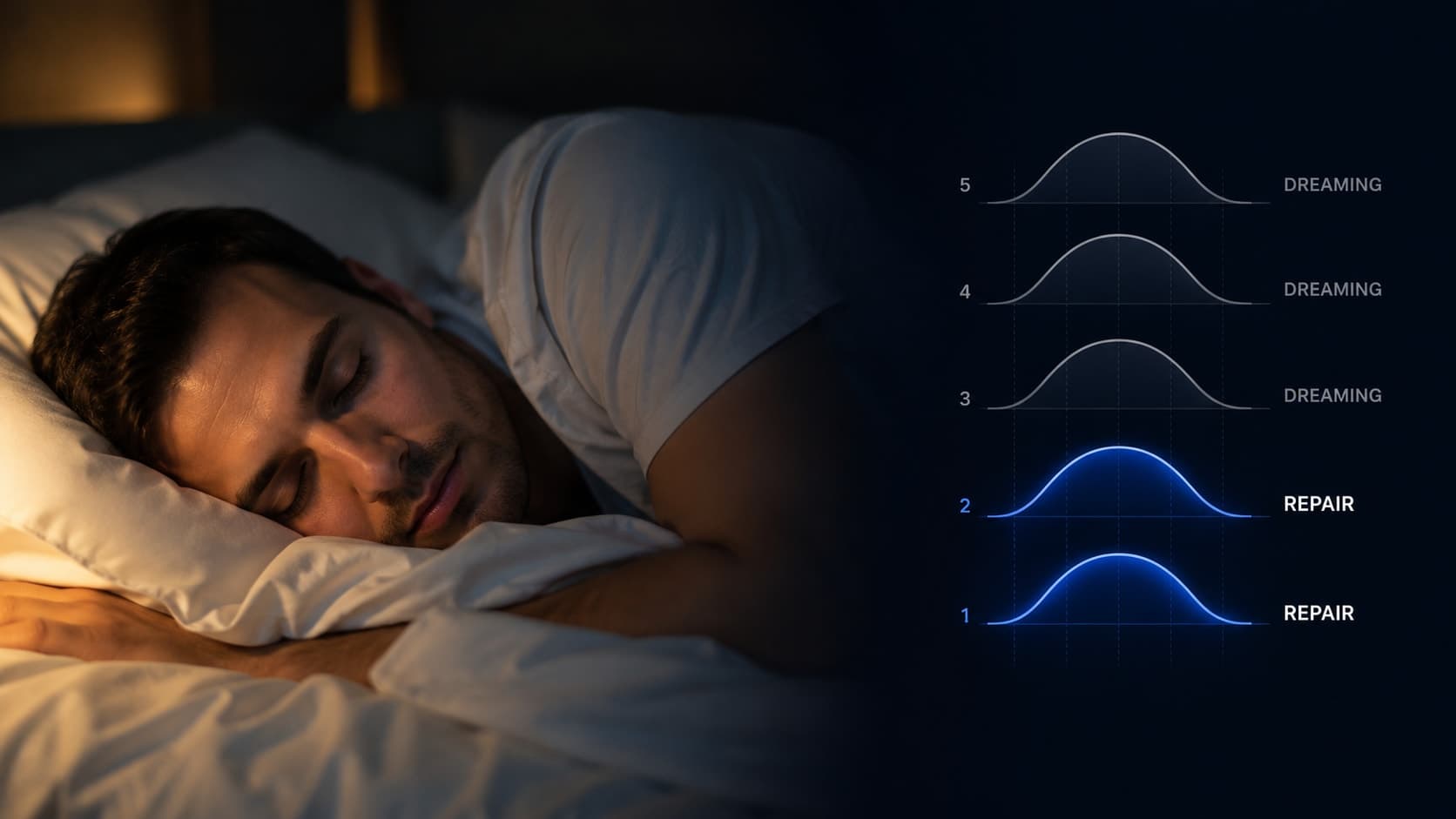
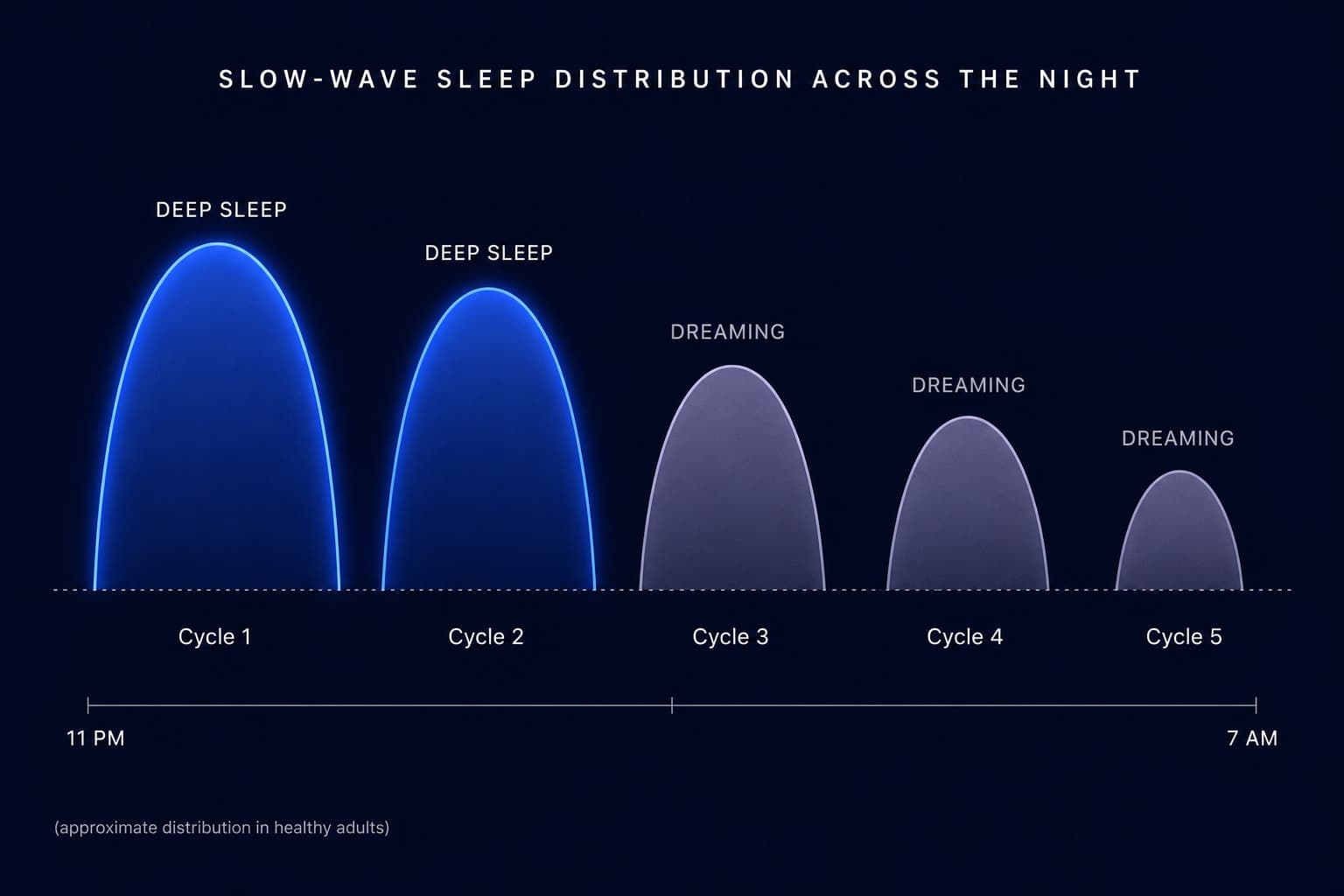
Sleep runs in 90-minute cycles, and the most restorative stage, called deep sleep, is concentrated almost entirely in the first two cycles of the night. Growth hormone is released, tissues are rebuilt, and the brain flushes metabolic waste during this window. By the third and fourth cycles, deep sleep has largely given way to dreaming. What you do in the two hours before bed shapes whether that first window opens fully or stays half-closed.
Most people assume that eight hours of sleep is eight hours of the same thing. Like filling a gas tank: the longer you leave it running, the fuller it gets. But your sleep is not a tank. It is a sequence, and the most important parts are not evenly distributed.
The structure of a night follows a pattern that researchers call sleep architecture, the sequence of stages your brain moves through from the moment you fall asleep to the moment you wake up. There are four main stages. Three of them are non-REM sleep, stages of progressively deeper rest. The fourth is REM, short for rapid eye movement, the stage where your eyes flicker under your eyelids and most dreaming occurs. Your brain cycles through all four stages roughly every 90 minutes, all night long.
Your Body Runs on a Schedule You Cannot Negotiate
Each 90-minute cycle is not identical. Picture them as waves. The first wave is the deepest. The second nearly as deep. But each wave after that is shallower than the last. By the fourth or fifth cycle of the night, your brain is barely dipping below the surface.
The stage that changes most across those cycles is called slow-wave sleep, named for the large, slow electrical waves the brain produces during it. This is the deepest stage of non-REM sleep, the one that is hardest to wake from, the one where your body moves furthest from its waking state. You get a substantial amount of it in the first two cycles. After that, the amount drops sharply with each successive cycle.
By the time you reach your fourth sleep cycle, the slow-wave sleep remaining is often close to zero. Your last hour of sleep may contain almost none of the most restorative stage.
What Deep Sleep Actually Does to Your Body
The word restorative gets used a lot without much explanation. It is worth being specific, because once you understand what actually runs during slow-wave sleep, protecting those first two cycles stops feeling like advice and starts feeling obvious.
During slow-wave sleep, your body releases the largest pulse of growth hormone it produces in a 24-hour period. Growth hormone is the protein responsible for repairing muscle tissue, rebuilding cells damaged during the day, and supporting metabolic function. Your body cannot stockpile it for later. What gets released tonight is used tonight.
A research team at the University of Chicago monitored sleep architecture and hormone secretion across full nights in healthy young men, drawing blood samples at regular intervals to map exactly when growth hormone entered the bloodstream and whether those spikes corresponded to specific sleep stages.
“Slow-wave sleep-related GH release represents the major secretory pulse in healthy young men.”
Miss that first window, and the growth hormone pulse does not shift to compensate later in the night. It simply does not happen at that scale until the following night.
Slow-wave sleep also drives glymphatic clearance, the process by which fluid surrounding the brain expands into neural tissue and flushes out metabolic waste that accumulated during the day. The proteins cleared this way include some linked to cognitive decline when they build up over time. Not a distant health concern. A process that runs tonight, or does not run at all.
Why the First Two Hours Are Different From All the Rest
The concentration of deep sleep in the early part of the night is not arbitrary. It is driven by sleep pressure, a biological force that builds throughout every waking hour. A chemical called adenosine, a byproduct of the brain's own activity, accumulates in neural tissue while you are awake. The longer you have been up, the higher the adenosine. And high adenosine is the signal that tells your brain to prioritize its deepest sleep first.
Think of it as a debt. Your brain owes your body a repair payment for the hours it spent running. The first chance it gets, it makes the largest installment. That is why the first two cycles carry the most slow-wave sleep: the biological debt is at its peak, and the repayment is proportionally deep.
Using continuous EEG recordings across multiple full nights, researchers quantified the slow-wave activity present in each successive sleep cycle, asking whether the decline from first cycle to last followed a consistent pattern or varied considerably between individuals.
“Slow-wave activity is highest in the first NREM sleep episode and declines in successive NREM sleep episodes throughout the night.”
The decline is consistent enough that researchers can model it from a single overnight recording. The first two cycles are not a warm-up for something that comes later. They are the main event.
What Closes the Repair Window Before You Get Into Bed
The threats to the first two cycles are mostly things that happen before sleep. Not during the night. Before it.
Alcohol is the one most people misread. It does help you fall asleep faster, and that part is real. The problem is that sedation and sleep are not the same state. When you fall asleep after drinking, your brain is suppressed, not cycling through the stages that make sleep productive. The structured architecture that allows growth hormone release and glymphatic clearing is disrupted from the first cycle onward.
A systematic review examining research on alcohol's effects on sleep structure posed a specific question: does alcohol change not just total sleep time, but which stages the brain enters and when, across a full night.
“Alcohol suppressed REM sleep in the first half of the night and was associated with increased sleep disruption in the second half as blood alcohol concentration fell.”
Your body spends the first cycles processing what you drank. The repair program runs at reduced capacity, or not at all.
Core body temperature is a factor fewer people consider. Falling asleep requires your body temperature to fall by approximately one degree Celsius. That drop is not a side effect of sleep. It is the trigger. A warm bedroom, or any prolonged exposure to heat close to bedtime, delays the temperature fall your brain needs to begin the descent into slow-wave sleep. The first cycle starts late, or starts shallow.
Mental stimulation close to bedtime creates a third problem. Cortisol, the hormone released in response to stress and sustained cognitive engagement, is a physiological antagonist to the deep sleep signal. An unresolved work problem still running in the background of your mind, a conversation that raised your heart rate, content on a screen that triggered any emotional response: each keeps cortisol elevated past the point where slow-wave sleep can begin cleanly.
- A glass of wine to wind down before bed
- Scrolling in bed because it feels passive
- A hot shower taken right before getting in
- Working until 30 minutes before closing your eyes
- Keeping the bedroom above 20°C (68°F)
Three Small Shifts That Change What Your Body Gets Done Tonight
None of these require rearranging your life. They are adjustments to what happens in the 60 to 90 minutes before sleep, and their combined effect on the first two cycles is significant.
Cool the bedroom before you get in
The optimal sleep temperature sits between 16 and 19°C (60 to 66°F). A cooler room accelerates the drop in core body temperature that signals your brain to begin slow-wave sleep. If you cannot control room temperature, a warm shower taken 60 to 90 minutes before bed can help: it draws blood to the surface of the skin, which releases heat and lowers core temperature after you step out.
High impactSet the alcohol cut-off at 90 minutes before sleep
Your liver metabolizes alcohol at roughly one standard drink per hour. Going to bed with significant alcohol still in your bloodstream means your body is managing that process during the exact window where slow-wave sleep should be running. A 90-minute buffer gives your body time to clear the bulk of it before the first cycle begins. The goal is not abstinence. It is timing.
High impactWind down your nervous system, not just your activity
Stopping work is not the same as lowering cortisol. Cortisol needs a specific signal to fall: a genuine reduction in cognitive and emotional load, not just a pause in typing. Reading fiction, slow breathing, or a quiet evening walk all work. What does not work is switching from work to social media. The cortisol stays elevated either way.
High impactThere is something worth sitting with in all of this. Sleep tends to be framed as the absence of waking: something that happens when you stop doing things. But the biology is far more deliberate. Your brain is not waiting for activity to cease. It is running a program that was set in motion hours before you lay down.
What you do in the evening is not preparation for sleep. It is already part of it.
Want to go deeper on sleep science?
Explore our full series on sleep, recovery, and what your brain does while you rest.
Browse Sleep ArticlesGetClariSync Sleep Desk
Editorial Research · Sleep Science
The GetClariSync Sleep Desk reviews peer-reviewed research in sleep science, chronobiology, and circadian medicine. We focus on journals indexed in PubMed — including Sleep, Sleep Medicine Reviews, Nature Communications, the Journal of Sleep Research, and the Journal of Clinical Sleep Medicine. Each article cites its primary sources, distinguishes correlational findings from causal evidence, and is reviewed for accuracy before publication. We update articles when stronger evidence emerges and post a correction note when we change a substantive claim. We are editorial researchers, not clinicians — for medical concerns, sleep disorders, or persistent insomnia please consult a board-certified sleep physician or your primary care provider.