You open your eyes. You look at the clock. Your alarm is set for 6:30. The time is 6:29. You did not see this coming, and yet somehow, your brain did.
The phenomenon of waking up moments before your alarm rings is real, well-documented, and biological. Your body begins preparing for the anticipated wake time about an hour in advance, releasing a steady rise of cortisol that pulls you up through lighter sleep stages so that you arrive at the surface right before the alarm sounds. This anticipatory awakening needs a stable sleep schedule and a clear mental expectation of the wake time. When either is missing, the timing breaks down.
It feels like a tiny miracle. You go to sleep with the alarm set. You sleep through the night without checking the clock. Somewhere in the dark before the alarm rings, your eyes open. You look at your phone. The time is one minute, sometimes two, sometimes thirty seconds, before the alarm. It is not a coincidence and not luck.
It is a measurement. Your brain was counting the entire time.
The Moment Before the Alarm
This experience is so common that most people brush it off as a charming brain quirk, a slight inconvenience of waking up just early enough to wonder why you bothered setting the alarm at all. The actual name for it is anticipatory awakening, a documented physiological response where the body times the end of sleep to match the time the brain expects to be woken.
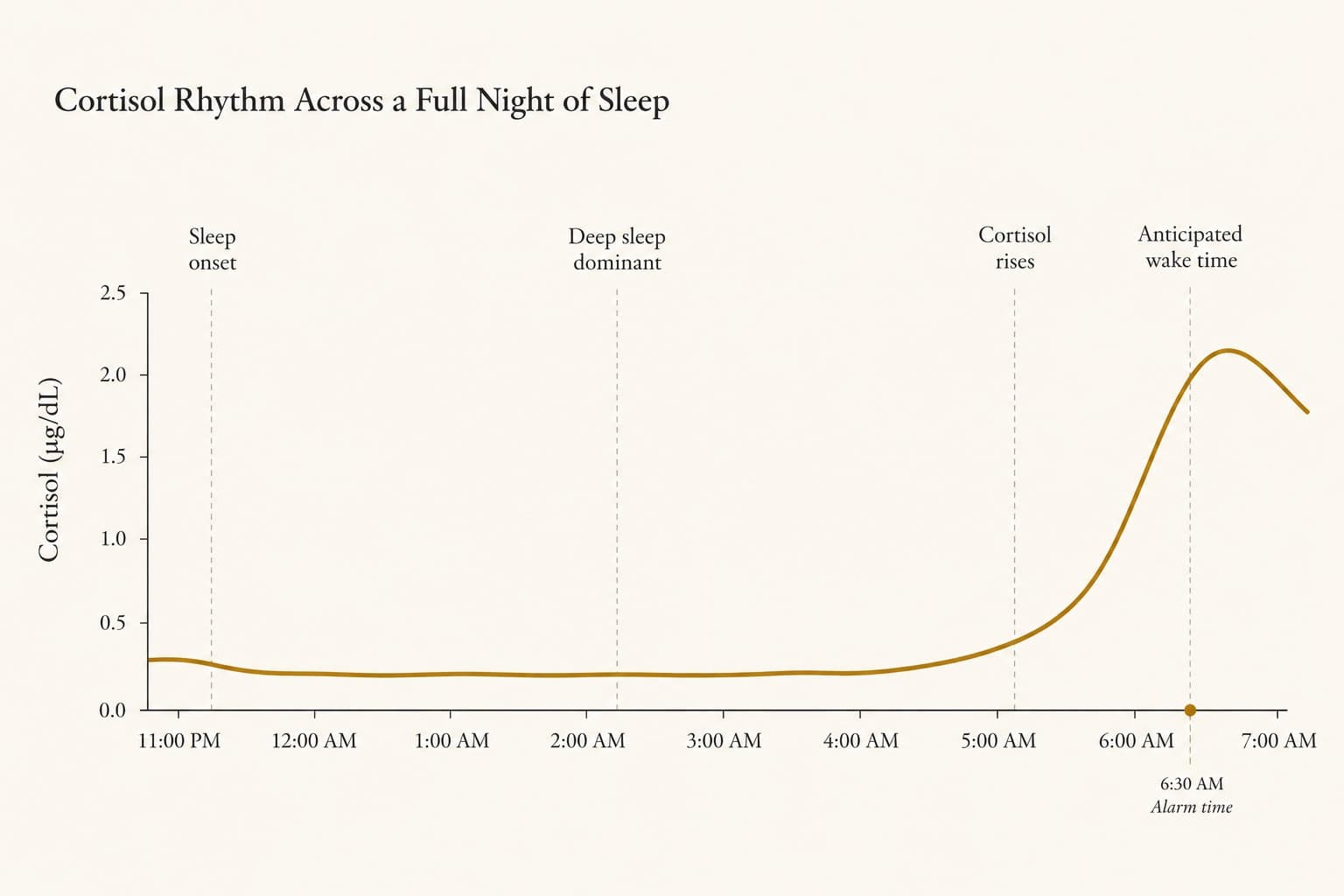
The mechanism behind it begins about an hour before the planned wake time. The hypothalamic-pituitary-adrenal axis, the system that releases the body's main arousal hormones, starts producing a slow climb of cortisol. The climb is not the small awakening cortisol response that happens after you actually wake up. It is something else: a preparation pulse, timed to bring you out of deep sleep gradually so that you are floating in light sleep stages when the alarm should be near. The whole process is so quiet you do not feel it. The result is that when the alarm is about to ring, you are already at the edge of the surface.
By the time the alarm was about to ring, your body had been preparing for it for almost sixty minutes. The cortisol was already rising. The light sleep stages were already taking over from the deep ones. You were ready to wake before you knew you would.
Your Brain Has Been Counting
What this tells you, plainly, is that some part of your brain has access to a timer. Not consciously. The conscious mind was asleep. But the deep timing systems of the brain, particularly the circuits coordinating with the master circadian clock buried in a small region called the suprachiasmatic nucleus, were measuring the night.
A team of researchers at the University of Lübeck designed an experiment to find out whether the body's hormone systems could be cued by a simple expectation of when sleep would end. Fifteen subjects spent multiple nights in a sleep laboratory. On some nights they were told they would be woken at six in the morning. On others they were told they would be woken at nine. Blood was sampled at intervals through the night, with the experimenters watching the cortisol curve.
“Anticipating an early awakening induced an adrenocorticotropic hormone release that began approximately one hour before the planned awakening, suggesting that hormonal events characterizing the end of sleep are timed to the expected wake-up time.”
What the finding showed was something the brain does without telling you. Tell it you need to be up at six and the cortisol begins climbing at five. Tell the same body the next night that it will be up at nine and the cortisol holds back until eight. The hormone curve responds to expectation, not just to the clock. Some part of you was paying attention when you set the alarm.
What Conditions Make the Reflex Show Up
The reflex needs two things to work. The first is a stable sleep schedule. The brain calibrates its anticipation against the rhythms it has been getting used to. If you have been going to bed and waking up at roughly the same time for at least a week, the anticipation system has something to anchor to. Your body knows what time of day six in the morning feels like because it has been there before.
The second is a clear mental expectation. Setting an alarm with intention seems to be enough for the brain to register the time. Sleeping with the vague hope of getting up around seven is not. The system responds to specific, named time targets, the kind you mentally rehearse before falling asleep. Travelers catching early flights, parents on call, students with morning exams, anyone whose mind enters sleep with a target time loaded into it tends to wake near it.
What Conditions Make It Disappear
The reflex breaks down when either of its two anchors is missing. Irregular sleep, the kind where your bedtime varies by more than an hour or two across a week, leaves the brain without a stable calibration to work from. Travel across time zones does the same thing on a larger scale: the internal clock has not yet realigned to the new local time, so its anticipation runs on the old time.
Anxiety changes the picture in a different way. When the wake target is emotionally charged, the cortisol rise can begin too early, sometimes two or three hours before the planned wake time. The result is the familiar pattern of waking up at three in the morning the night before a flight, an interview, or any important event. The system has not malfunctioned. It has overestimated.
- Sleep schedule that varies by more than an hour or two across the week
- Travel across time zones, before the internal clock has realigned
- High anxiety the night before, which pulls the cortisol rise too early
- Alcohol or sedatives, which blunt the natural cortisol curve
- Sleep deprivation deep enough to keep you in slow-wave sleep through the expected wake time
What This Means for the Rest of Your Sleep
What is happening here is bigger than a charming party trick. The brain is not just falling asleep and waking up. It is preparing for waking up the entire time it is asleep. The architecture of your night, the timing of your deep sleep stages, the curve of your hormones, all of it is shaped in part by what your brain expects the morning to look like.
This is part of why a consistent sleep schedule does so much more than it sounds like it should. The cortisol awakening response in the half hour after you actually wake up has been studied extensively as a marker of overall sleep quality and physiological readiness for the day (Pruessner et al., 1997). What anticipatory awakening adds to the picture is that the body's preparation begins long before your eyes open. Waking up is not a transition. It is a process that runs through the second half of the night.
The Quiet Conversation Between Sleep and Time
There is something quietly moving about all of this. You set an alarm before you fall asleep. Somewhere in the dark, your brain holds onto that number while the rest of you is unconscious. It checks the night, measures the hours, releases what needs to be released so that by the time the morning is about to arrive, your body is already meeting it.
The next time you open your eyes a minute before the alarm, it might be worth pausing for a second. Not because of what it teaches you about sleep. Because of what it shows you about how much of your life is being quietly looked after by parts of yourself you will never get to meet.
Want to go deeper on sleep science?
Read our breakdown of NSDR, the 20-minute non-sleep deep rest practice that restores dopamine and focus better than a nap.
Explore Sleep ScienceGetClariSync Sleep Desk
Editorial Research · Sleep Science
The GetClariSync Sleep Desk reviews peer-reviewed research in sleep science, chronobiology, and circadian medicine. We focus on journals indexed in PubMed — including Sleep, Sleep Medicine Reviews, Nature Communications, the Journal of Sleep Research, and the Journal of Clinical Sleep Medicine. Each article cites its primary sources, distinguishes correlational findings from causal evidence, and is reviewed for accuracy before publication. We update articles when stronger evidence emerges and post a correction note when we change a substantive claim. We are editorial researchers, not clinicians — for medical concerns, sleep disorders, or persistent insomnia please consult a board-certified sleep physician or your primary care provider.