Right before sleep, your whole body suddenly jerked. For a second you felt like you were falling off a cliff. Your eyes opened and you were back in bed, slightly confused. The twitch happened. The falling sensation came after. Your brain wrote the second one to explain the first.
The sudden full-body twitch some people feel just before falling asleep is called a hypnic jerk, or sleep start. It is one of the most common involuntary movements in human sleep, experienced by roughly 60 to 70 percent of adults. The vivid sensation of falling, slipping, or losing balance that often accompanies it is not what triggered the twitch. It is a story the brain assembled milliseconds later to make sense of an unexpected muscle movement during the wake-to-sleep transition. The twitch came first. The falling feeling was the brain's reconstruction.
You have probably had this happen. The lights are off, your eyes are closed, your body is heavy. Sleep is somewhere within reach. Without warning, your arm or your leg or your whole body fires in a sharp jolt, your heart accelerates, and for a fraction of a second you are sure you were just falling. None of the falling happened. Your bed was exactly where it had been. The twitch was real. Everything else was a story.
The phenomenon has a name in sleep medicine, and what it actually is overturns the order most people assume.
What Sleep Medicine Calls It and Who Gets It
The clinical term is hypnic jerk, sometimes written as hypnagogic jerk or sleep start. The word hypnic refers to sleep, from the Greek hypnos, and jerk describes what it feels like: a sudden, involuntary muscle contraction. It happens during the wake-to-sleep transition, the brief window when the brain is leaving wakefulness but has not yet entered the first formal stage of sleep. By the time the muscle contracts, you are usually just seconds away from being asleep.
Almost everyone has experienced this. Survey research and sleep laboratory observation place the rate at somewhere between 60 and 70 percent of adults, though many people never realize there is a name for it. Frequency varies enormously. Some people get a hypnic jerk only every few months. Others get one almost every night. Most fall somewhere in between, and the rate tends to drift upward during periods of stress, sleep deprivation, or heavy caffeine use.
What Your Brain Is Actually Doing in That Moment
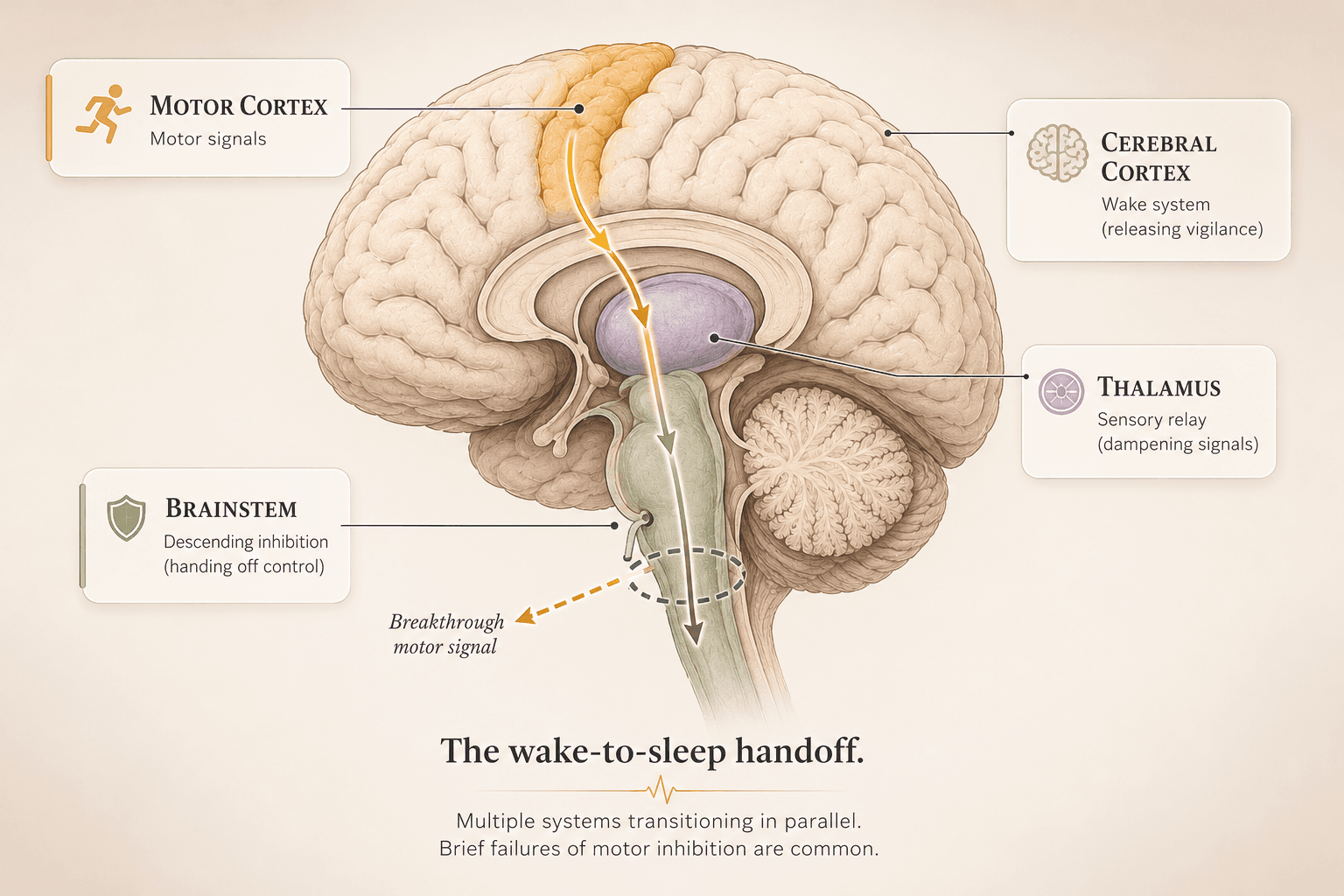
The wake-to-sleep transition is not a clean switch. Your brain does not turn off wakefulness and turn on sleep at the same instant. Instead, multiple systems hand off control to each other over several minutes. The motor system, which kept your muscles ready to move all day, has to be quietly silenced. The vigilance system that kept your attention scanning the room has to release its hold. Down in the relay station of the thalamus, the sensory signals climbing up to your cortex begin to dampen. All of these processes run in parallel and not always in perfect coordination.
A review of the neurobiology of sleep onset examined what happens in the brain during the brief window between full wakefulness and the start of sleep, asking what specifically governs the timing and completeness of motor system silencing during that interval.
“The wake-sleep transition is a graded, multi-system process during which descending inhibitory control over motor pathways must be progressively established. Brief failures of this inhibition during the transition are common and present clinically as sleep starts or hypnic jerks, occurring more frequently when the transition is forced or disrupted.”
What this means in plain terms is that the twitch is a moment of disinhibition. While the rest of your brain is moving toward sleep, the part responsible for suppressing motor activity has briefly lost its grip. A neuron that should not have fired, fires. A muscle that should not have moved, moves. By the time it happens, the rest of your brain is already most of the way into sleep and is not in a position to deliberate about what just occurred. So it does what brains do with unexpected information arriving in a fading state of consciousness. It makes something up.
Why the Twitch Comes Wrapped in a Falling Sensation
The classic theory is evolutionary. In this account, the brain still interprets sudden muscle relaxation as the body losing grip on a tree branch, a holdover from when human ancestors slept in arboreal environments where falling was a real risk. The twitch is supposedly the body's reflex to catch itself, and the falling sensation is the perception of the imagined fall. The story is appealing. It is also speculative, with limited direct evidence to support it.
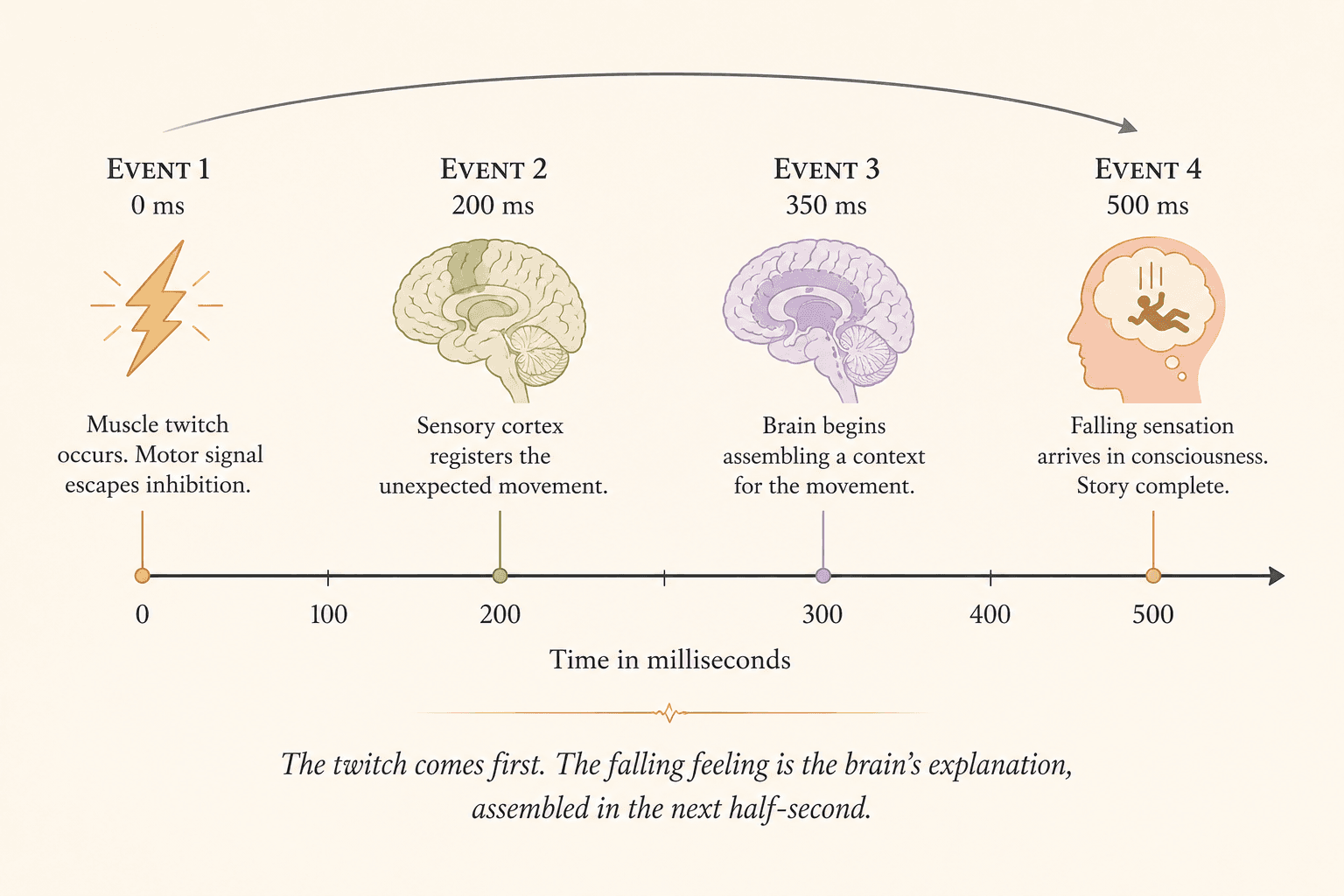
The modern explanation is less narrative and more neurological. When the motor system fires unexpectedly in the wake-sleep transition, your sensory cortex registers the movement but receives no preceding intention to explain it. The mind, partially shut down but not entirely offline, tries to construct a context for the muscle activation. Falling is the most plausible explanation it can assemble in the chemistry of half-sleep. Your visual system, partially shut down, contributes whatever vague imagery is at hand. The result is an experience that feels like a vivid fall but that was authored after the fact by a brain trying to make sense of its own glitch.
Put simply: the twitch is the event. The falling feeling is the brain's explanation.
What Makes Hypnic Jerks More Frequent
Most factors that increase the rate of hypnic jerks are factors that disturb the smoothness of the wake-sleep transition. When the transition is forced, rushed, or arrived at with the wake system still elevated, the motor inhibition system has less time to settle into place, and breakthrough movements become more common.
- Significant sleep deprivation, which forces a faster, more abrupt transition
- Caffeine consumed in the afternoon or evening, which keeps wake systems active longer
- Strenuous physical exercise within two hours of sleep, which leaves the motor system activated
- Acute stress or anxiety, which raises baseline muscle tone going into sleep
- Heavy alcohol consumption, which fragments the architecture of the transition into sleep
When the Twitch Is Worth a Conversation With a Doctor
Hypnic jerks at the rate most people experience them are entirely benign. They are not a sign of a sleep disorder, not connected to neurological disease, and not associated with worse sleep quality once they pass. Their existence is essentially a quirk of how the human nervous system handles the transition out of wakefulness.
There are a few situations where the twitches are worth bringing up with a healthcare provider. Hypnic jerks that occur many times a night and prevent you from falling asleep for an hour or more can become functionally disruptive. Jerks that begin suddenly in adulthood after never having occurred before, especially if accompanied by other changes in sleep, are worth mentioning. Movements during established sleep, rather than at the threshold of sleep, are a different category and should be evaluated. None of these are emergencies. They are conversations worth having when you next see a doctor.
Most people who get hypnic jerks experience the falling sensation as completely real. The brain that experiences it has no internal flag to mark it as confabulated. The story feels indistinguishable from a memory of having actually fallen, because in the moment of construction, it was a memory the brain was authoring in real time.
The Brain Wasn't Sure What Just Happened. So It Decided.
There is something quietly fascinating about all of this. The hypnic jerk is one of the few experiences in human life where you can sometimes feel the seam between perception and explanation. Most of the time the brain narrates your life so smoothly that you do not notice the difference between what happened and what your mind says happened. The sleep-transition twitch is a rare moment when the seam shows. The body moved before the story arrived to explain it.
The next time it happens, it might be worth lying still for a second instead of resetting your position. You did not fall. You did not nearly fall. A small breakthrough movement occurred in the transition out of wakefulness, and the brain assembled the best story it could in the few hundred milliseconds available. Sleep was waiting for you on the other side of the seam. The seam itself is, in its strange small way, a window into how perception works the rest of the time.
Want to go deeper on sleep science?
Read our breakdown of why most of a dream disappears within five minutes of waking, and the chemistry that builds the dream but cannot save it.
Explore Sleep ScienceGetClariSync Sleep Desk
Editorial Research · Sleep Science
The GetClariSync Sleep Desk reviews peer-reviewed research in sleep science, chronobiology, and circadian medicine. We focus on journals indexed in PubMed — including Sleep, Sleep Medicine Reviews, Nature Communications, the Journal of Sleep Research, and the Journal of Clinical Sleep Medicine. Each article cites its primary sources, distinguishes correlational findings from causal evidence, and is reviewed for accuracy before publication. We update articles when stronger evidence emerges and post a correction note when we change a substantive claim. We are editorial researchers, not clinicians — for medical concerns, sleep disorders, or persistent insomnia please consult a board-certified sleep physician or your primary care provider.