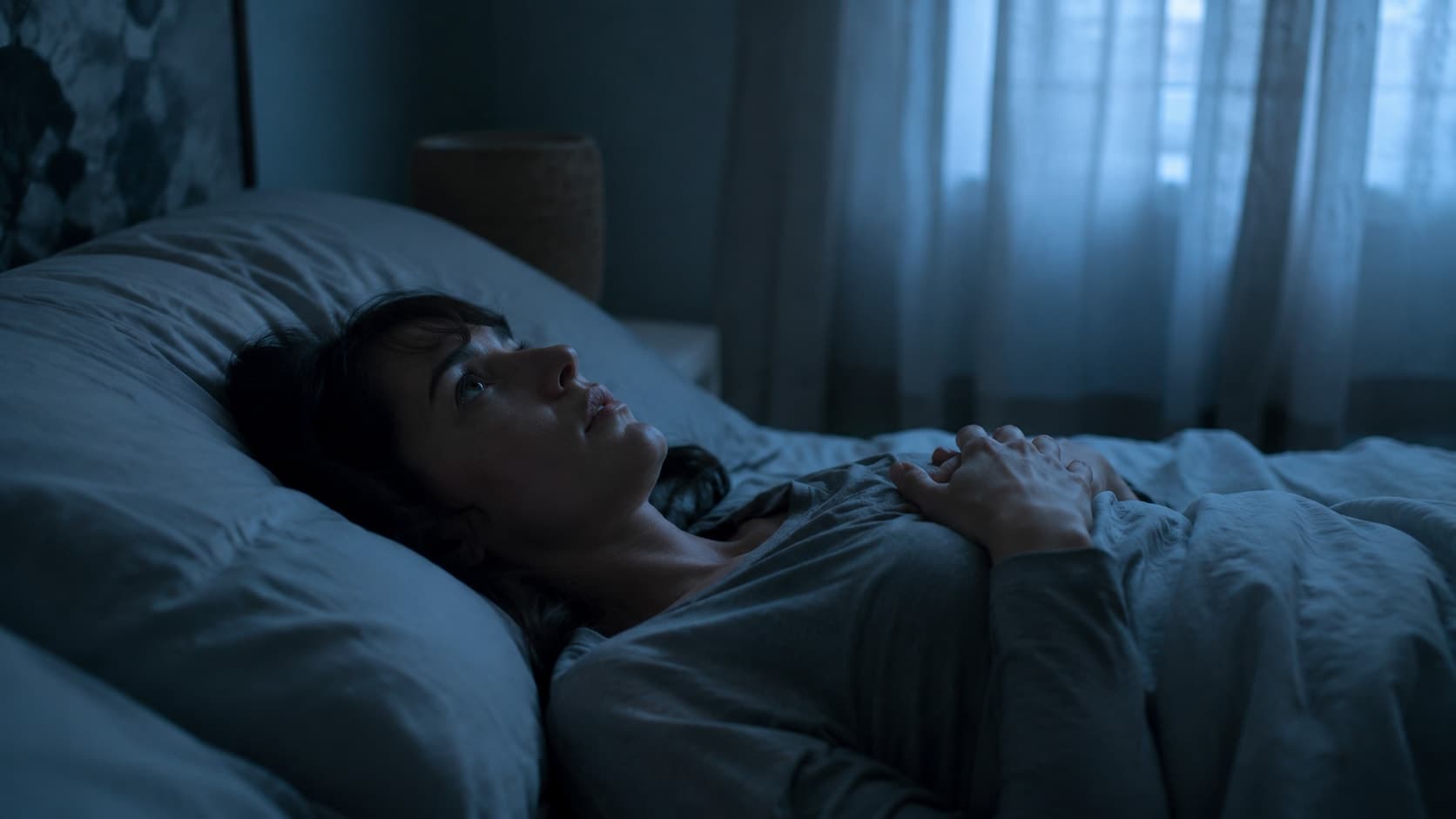
That feeling. Before you've checked your phone, before you've remembered what day it is. A low-grade dread, already there.
Waking up anxious before anything has gone wrong is not a mindset problem. It's a biological mechanism called the Cortisol Awakening Response — a deliberate cortisol surge your body fires within 30 to 45 minutes of waking. Whether that surge feels like quiet readiness or sourceless dread depends almost entirely on what happened the night before.
The honest version of this is that your body does not care what day it is. Every morning, before memory, before thought, before the first awareness of what's on your schedule, the HPA axis fires the same signal it has fired your entire life. Cortisol climbs steeply. The system prepares for a day it doesn't know the contents of yet. That sourceless dread you feel before you've checked anything, before context has arrived: it is not anxiety about today. It is a readout of the last 72 hours. The morning is not a starting point. It is an invoice.
Your Body Runs a Pre-Dawn Alert System
Every morning, before you are fully conscious, your adrenal glands receive a signal. Cortisol — your primary stress hormone — begins climbing steeply. Within 30 to 45 minutes of waking, it reaches a peak that is 50 to 160% higher than the level present the moment before you opened your eyes. This is the Cortisol Awakening Response.
The CAR is not a stress response in the clinical sense. It is an anticipatory one. Your body is not reacting to a threat — it is preparing for a day that has not started yet. The signal originates in the suprachiasmatic nucleus (your internal clock), travels through the HPA axis, and triggers the adrenal cortex to flood the bloodstream with cortisol before you have had a single thought about what lies ahead.
This mechanism is not a flaw. It mobilizes glucose, sharpens attention, and gives you the capacity to face the morning at all. In 2016, thirteen researchers across eight countries published the first expert consensus guidelines for measuring and interpreting the CAR. Their task was to determine whether this morning surge was genuinely distinct from the general daily cortisol pattern, or simply an artifact of the measurement window.
“The CAR represents a distinct feature of the HPA axis and can be separated empirically from the general diurnal cortisol decline.”
The CAR is not the problem. In the right range, it is what makes you functional before noon. The problem is the gain dial — and it turns out the dial is not set in the morning. It was set the night before. And the night before that.
Why Some Mornings Hit Harder
Two factors consistently predict an amplified CAR. Both happen before you go to sleep.
108 school teachers provided saliva cortisol samples at 10pm and then at four points across the following morning. Teachers were classified by their level of work-related rumination: whether they mentally replayed unresolved problems in the evening. The research question was specific. Does perseverative thinking keep the HPA axis from fully downregulating overnight? And if so, does it show up not just in evening cortisol, but in the following morning's CAR?
“High ruminators demonstrated significantly higher evening cortisol and a significantly larger cortisol awakening response the following morning.”
The mechanism is not mood. Unresolved cognitive content circulating through the evening keeps the stress axis biologically active through the night. By morning, the system is not starting fresh. It is resuming.
Young adults reported daily stress levels and sleep duration across a measurement period. When both variables were examined simultaneously, the researchers could ask which one actually predicted the morning cortisol spike: the stress experience itself, or the sleep it cost. These are different mechanisms with different intervention points. If stress elevates CAR directly, managing the stressor changes the morning. If sleep mediates it, protecting sleep changes the morning regardless of whether the stress resolves.
“Total sleep time emerged as the primary predictor of CAR magnitude, suggesting sleep mediates previously observed associations between stress and elevated CAR.”
This reframes the practical question. Much of what feels like morning anxiety about unresolved problems may actually be the physiological signature of sleep deprivation caused by worrying about those problems. The stress and the sleep debt are entangled. But they have different levers.
The morning anxiety you feel on Sunday has less to do with Monday than with every other night that week. The CAR reads accumulated sleep debt, not calendar events.
The Caffeine Timing Problem
There is a popular recommendation — associated with neuroscientist Andrew Huberman — to delay caffeine 90 to 120 minutes after waking. No single controlled trial has tested that specific window. But the underlying physiology is real.
Caffeine works by blocking adenosine receptors — the same receptors that accumulate sleep pressure and eventually trigger fatigue. What is less discussed is that adenosine receptor blockade also activates the HPA axis. Research measuring cortisol responses across a full waking day after a caffeine challenge examined whether habitual users develop complete tolerance to this effect — whether the body fully adapts, or whether the HPA signal persists despite daily exposure.
“Caffeine produced robust cortisol elevations across the test day, with attenuated but still significant responses in habitual users.”
Attenuated is the key word. Habitual users show a reduced HPA response compared to non-users, but not zero. Drink coffee during the 45-minute CAR peak and you are stacking two cortisol-elevating signals on top of each other. Whether that produces noticeable anxiety depends on the person — but the mechanism for amplification is there.

Cortisol begins climbing immediately. HPA axis was primed overnight by the suprachiasmatic nucleus signal.
CAR peak. Cortisol is 50–160% above pre-wake level. Attention sharpens, heart rate rises slightly. Most people drink coffee here.
Natural resolution window. Cortisol begins its decline. Caffeine at this point operates without overlapping the HPA peak.
Return toward baseline. Cortisol continues its daily decline toward the afternoon trough.
Working With the Rhythm
Most morning anxiety advice targets the morning. That is the wrong end of the problem. The CAR is already set before your alarm goes off. What you do between 7 and 9am manages the expression — what you did between 9pm and midnight determines the magnitude. Three adjustments, each targeting the actual leverage point.
Give the HPA axis an off-switch at night
The Cropley research does not say 'relax before bed.' It says that unresolved, circulating mental content keeps the HPA axis biologically active through the night. The fix is not meditation — it is completion. A specific time after which open problems go onto a list, not back into your head. The list does not solve the problem. It tells your nervous system the problem is held somewhere outside you. That distinction, neurologically, is enough to begin the downregulation.
High impactUse light to anchor the curve, not end it
Outdoor morning light does not suppress the CAR — a common misconception. What it does is synchronize the suprachiasmatic nucleus signal to your actual environment, rather than leaving the HPA axis running on an internal estimate of when the day started. The practical effect: the peak aligns with your waking moment rather than drifting ahead of it, which is what happens after weeks of late-night screens or inconsistent wake times.
High impactLet the peak resolve before you stack caffeine on top
This is not about avoiding caffeine. It is about timing two cortisol-elevating signals so they do not overlap. The CAR peaks at 30 to 45 minutes and begins resolving by 90 minutes. Caffeine drunk during the peak adds its own HPA activation on top of an already-elevated baseline. If your mornings are regularly tight and anxious before the first coffee, the coffee is not the cause — but it is amplifying something already running at high gain.
Practical
Morning anxiety is not a signal that something is wrong with you. It is evidence that your system is working — calibrated to the stress load you handed it the night before, and the night before that. The people who wake up calm are not more resilient. They are people whose evenings gave their HPA axis an off-switch. That is a solvable problem. It just has to be solved at the right time.
More on stress, sleep, and rhythm
GetClariSync covers the mechanisms that connect sleep quality, cortisol, and daily performance — delivered weekly.
Get the weekly noteGetClariSync Habits Desk
Editorial Research · Behavioral Science
The GetClariSync Habits Desk studies behavioral science, habit formation, and applied performance psychology. We distill peer-reviewed research from journals like the European Journal of Social Psychology, Psychological Bulletin, the Journal of Personality and Social Psychology, and Behaviour Research and Therapy. We separate findings replicated in pre-registered studies from popular but underpowered effects, and we cite the original papers — not secondary write-ups. Our coverage is informational, not coaching or therapy; for behavioral health concerns please consult a licensed therapist or evidence-based behavioral health professional.