
The 30-minute window after training became one of fitness culture's most enforced rules. It was never the science's idea.
The anabolic window is real — but research shows it spans 4 to 6 hours after training, not 30 minutes. The urgency around post-workout protein shakes was driven by supplement marketing, not physiology. What actually determines muscle protein synthesis is total daily protein distributed across meals that each clear the leucine threshold, not the speed of your first post-workout shake.
Thirty minutes. That was the number. After every training session, the message was identical: consume protein immediately or the window closes and the work you just did goes to waste. It was spoken with the certainty of a biological law. Personal trainers repeated it. Product labels reinforced it. Gym culture turned it into something close to dogma.
The problem is that muscle physiology does not work that way. The research that seeded the 30-minute rule was studying glycogen — not muscle protein synthesis. By the time sports nutrition scientists tracked the actual window for muscle repair and growth, they found it measured in hours, not minutes.
Where the 30-Minute Rule Actually Came From
The origin traces to glycogen research from the late 1980s. Studies by John Ivy and colleagues showed that carbohydrate intake immediately after exhaustive endurance exercise accelerated glycogen resynthesis. The window for maximum glycogen replenishment was genuinely narrow — roughly 30 to 45 minutes. That finding was real.
The error was what came next. Supplement companies took findings about glycogen in endurance athletes and applied them wholesale to muscle protein synthesis in resistance-trained individuals. Two completely different mechanisms, two completely different timelines, one marketing message. The 30-minute rule created a product category before it created evidence.
Ivy's foundational work was conducted on cyclists performing multiple exhaustive sessions per day. In that context, rapid carbohydrate intake is genuinely time-sensitive because the next session begins before glycogen stores are naturally restored. The urgency is real — but it applies to glycogen restoration between repeated endurance sessions, not to muscle protein synthesis in typical resistance training. These are separate molecular processes with separate timing windows. The supplement industry extrapolated one to explain the other.
What the Actual Research Shows
A 2013 review in the Journal of the International Society of Sports Nutrition examined the available evidence on protein timing and muscle hypertrophy directly. When total daily protein intake was controlled for, the timing of protein consumption around training had no statistically significant independent effect on muscle gains.
“The importance of post-exercise nutritional intake is well acknowledged, but the concept of a narrow anabolic window of opportunity is a significant oversimplification.”
What the research shows instead is that muscle protein synthesis remains elevated for 4 to 6 hours after resistance training. The molecular machinery for muscle repair — mTOR pathway activation, ribosomal protein synthesis, nitrogen incorporation — does not switch off at the 30-minute mark. It stays open.

The Leucine Threshold: What Actually Triggers Muscle Repair
The key variable is not timing. It is the leucine content of each meal — leucine, a branched-chain amino acid that directly activates mTOR, the molecular switch that initiates muscle protein synthesis. Research indicates that each meal needs to deliver approximately 2 to 3 grams of leucine to trigger a full muscle protein synthesis response. Below that threshold, the anabolic signal is weak or absent regardless of when the meal is consumed relative to training.
“Ingestion of moderate amounts of protein at regular intervals stimulated greater myofibrillar protein synthesis rates over 12 hours of recovery than large boluses or small pulses.”
| Food source | Approx. leucine | Threshold status |
|---|---|---|
| 30g whey protein | ~3.0g | Above threshold |
| 150g salmon | ~2.4g | Above threshold |
| 150g chicken breast (cooked) | ~2.2g | At threshold |
| 200g Greek yogurt | ~1.9g | Below alone |
| 3 whole eggs | ~1.5g | Below alone |
This reframes the old debate about meal frequency. The question is not only how many grams per day in total — though that matters — but whether each individual meal clears the leucine threshold. Spreading 160g of daily protein across two large meals may produce weaker signaling than the same amount distributed across four meals that each cross the 2 to 3 gram leucine mark.
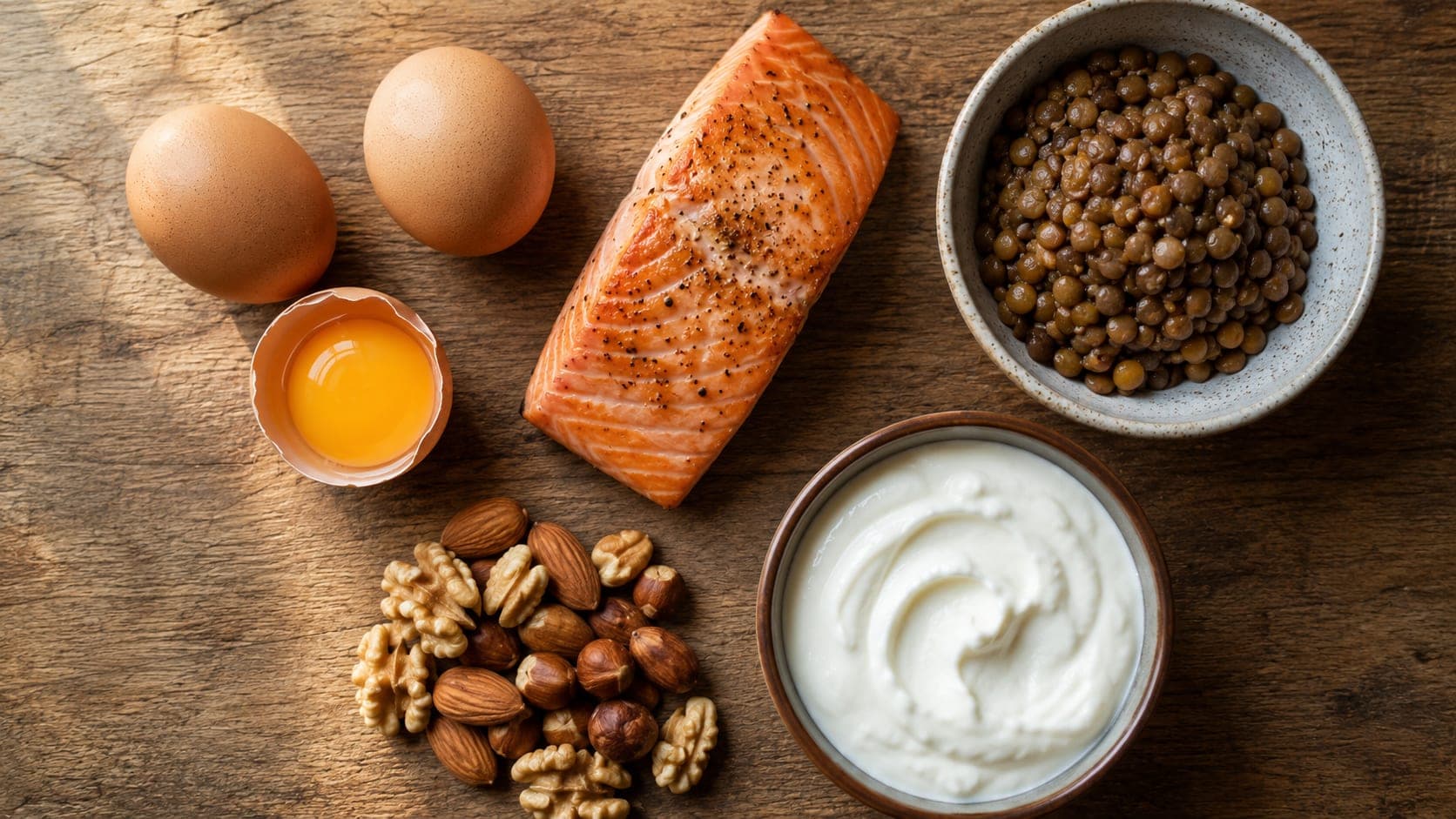
The Daily Protein Ceiling Most People Never Hit
The other number the 30-minute myth obscured is the one that actually determines muscle gain over time: total daily protein intake. A 2018 systematic review and meta-analysis in the British Journal of Sports Medicine — pooling data from 49 studies and 1,800 participants — found that protein supplementation significantly increased muscle mass and strength gains, but with a clearly defined upper limit.
“The upper limit of protein intake beyond which further augmentation of muscle mass did not occur was 1.62g/kg/d.”
1.62 grams per kilogram of body weight per day. Beyond that threshold, additional protein does not produce additional muscle. A 75kg individual plateaus at approximately 122g daily. More than that and the excess is metabolized as energy, not incorporated into muscle tissue. The ceiling is well-defined, and most recreational athletes consuming a protein-adequate diet are already close to it.
Rapid carbohydrate intake after training still matters in one specific context: athletes performing multiple glycogen-depleting sessions within the same day — competitive cyclists, triathletes, or anyone training twice daily. For them, glycogen replenishment benefits from faster carbohydrate intake to restore fuel stores before the next session. The 4-to-6-hour window applies to muscle protein synthesis. Glycogen restoration between repeated sessions is a separate mechanism with its own timeline. The myth was applying that glycogen urgency to resistance-trained individuals performing a single daily session — where the urgency simply does not exist.
Fasted vs. Fed Training: What the Evidence Actually Says
A recurring question from the timing debate is whether it matters if you train fasted. If the 30-minute window is false, does pre-training nutrition change the equation?
Fasted training
- May increase fat oxidation during the session
- No pre-loaded amino acids — relies entirely on post-workout meal
- Works when previous meal was protein-adequate within 6–8 hours
- Practical for early morning training without appetite
Fed training
- Pre-exercise protein contributes to the same anabolic window
- A meal 2–3 hours before training can serve as both pre- and post-workout nutrition
- Reduces reliance on immediate post-workout intake
- More practical for most training schedules and performance
The practical implication is significant. If you trained at noon and ate a leucine-sufficient breakfast at 9am, that meal is already contributing to your anabolic window. The anxiety about rushing to consume protein within 30 minutes of finishing a session is physiologically unfounded for the vast majority of recreational and fitness-focused athletes.
“Protein timing did not produce statistically significant effects on muscle hypertrophy when total protein intake was held constant across conditions.”
The Practical Protocol
Meet your daily protein target first
1.6g per kilogram of bodyweight is the evidence-based ceiling. A 75kg person targets ~120g daily. Everything else — timing, supplements, meal composition — is secondary to this number.
High impactDistribute protein across 3–4 meals
Each meal should clear the leucine threshold — roughly 25–40g of high-quality protein depending on the source. Distribution across meals matters more than the total on paper.
High impactEat within 4–6 hours of training
The actual window is 4 to 6 hours. A pre-workout meal counts. A post-workout meal counts. Both count. Neither needs to happen within 30 minutes.
CriticalPrioritize leucine-complete sources
Salmon, chicken, Greek yogurt, eggs, whey. Plant-based: combine rice with legumes, or tofu with edamame, to reliably clear the leucine threshold at each meal.
High impactScience, not supplement schedules.
GetClariSync covers nutrition the way it should be covered — starting with what the research actually says, not what the industry needs you to believe.
Explore more nutrition scienceGetClariSync Nutrition Desk
Editorial Research · Nutritional Science
The GetClariSync Nutrition Desk reviews research in nutritional biochemistry, metabolism, and dietary science. We read across the American Journal of Clinical Nutrition, the British Journal of Nutrition, the Journal of Nutrition, Nutrients, and Cochrane Reviews — and we are explicit about what the evidence shows and where it is weak. We do not promote restrictive diets, supplements, or single-food claims unsupported by replicated research. We are editorial researchers, not registered dietitians or physicians — please consult a qualified nutrition professional or your doctor before significant dietary changes, especially if you have a health condition, take medication, are pregnant, or are managing a chronic disease.