
Every week, millions of people inject a drug that mimics a hormone their gut already produces. The drug costs $900 a month. The hormone is free. Nobody explained that your body has been running this system your entire life, or that the way most people eat has quietly turned the factory off.
GLP-1 (glucagon-like peptide-1) is a satiety hormone produced naturally by L-cells lining your small intestine every time you eat. It signals fullness to your brain, slows gastric emptying, and helps regulate insulin. Ozempic, the blockbuster weight-loss drug, is a synthetic GLP-1 receptor agonist: it mimics this hormone pharmacologically. The core issue is not that people lack GLP-1 receptors. It is that the modern food environment, ultra-processed and engineered for speed, texture, and palatability, systematically bypasses the physical and chemical signals that trigger L-cells to release GLP-1 in the first place. The satiety system is intact. It is simply receiving no signal.
In 2023, Ozempic became one of the fastest-selling drugs in pharmaceutical history. By 2026, the global market for GLP-1 receptor agonists is projected to reach $50 billion annually, and $157 billion by 2035. The drug works by mimicking a hormone, attaching to GLP-1 receptors in the brain and gut, and telling the body it has eaten enough. It does this better, and for longer, than the natural version. That last part is the detail almost every news article quietly skips: there is a natural version. It has been working in your intestine since you were born. And an enormous amount of evidence now points to the same conclusion: the modern food environment did not just make people eat more. It systematically disabled the biological system that was supposed to prevent it.
What GLP-1 Is, and Why a Drug That Copies It Is Worth More Than Most Countries' GDP
GLP-1 stands for glucagon-like peptide-1. It was first isolated and described in the 1980s by Danish scientist Jens Juul Holst, working alongside colleagues at the University of Copenhagen. What they discovered was a gut-derived hormone released after meals that did something surprising: it did not just help regulate blood sugar. It told the brain to stop eating. It slowed the rate at which the stomach emptied food into the intestine. It reduced appetite without the side effects of stimulants or appetite suppressants. It was, in short, a natural satiety signal that operated at the intersection of the gut, the pancreas, and the brain.
It took several decades and multiple independent research groups to piece together exactly how GLP-1 worked, and why pharmaceutical companies became so interested in synthesising a version that lasted longer in the body. The natural hormone is degraded within two minutes of release by an enzyme called DPP-4. A drug version that could resist that degradation and activate GLP-1 receptors for days at a time would give the body a sustained pharmacological satiety signal the natural system cannot produce. That is what semaglutide, the active compound in Ozempic and Wegovy, does.
GLP-1 is produced by L-cells, specialised enteroendocrine cells scattered throughout the small intestine and colon, most densely in the distal ileum. When nutrients, particularly fiber, protein, and certain fats, physically contact the intestinal wall and enter the gut lumen, L-cells detect chemical and mechanical signals and secrete GLP-1 into the bloodstream and enteric nervous system. From there, GLP-1 travels via the vagus nerve to the hypothalamus (hunger regulation) and via the bloodstream to the pancreatic beta cells (insulin stimulation). The combined effect: slower gastric emptying, reduced appetite signalling, improved insulin sensitivity. Half-life in the body: approximately 2 minutes before enzymatic breakdown by DPP-4.
“The incretin effect of GLP-1 and its role in satiety represent one of the most consequential discoveries in metabolic medicine — the hormone's short half-life makes pharmacological extension of its action the central challenge of GLP-1-based therapeutics.”
The L-Cell: Your Built-In Satiety Manufacturer That Nobody Told You About
The L-cell is one of the least discussed cells in popular health writing, and arguably one of the most important in determining whether you feel satisfied after a meal. There are millions of them lining your small intestine. They are not passive. They are active sensors: they respond to the physical presence of nutrients in the gut lumen, to the mechanical stretching of the intestinal wall, to the chemical composition of what you ate, and to the speed at which food arrives. When they detect the right combination of signals, fiber that ferments, protein that digests slowly, fat that takes time to break down, they release GLP-1. That hormone then travels through the enteric nervous system and the bloodstream to tell the brain: enough has arrived. Slow down.
This system works. It evolved over hundreds of thousands of years of eating whole, unprocessed, structurally complex food. The problem is not that L-cells are broken in most people. The problem is that the signals they are designed to detect, physical contact time, fiber fermentation, slow gastric arrival, have been systematically removed from the modern food supply. Ultra-processed foods move through the stomach quickly, require minimal mechanical digestion, and deliver energy to the gut wall faster than the L-cell detection system can respond. The hormone is not released. The brain receives no satiety signal. The meal ends without the biological feeling of completion.

How Ultra-Processed Food Engineers Around Your Satiety System
The food engineering industry did not set out to disable GLP-1 signalling. It set out to maximise palatability and eating speed, and the two are, biochemically, almost the same thing. A food that is easy to eat quickly, that requires little chewing, that delivers a concentrated energy payload in a short time, that has had its fiber matrix disrupted through processing: that food reduces the physical contact time between nutrients and the intestinal wall. Less contact time means fewer L-cells triggered. Fewer L-cells triggered means less GLP-1 released. Less GLP-1 means a weaker satiety signal reaching the hypothalamus.
- Ultra-processed foods: disrupted fiber matrix, fast gastric emptying, minimal L-cell contact time
- Eating in under 10 minutes: reduces GLP-1 and PYY output measurably compared to the same meal eaten slowly
- Low-fiber meals: removes the fermentation substrate that activates distal L-cells via short-chain fatty acids
- High-glycaemic refined carbohydrates: rapid glucose spike bypasses the slower GLP-1 satiety sequence
- Liquid calories: bypass the gastric stretching and mechanical breakdown signals L-cells partially rely on
- Irregular meal timing: disrupts the enteroendocrine rhythm that optimises L-cell sensitivity
A 2026 review in Nature Reviews Gastroenterology & Hepatology examined whether gut-brain satiety signalling disruption reflects a defect in the endocrine system itself, or a failure of the inputs reaching it. The question was whether the receptor system had changed, or whether the environment had simply stopped delivering what the system was built to detect. What the pharmaceutical intervention does, in this framing, is not fix a broken system. It restores a signal to a functioning system that has been left without input.
“The disconnect between energy intake and satiety signalling in modern diets reflects not a failure of the enteroendocrine system but an environment engineered to bypass its activation thresholds.”
Eating Speed Is a Hormone Signal, and Almost No One Treats It That Way
One of the most consistent and underappreciated findings in GLP-1 research is the relationship between eating rate and hormone output. The same meal (identical ingredients, identical calories) produces meaningfully different GLP-1 and PYY (peptide YY, another satiety hormone) responses depending on how fast it is consumed. Eating the same portion over 30 minutes versus 5 minutes produces measurably higher GLP-1 and PYY concentrations, along with greater reported satiety and lower intake at a subsequent meal. The mechanism is physical: slower eating means more thorough mechanical breakdown of food, more gradual arrival of nutrients at the intestinal wall, and longer contact time between the nutrient stream and the L-cell surface.
Multiple controlled trials have compared slow eating (20–30 minutes per meal) versus fast eating (5–10 minutes) on postprandial GLP-1 and PYY concentrations. Results consistently show: slower eating produces higher peak GLP-1 concentrations, greater perceived satiety at meal end, lower ad-libitum energy intake at the next meal, and reduced total daily caloric intake without conscious restriction. The effect size is not trivial: differences of 15–20% in subsequent meal intake have been observed under controlled conditions. Eating rate is not a social behaviour. It is a hormonal input.

The Dopamine Problem: Why Your Brain Is Actively Fighting Your Own Satiety
A landmark paper published in Science in 2025 investigated why GLP-1 satiety signals can be neurologically present but behaviourally ineffective. The research mapped connectivity between the brain's reward circuitry and the neural pathways that process fullness signals, asking whether dopaminergic activity triggered by food anticipation could structurally interfere with satiety processing. The system is not designed to be defective. It evolved to drive eating in environments where food was scarce. In an environment where highly palatable, engineered food is available at every moment, it creates a situation where the satiety signal and the reward signal are in direct competition, and the reward signal has a structural advantage.
“We identify a population of dopamine neurons whose activity encodes the hedonic value of food and directly inhibits GLP-1 receptor-mediated satiety — a circuit that evolved for caloric scarcity but creates vulnerability in food-abundant environments.”
This finding reframes the Ozempic effect in a significant way. Part of what makes GLP-1 receptor agonist drugs effective is not only that they restore satiety signalling, but that they produce a GLP-1 signal strong enough to overcome the dopamine opposition. The natural hormone, released in quantities determined by what you ate and how fast, often cannot compete with the reward circuit when ultra-processed food has primed it. The drug does not just turn on the satiety system. It turns up the volume until the signal can actually be heard.
The brain circuit that drives hedonic eating and the hormone that signals fullness are wired in direct opposition. They were designed to balance each other. Ultra-processed food tips the scale, and a $900/month drug is, in part, a way to restore the equilibrium.
What Actually Triggers GLP-1 — The Specific Inputs Your L-Cells Are Waiting For
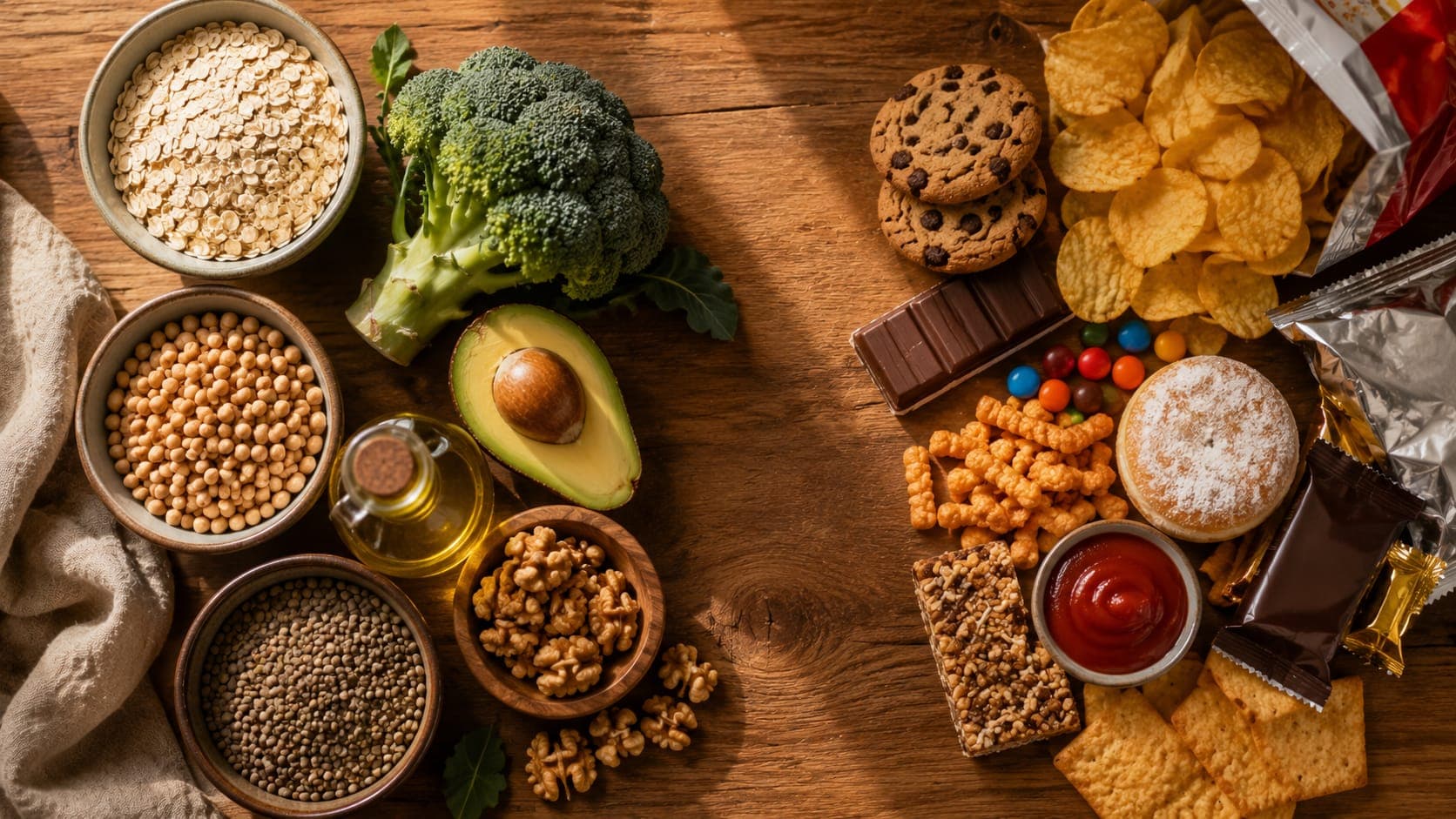
L-cells are not generic nutrient detectors. They respond specifically to certain properties of food, properties that whole, minimally processed foods have and that ultra-processed foods typically lack. Understanding what triggers L-cell secretion is the clearest route to working with the system rather than around it.
What Triggers GLP-1
- Soluble fiber (oat beta-glucan, legumes, psyllium): ferments in colon, produces short-chain fatty acids that activate distal L-cells
- Protein, particularly leucine-rich sources: slows gastric emptying and directly stimulates L-cell secretion
- Long-chain fatty acids, especially oleic acid in olive oil: trigger GLP-1 via GPR119 and GPR40 receptors on L-cells
- Slow eating: extended contact time between nutrients and intestinal wall gives L-cells time to respond
- Structural food complexity: intact whole foods require more digestion, spending longer in the stomach before reaching L-cells
What Suppresses GLP-1
- Ultra-processed foods: engineered to move quickly through the gut, bypassing the L-cell contact window
- Fast eating: nutrients arrive at the intestinal wall in a concentrated bolus before L-cells can respond proportionally
- Refined carbohydrates: spike glucose rapidly, bypassing the slower GLP-1 satiety sequence
- Liquid calories: bypass gastric stretching and mechanical breakdown signals
- Low-fiber meals: no fermentation substrate for the secondary, distal L-cell activation pathway
Working With the System You Already Have
The research does not suggest that anyone can eat more fiber and replicate the clinical effect of semaglutide. GLP-1 receptor agonists produce a sustained, pharmacologically amplified hormone signal that the natural system cannot match through food alone, particularly in individuals with significant metabolic dysfunction. What the research does suggest is that the natural GLP-1 system is more responsive to dietary inputs than popular coverage implies, and that chronic suppression of that system through food environment and eating behaviour is a meaningful contributor to the appetite dysregulation that makes intentional eating so difficult for so many people.
Slow the Meal, Change the Signal
Eating over 20–30 minutes rather than 5–10 produces measurably higher GLP-1 and PYY concentrations from the same meal. Put utensils down between bites. Eat without screens: distraction is consistently associated with faster eating rate and reduced satiety awareness. Chew thoroughly. This is not mindfulness advice. It is a physiological input to the L-cell detection system.
High impactFront-Load Fiber and Protein
Beginning a meal with fiber-rich or protein-rich foods before refined carbohydrates changes the hormonal sequence of the meal. Fiber and protein trigger earlier L-cell activation; arriving carbohydrates then encounter an already-engaged satiety system. Studies on meal sequencing show meaningful differences in postprandial GLP-1 and glucose response depending on the order in which food types are consumed, not just the total content.
High impactStructural Complexity Over Caloric Density
Foods that require mechanical digestion, whole grains, legumes, raw vegetables, nuts, spend longer in the stomach and release nutrients more gradually into the intestinal lumen. This extended contact time is exactly what L-cells need to respond proportionally. A 400-calorie meal of whole oats and lentils generates a substantially different GLP-1 response than 400 calories of ultra-processed food with equivalent macros, because the structural properties of the food, not just the nutrients, determine the hormonal output.
High impact
- 1The satiety system is not broken — it is being bypassed GLP-1 receptors in most people are functional. The deficit is upstream: the food environment removes the nutrient properties that trigger L-cell secretion, so the signal never gets sent. This is structurally different from a hormonal deficiency.
- 2Eating speed is a physiological variable, not a personal habit How fast you eat changes measurable hormone output from the same meal. This is not about willpower or mindfulness as a practice. It is about giving the L-cell detection system enough time to register what arrived.
- 3Fiber's role in satiety is more specific than 'gut health' Soluble fiber ferments in the colon and produces short-chain fatty acids, particularly butyrate and propionate, that activate L-cells in the distal intestine hours after a meal. This delayed GLP-1 wave is why high-fiber meals reduce appetite longer than their caloric content predicts.
- 4Dopamine makes satiety harder in a food-abundant environment The 2025 Science paper confirms that specific dopamine neurons actively oppose GLP-1 satiety signalling when highly palatable food is present. This is not a character flaw. It is a circuit designed for scarcity operating in abundance.
- 5GLP-1 drugs restore a signal to a working system For individuals for whom the natural system cannot produce sufficient satiety, due to metabolic dysfunction, obesity, or other factors, GLP-1 receptor agonists provide a pharmacological signal that the food environment has made structurally difficult to generate naturally. The research supports both approaches: restoring natural inputs for those who can, and pharmacological support for those who need it. These are not competing positions.
The GLP-1 story is, at its core, a story about a system that works, and an environment that was built, without intention or malice, in a way that stopped it from receiving the inputs it was designed to detect. Understanding the mechanism does not make the drug unnecessary for those who need it. It does make the food environment, the eating pattern, and the structural properties of what you choose to eat considerably more meaningful than 'eat less and move more' ever managed to convey.
The Nutrition Brief — Every Week
Research on food, metabolism, and what the body actually does with what you eat — written clearly, cited properly, delivered weekly.
Subscribe freeGetClariSync Nutrition Desk
Editorial Research · Nutritional Science
The GetClariSync Nutrition Desk reviews research in nutritional biochemistry, metabolism, and dietary science. We read across the American Journal of Clinical Nutrition, the British Journal of Nutrition, the Journal of Nutrition, Nutrients, and Cochrane Reviews — and we are explicit about what the evidence shows and where it is weak. We do not promote restrictive diets, supplements, or single-food claims unsupported by replicated research. We are editorial researchers, not registered dietitians or physicians — please consult a qualified nutrition professional or your doctor before significant dietary changes, especially if you have a health condition, take medication, are pregnant, or are managing a chronic disease.