Every October, the shower drain fills. Brushes clog faster. Pillowcases tell a story. Most people assume stress, diet, or hormones. The calendar is rarely on the list of suspects.
Autumn hair shedding is real and documented. Human follicles appear to follow a photoperiodic cycle — synchronized over summer, shed in autumn — one that resembles, though is not equivalent to, the stronger seasonal mechanisms seen in other mammals. The peak typically hits October–November and resolves within 8–12 weeks. A rosemary-based rinse has evidence behind it, though its evidence base remains far smaller than that for established treatments. Traditional Moroccan recipes built around rosemary and scalp-stimulating herbs may support follicle environment during this window, but they do not halt the seasonal cycle. If shedding is excessive, persists past 12 weeks, or is accompanied by visible thinning, see a dermatologist.
There is a name for it: a seasonal telogen shift — a period when a larger-than-usual proportion of hair follicles enter their resting phase simultaneously and release the hair itself. It sounds alarming. It is, in most cases, completely normal. Losing 50–100 hairs per day is baseline; seasonal peaks can temporarily climb higher without signaling pathology. The mechanism is timed by ancient biological cues also seen in coat-cycling mammals, though in humans the seasonal signal is weaker and less direct.
The biology behind seasonal shedding
Hair follicles are not all doing the same thing at the same time. Under typical conditions, roughly 85–90% are in anagen (active growth), 1–2% in catagen (transition), and 10–15% in telogen (resting, then releasing). The problem in autumn is synchronization: over the summer months, an above-average proportion of follicles enter anagen together — likely triggered by extended daylight and UV exposure. When that cohort exits anagen and enters telogen, they do it together. The result, approximately 100 days later, is an October or November shower floor that looks like something went wrong.
“A significant increase in the proportion of telogen hairs was observed in July, with a corresponding increase in shedding approximately 100 days later — consistent with seasonal cycling.”
The photoperiodic mechanism — daylight length regulating biological timing — is well documented in other mammals. In humans, the evidence points toward a plausible but incompletely mapped pathway through melatonin. Hair follicles contain melatonin receptors, suggesting they can receive indirect seasonal signals — though precisely how day length translates to synchronized human follicle cycling remains an active area of research.
“Melatonin receptor expression in human hair follicles suggests a direct role for photoperiodic signalling in follicle cycling.”
What the Moroccan tradition actually contains
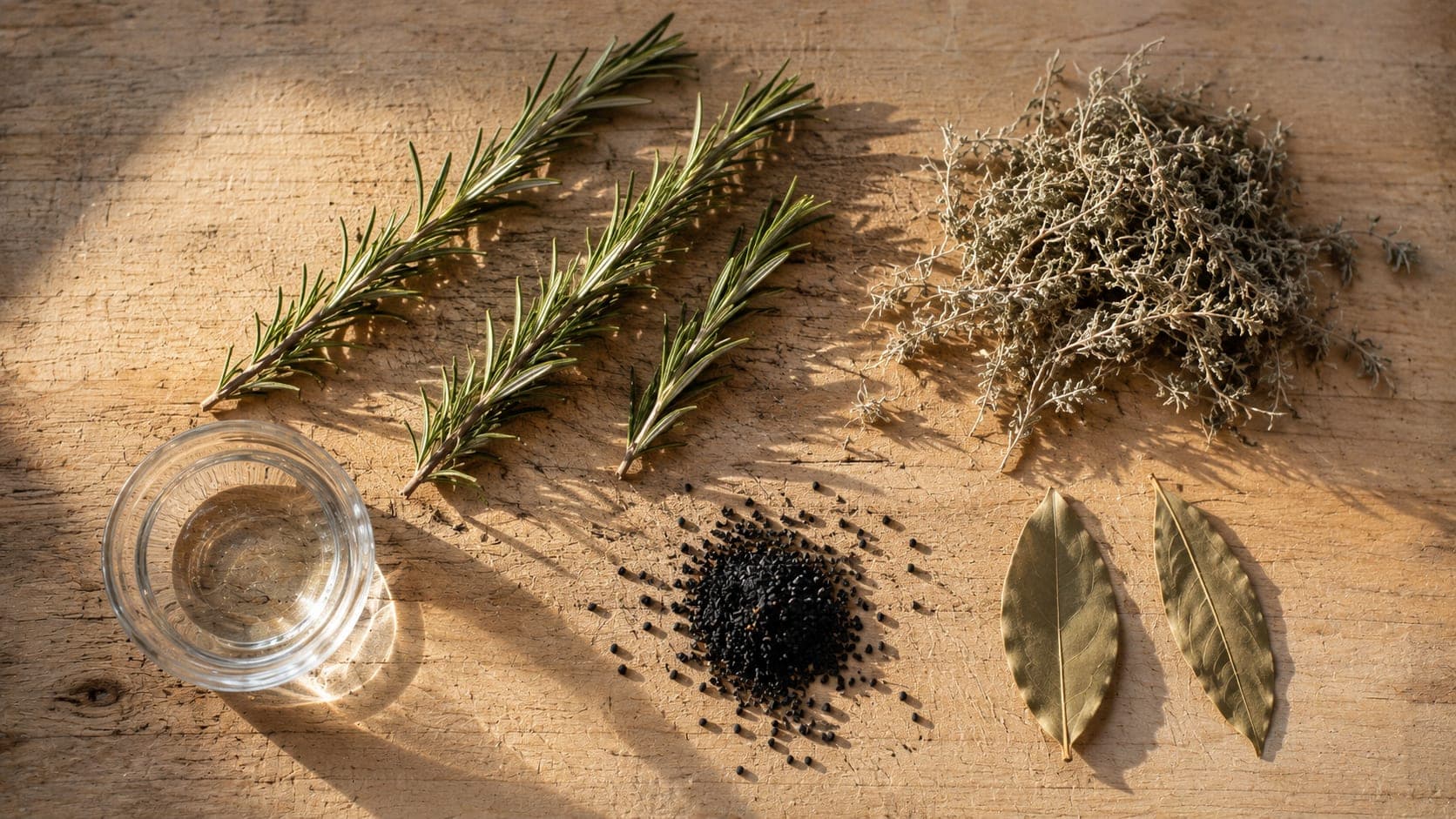
Across North Africa, autumn hair care has long included herbal rinses prepared at home — variations of a recipe passed from mother to daughter that typically combine rosemary, wormwood (shih in Darija), and sometimes black seed oil or bay leaves. The ingredients vary by region and family. What they share is a focus on the scalp rather than the shaft. The traditional logic was empirical: these ingredients had observable effects over generations. The molecular explanation came much later.
In a 6-month RCT of 100 patients with androgenetic alopecia, topical rosemary oil produced comparable hair count improvement to minoxidil 2%. Proposed mechanism: carnosic acid stimulates nerve growth factor and improves scalp microcirculation. Rosemary produced less scalp itching. Study limitations: androgenetic alopecia population only (not seasonal effluvium), no placebo arm for rosemary, small sample, not replicated at large scale. Importantly, the overall evidence base for rosemary remains far smaller than the decades of large-scale trial data behind minoxidil — these results are promising, not conclusive.
“The study reported comparable hair-count improvement between groups over six months, though the evidence for rosemary remains far smaller than the established evidence base for minoxidil.”
Wormwood (Artemisia absinthium) has documented anti-inflammatory and antimicrobial properties in phytochemistry research. Applied topically, it may help reduce scalp inflammation that can disrupt the follicle environment. Its evidence base for direct hair growth is thinner than rosemary — it earns its place in the recipe for scalp health, not follicle stimulation. Safety note: wormwood should not be taken internally during pregnancy. Topical use in a rinse is generally considered low-risk for most people, but perform a 24-hour patch test on the inner arm before first use. Do not apply to a broken or inflamed scalp. Discontinue immediately if burning or redness develops. If you are pregnant or breastfeeding, substitute with additional rosemary or omit entirely.
The recipe
Rosemary is the ingredient with the strongest evidence behind it. Everything else is supportive.
- 4–5 fresh rosemary sprigs, or 2 tablespoons dried rosemary
- 1 tablespoon dried wormwood / shih — optional, omit if pregnant or breastfeeding
- 500ml water
- Optional additions: 5 drops of black seed oil stirred in after cooling, or 2 dried bay leaves added to the boil
- Bring 500ml water to a gentle boil. Add rosemary and wormwood if using. Reduce heat and simmer for 15 minutes.
- Remove from heat, cover the pot, and steep for 20 minutes. The water should turn pale amber.
- Strain into a bowl or bottle. Allow to cool completely to room temperature — never apply warm.
- After shampooing and rinsing your hair, pour the rinse slowly over the scalp and work it in with your fingertips using small firm circular movements for 2–3 minutes.
- Leave on for 5–10 minutes, then rinse off with cool water. Some people leave it in — this is personal preference.
- Repeat 2–3 times per week through the autumn shedding window (October through December).
The massage matters as much as the recipe
The circular scalp massage is not incidental. Standardized scalp massage performed daily for 24 weeks increased hair thickness in a small clinical study (Koyama et al., 2016, Eplasty). The rinse delivers active compounds; the massage drives microcirculation and ensures contact with follicle openings. Two minutes, firm pressure, small circles at the crown and temples. This is likely part of the mechanism — not just ritual.
High impact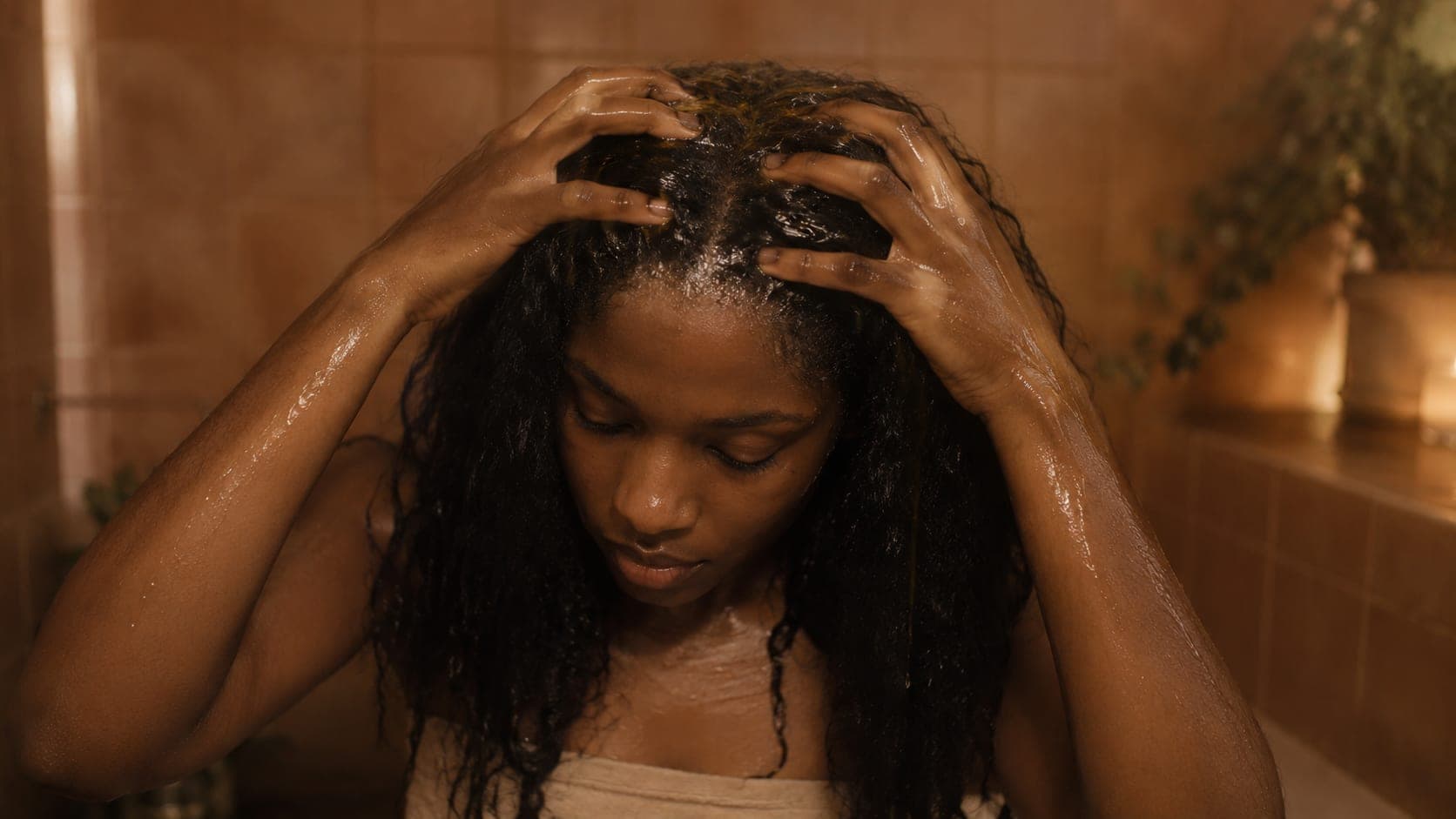
When autumn shedding is not autumn shedding
A seasonal telogen shift self-resolves within 8–12 weeks. If shedding continues past three months, intensifies rather than stabilizes, or presents with visible thinning at specific zones — temples, the crown parting, the hairline — the cause is not seasonal. Iron-deficiency anemia, thyroid dysfunction, and early androgenetic alopecia can all present as increased diffuse shedding and require diagnosis, not a rinse.
Shedding that continues beyond 12 weeks without improvement / Visible scalp at the parting, crown, or temple zone / Shedding that began before September or after January / Scalp pain, burning, persistent itch, or visible inflammation / Consistently losing more than ~150 hairs per day. A dermatologist can perform a trichogram and run targeted bloodwork to distinguish a seasonal shift from iron deficiency, thyroid dysfunction, or early AGA. Earlier evaluation means better outcomes for non-seasonal causes.
“Telogen effluvium caused by identifiable triggers typically resolves within 3–6 months. Persistent or patterned loss warrants dermatological evaluation to rule out androgenetic alopecia and systemic causes.”
What to realistically expect
The rosemary rinse will not stop the seasonal cycle — nothing will, because it is not a malfunction. What consistent topical use over 8–12 weeks may do is support the scalp environment so that follicles entering their next anagen phase do so in better condition. The Panahi RCT showed meaningful changes at three and six months, not at two weeks. This is a slow intervention for a slow system. The realistic expectation is: less scalp sensitivity, potentially better density in the next growth cycle, and a practice that is genuinely calming to perform. That last part is not nothing when the shower floor is unsettling you every morning in October.
“Patients using the rosemary-based formulation showed gradual but statistically significant improvement in hair count over a 6-month period.”
The 100-day delay between peak telogen and peak shedding is why autumn hair loss feels disconnected from its cause. You are not losing summer hair in October. You are losing June's follicle decisions in October.
Your scalp runs on a seasonal clock. Now you know why.
Subscribe to GetClariSync for weekly insights on skin science, sleep biology, and the mechanisms behind what your body actually does.
Subscribe — it's freeGetClariSync Skin Desk
Editorial Research · Dermatological Science
The GetClariSync Skin Desk reviews research in dermatological science, cosmetic chemistry, and skin biology. We follow journals including the Journal of the American Academy of Dermatology, the British Journal of Dermatology, JAMA Dermatology, and the International Journal of Cosmetic Science. We assess ingredients against clinical evidence rather than marketing claims and we are explicit about the concentration, vehicle, and study quality required for an effect. We are editorial researchers, not board-certified dermatologists — please consult a qualified dermatologist for persistent skin conditions, before starting prescription-strength treatments (e.g. tretinoin), or if you have sensitive or compromised skin.