
You quit on day 22. Not because you lacked discipline, but because someone told you day 21 was the finish line. That advice came from a plastic surgery book. It was never meant for you.
The '21-day habit rule' originated from a 1960 surgeon's minimum observation. The word 'minimum' was then quietly dropped. Research from University College London (2010, n=96) puts the real average at 66 days, ranging from 18 to 254. But the more important finding: what determines habit formation isn't time; it's cue specificity, reward immediacy, and environmental friction. Your brain doesn't build habits through willpower. It builds them through pattern recognition in the basal ganglia.
You know the feeling. Day 22. The habit you were supposed to have locked in by now still feels like work. The books said 21 days. You did 21 days. And yet there's no autopilot, no frictionless morning routine, no version of yourself who just does this naturally. So you conclude, quietly and privately, that you might be one of those people. The undisciplined ones.
The map was wrong from the start, drawn not by neuroscientists, but by a cosmetic surgeon named Maxwell Maltz, then quietly repackaged by decades of self-help publishing into something that was never a scientific finding. The neuroscience tells a stranger, more useful story.

A Plastic Surgeon's Footnote That Hijacked 60 Years of Self-Help
In 1960, Dr. Maxwell Maltz published Psycho-Cybernetics, a book about self-image, written for his surgical patients. He noted something he observed clinically: patients took at least 21 days to stop feeling phantom sensations after amputation, and at least 21 days to adjust to their appearance after rhinoplasty. A minimum observation. Anecdotal. From one surgeon's practice.
By the 1970s, the self-help industry had performed its own quiet editorial surgery: it removed the word "minimum", transforming a clinical footnote into a universal law. "21 days to a new habit" spread through motivational speaking, bestselling books, and eventually the internet with the velocity of a fact and the rigor of a rumor. It became, arguably, the most expensive piece of misinformation in the history of personal development.
Maltz's book sold over 30 million copies. None of them contained a controlled study, a sample size, or a replication. The number 21 was never tested — it was observed once, in a surgical context, then extrapolated to all of human behavior. This is how myths become doctrine: one misquote, repeated at scale, until no one remembers there was ever a source.
UCL researchers tracked 96 participants forming real-world habits over 12 weeks. Average time to automaticity: 66 days. Range: 18 to 254. The finding that matters most isn't the average; it's the range. A glass of water after breakfast automated in ~20 days. A 15-minute run after lunch took ~50–75. Habits don't form on a schedule. They form through a mechanism. And understanding the mechanism is the only thing that actually helps.
The Habit Machine You Never Knew You Had
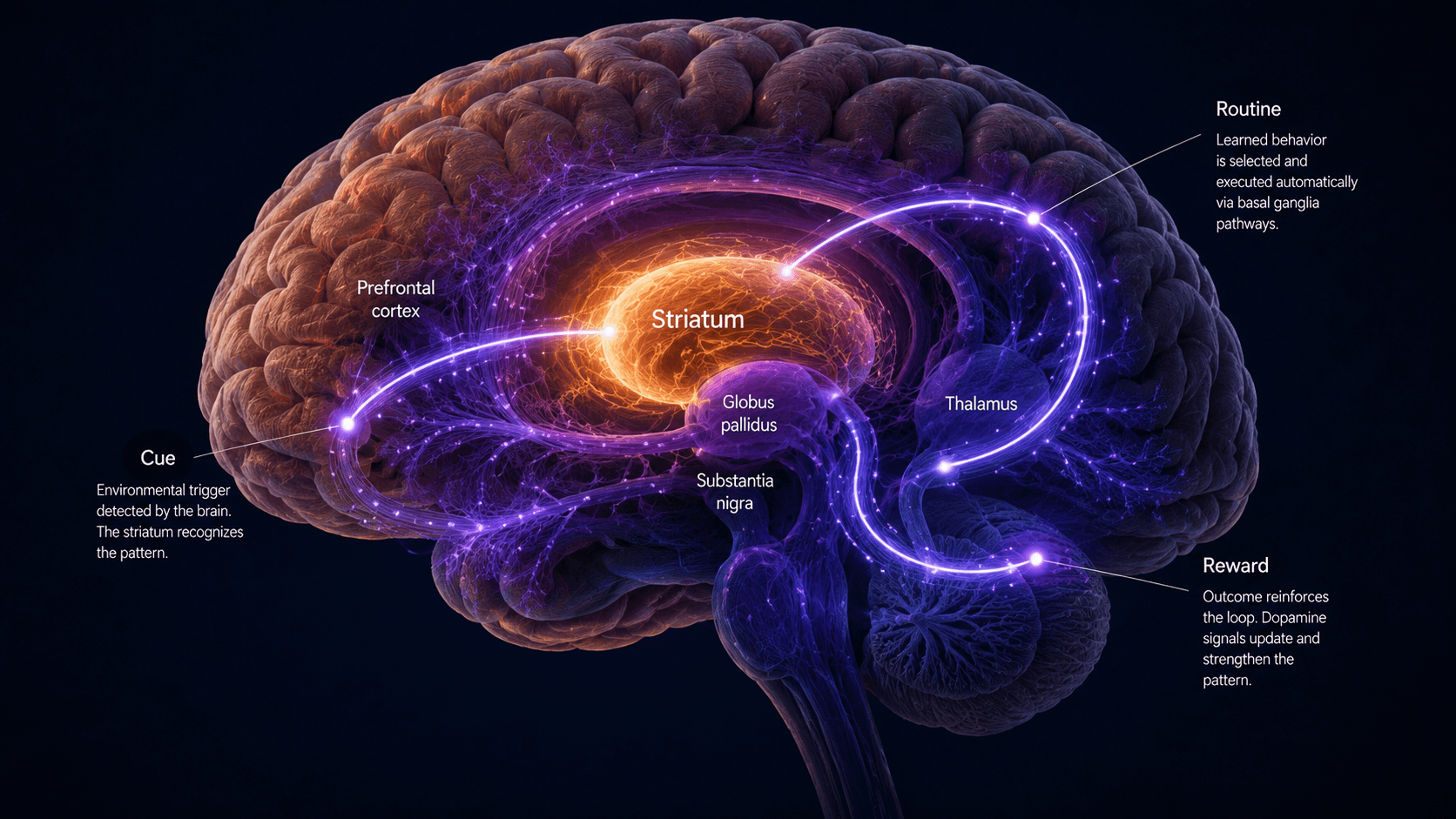
Deep inside your brain, below the cortex, below conscious thought, sits a cluster of structures called the basal ganglia. They are ancient. They predate language, abstract reasoning, and goal-setting by hundreds of millions of years. And every time you repeat a behavior in the same context, they are doing something quietly extraordinary: watching for patterns.
When you perform a new behavior, your prefrontal cortex is fully engaged. It burns glucose. It requires sustained attention. It is, metabolically, expensive. Your brain, at its core a prediction and efficiency machine, notices this cost. So when it detects the same sequence repeated in the same context, the basal ganglia begin a process researchers call chunking: compressing the behavior into a single automated unit, offloading it from expensive prefrontal processing to a faster, cheaper system.
The structure that makes this possible is called the striatum, part of the basal ganglia, heavily wired into the dopamine system. This connection is critical and almost never discussed in popular habit advice: your brain doesn't just want you to feel good after a habit. It wants you to crave doing it before you start. That craving, driven by dopamine prediction errors, is what automaticity actually feels like from the inside.
Ann Graybiel's lab at MIT found that the striatum fires most intensely at the beginning and end of a habit, not during it. This is the 'habit bracket': the cue triggers a burst of anticipatory neural activity, the behavior runs on autopilot, the reward closes the loop. Motivation lives in that first burst. Which is why the cue is everything — and why you can engineer it.
Prefrontal cortex fully engaged on every repetition. High mental cost, deliberate effort. Your basal ganglia are observing, not yet encoding. This is normal, not a sign of failure.
Chunking begins. The basal ganglia start building the habit bracket. Behavior still feels effortful but cue-recognition is improving. The dopamine signal begins to shift from reward to anticipation.
The behavior feels neither automatic nor rewarding. Flat. Tedious. This is where most people quit, and based on current models, it is where the deepest basal ganglia encoding is occurring.
The cue triggers the behavior with minimal prefrontal involvement. The habit begins to feel wrong to skip, rather than good to do. You've arrived.
The 3 Variables That Separate Habits That Encode From Habits That Fade
Researchers don't agree on much. But on this, the evidence from behavioral neuroscience, cognitive psychology, and implementation science keeps landing in the same place. Habit formation isn't random — it's governed by three variables. Change any one of them, and your probability of reaching automaticity shifts dramatically.
1. Cue Specificity: The More Precise, the More Powerful
Your basal ganglia cannot encode a vague intention. "I'll meditate more" gives the system nothing: no temporal anchor, no contextual trigger, no signal that the routine should begin. "When I close my laptop at 6pm, I will sit in my reading chair and meditate for 10 minutes" gives it everything: a precise cue, a location, a behavior, a duration. Psychologists call this an implementation intention, one of the most robustly replicated findings in all of behavior change research. The formula: 'When [cue], I will [behavior] at/in [location].' That's it. Deceptively simple. Consistently powerful.
Gollwitzer & Sheeran's 2006 meta-analysis covered 94 independent studies across health, academic, and lifestyle behaviors. Participants who wrote a specific when-where-how plan were more than twice as likely to follow through. This effect held across personality types, motivation levels, and prior behavior history. The single most predictive variable wasn't commitment strength or willpower; it was plan specificity.
2. Reward Immediacy: Your Basal Ganglia Live Entirely in the Present
Nobody in the habit space wants to tell you this, because it makes the whole thing sound less poetic: your basal ganglia are completely, embarrassingly present-tense. They don't process 'this will benefit me in three months.' They process what happens in the seconds immediately following a behavior. This is driven by the dopamine system, specifically by what neuroscientists call dopamine prediction errors: your brain releases dopamine not just when you receive a reward, but when you anticipate one. Over repeated pairings, the dopamine signal migrates from the reward to the cue itself. This is how cravings are built. Engineering immediate rewards isn't cheating, it's the mechanism.
Create an exclusive, immediate reward
Pick something you genuinely enjoy (a specific podcast, a playlist, a premium coffee) and make it exclusively available during your new habit. Not sometimes. Only then. Over repeated pairings, your dopamine system begins to anticipate the reward at the cue, not after the behavior. You stop needing motivation to start. You start feeling pulled toward the habit instead. That shift is the entire game.
High impact3. Friction Asymmetry: Your Environment Is Already Writing Your Behavior Script
Wendy Wood's research found that approximately 45% of daily behaviors are habitual, triggered by environmental cues rather than conscious decisions. Your environment isn't neutral. It is already a behavior script, written by default, optimizing for whatever was convenient when you set it up. The only question is whether you designed it intentionally, or inherited it by accident.
- Sleep in your gym clothes: eliminate every barrier between intention and action
- Phone charger in another room: friction increases, usage reliably decreases
- Book on the pillow: proximity is a cue; the object becomes the trigger
- Fruit on the counter, cookies in a high cabinet: choice architecture isn't manipulation, it's design
- Meditation app as the first screen on your phone: visual salience creates behavioral pulls before conscious thought begins

Why Motivation Is the Wrong Variable to Optimize For
The self-help industry built a billion-dollar business on the premise that motivation is a muscle, something you strengthen through journaling, vision boards, and 5am alarms. The research has a different take. Motivation isn't a resource you cultivate. It's a symptom of variables you largely don't control: your cortisol levels this morning, your sleep quality last night, your blood glucose right now. It fluctuates. It disappears. And it is, as a foundation for behavior change, remarkably unreliable.
Building a behavior change strategy on motivation is like planning a commute that assumes no traffic. It works on the good days. High-performing habit systems are built to function on the bad days, the days when you're exhausted, stressed, and the last thing you want to do is the thing you committed to. They don't wait for motivation. They remove the requirement for it.
A 2002 study in the British Journal of Health Psychology divided participants into three groups: motivation-focused, health information, and structured planning via implementation intentions. After two weeks, 91% of the planning group exercised at least once per week, compared to 35–38% in the other two groups. Same people. Same goals. Same motivation levels going in. Different architecture.
You don't need to feel like doing the thing. You need to design a system that runs whether you feel like it or not.
GetClariSync Habits Desk
The Identity Trap Nobody Warns You About
Your brain maintains a continuously updated model of who you are. This isn't metaphorical; it's a functional construct that influences behavior before conscious reasoning kicks in. When a new habit conflicts with this self-model (a person who identifies as 'not a morning person' trying to build a 6am workout), the brain experiences cognitive dissonance. Its fastest resolution is to abandon the conflicting behavior and restore internal consistency. You don't quit the habit because you're undisciplined. You quit because your brain is protecting a coherent sense of self.
Affirmations don't fix this. Declaring a new identity without behavioral evidence creates a gap between stated and experienced self that the brain finds uncomfortable. What actually updates the self-model is evidence accumulation through action. A 10-minute walk is a vote for 'I am someone who moves their body.' Water before coffee is a vote for 'I prioritize how I feel.' Each vote is small. The pattern they form over time is not.
Research on 'self-concept clarity' (the stability of your sense of self) finds that people with high self-concept clarity show significantly stronger habit maintenance over time. The mechanism is counterintuitive: a clearer identity makes aligned habits feel less like discipline and more like expression. You're not trying to become someone. You're acting like who you've already decided you are.
What most people do
- Declare a new identity without behavioral evidence to back it
- Rely on motivation to bridge the identity gap every single day
- Quit after one missed day, interpreting it as proof they were right
- Chase outcomes while ignoring the identity votes that compound into self-concept
What the science suggests
- Build identity through repeated behavioral evidence, not declarations
- Design system-level architecture that removes the identity conflict
- Apply 'never miss twice': one miss is data, two consecutive is a new pattern
- Frame every small action: 'This is the kind of person I'm becoming'
The Protocol: 5 Steps to Build a Habit That Actually Encodes
No morning routine advice. No mindset frameworks. Five things the research consistently associates with habits that actually reach automaticity — distilled into a sequence you can start today.
- 1Choose ONE habit — and only one Not a stack. Not a morning routine of seven behaviors you found in a productivity thread at 11pm. One. Your prefrontal cortex has limited encoding bandwidth, and novel habits appear to compete for the same basal ganglia resources. One habit done every day beats three habits done when you feel like it. Every study on this reaches the same conclusion.
- 2Write the implementation intention Write this sentence: 'After I [existing behavior], I will [new habit] at/in [location] for [duration].' Sounds almost insultingly simple. And yet this one sentence, tested across 94 independent studies, consistently outperforms motivation, personality type, and prior commitment strength as a predictor of follow-through.
- 3Make it embarrassingly small Two minutes. One sentence. One pushup. If your first instinct is 'that's not enough to matter,' that instinct is the problem. Your basal ganglia don't evaluate magnitude. They encode repetition in context. A two-minute habit done daily for 66 days encodes. A 45-minute habit done 'when I have time' never does.
- 4Attach an exclusive, immediate reward Pick something you genuinely enjoy and make it exclusively available during or right after your habit. Only then. Over repeated pairings, your dopamine system begins to anticipate the reward at the cue itself — the craving shifts from the reward to the trigger. That's when the habit stops requiring effort.
- 5Protect the 'never miss twice' rule Miss once. Fine. Miss twice in a row? That's not a slip; it's the beginning of a competing pattern your basal ganglia will encode just as efficiently as the one you're trying to build. On your worst days, do the minimum viable version: one minute, one rep, one sentence. The streak isn't sacred. The pattern is.
Stack the new habit onto an existing one
'After I pour my morning coffee, I will sit at my desk and write one sentence.' Piggybacking a new behavior onto an already-encoded one gives your basal ganglia a ready-made cue, one that fires reliably regardless of motivation state. Research on habit stacking consistently shows faster automaticity than standalone implementation intentions.
High impactThe Week 3–5 Plateau: The Moment Most People Quit Is the Moment That Matters Most
There is a phase in habit formation the research describes clearly, and that the self-help industry never prepared you for. It arrives somewhere between week 3 and week 5. The behavior feels neither automatic nor rewarding. The initial novelty has worn off. The discipline of early commitment has faded. The automaticity you were promised hasn't arrived. The behavior just feels flat. Tedious. Like something you do, not something you are.
Most people interpret this flatness as evidence the habit isn't working, or worse, that they're not built for it. They quit. And they quit at precisely the worst possible moment. Because based on current models of basal ganglia function, weeks 3–5 appear to be exactly when the deepest encoding work is happening. The behavior is being compressed. The neural pathway is being reinforced. The automaticity is being built, invisibly, beneath conscious experience, in a structure that sends no progress reports to your cortex.
Graybiel's lab found that habit extinction — truly unlearning a habit — is remarkably difficult even after long periods of non-performance. The basal ganglia appear to retain habit encoding almost indefinitely. This cuts both ways: bad habits are hard to fully erase. But good habits, once deeply encoded, are nearly impossible to forget. The encoding phase is the bottleneck. Survive it, and the investment compounds for years.

- Optimizing for motivation rather than environmental and structural design
- Writing vague intentions with no specified time, location, or context
- Quitting after one missed day — the real risk is two consecutive misses
- Choosing behaviors too complex to automate quickly in the critical early weeks
- Abandoning during the week 3–5 plateau, exactly when basal ganglia encoding is most active
Reframe the plateau as the process itself
When week 3 arrives and the habit feels flat and unrewarding, that's not a signal to stop. Based on current neuroscience models, that's the basal ganglia doing their heaviest work. The only strategic response: hold the pattern. Reduce the intensity if you need to. Do one minute instead of twenty. But don't stop. The exit from the plateau is automaticity. And it comes to everyone who stays.
CriticalWhat This Actually Changes — Starting Today
You haven't been failing at habits because you lack willpower or discipline. You've been using a model of behavior that is sixty years out of date, assembled from a misread surgery observation, amplified by an industry that benefits from your repeated failure, and designed to optimize for motivation rather than the actual mechanism of habit formation.
The updated model doesn't ask you to become more disciplined. It asks you to understand what your basal ganglia actually respond to: precise cues, immediate rewards, low-friction environments, and time. Not 21 days. Closer to 66. And when the plateau comes, and it will come, it's not the end. It's the evidence that the process is working. The encoding is happening. You just can't feel it yet.
The goal was never to feel motivated enough to start. The goal is to design a system so well-structured that motivation becomes optional.
GetClariSync Habits Desk

Want the weekly note on behavioral science and performance?
Every week, we distill the most interesting research on habits, sleep, and mental performance, with the same rigor you found here. No motivation culture. No fads. Just what the evidence actually shows.
Explore All Habits Research →GetClariSync Habits Desk
Editorial Research · Behavioral Science
The GetClariSync Habits Desk studies behavioral science, habit formation, and applied performance psychology. We distill peer-reviewed research from journals like the European Journal of Social Psychology, Psychological Bulletin, the Journal of Personality and Social Psychology, and Behaviour Research and Therapy. We separate findings replicated in pre-registered studies from popular but underpowered effects, and we cite the original papers — not secondary write-ups. Our coverage is informational, not coaching or therapy; for behavioral health concerns please consult a licensed therapist or evidence-based behavioral health professional.