Cortisol face is real. TikTok is describing the wrong version of it.
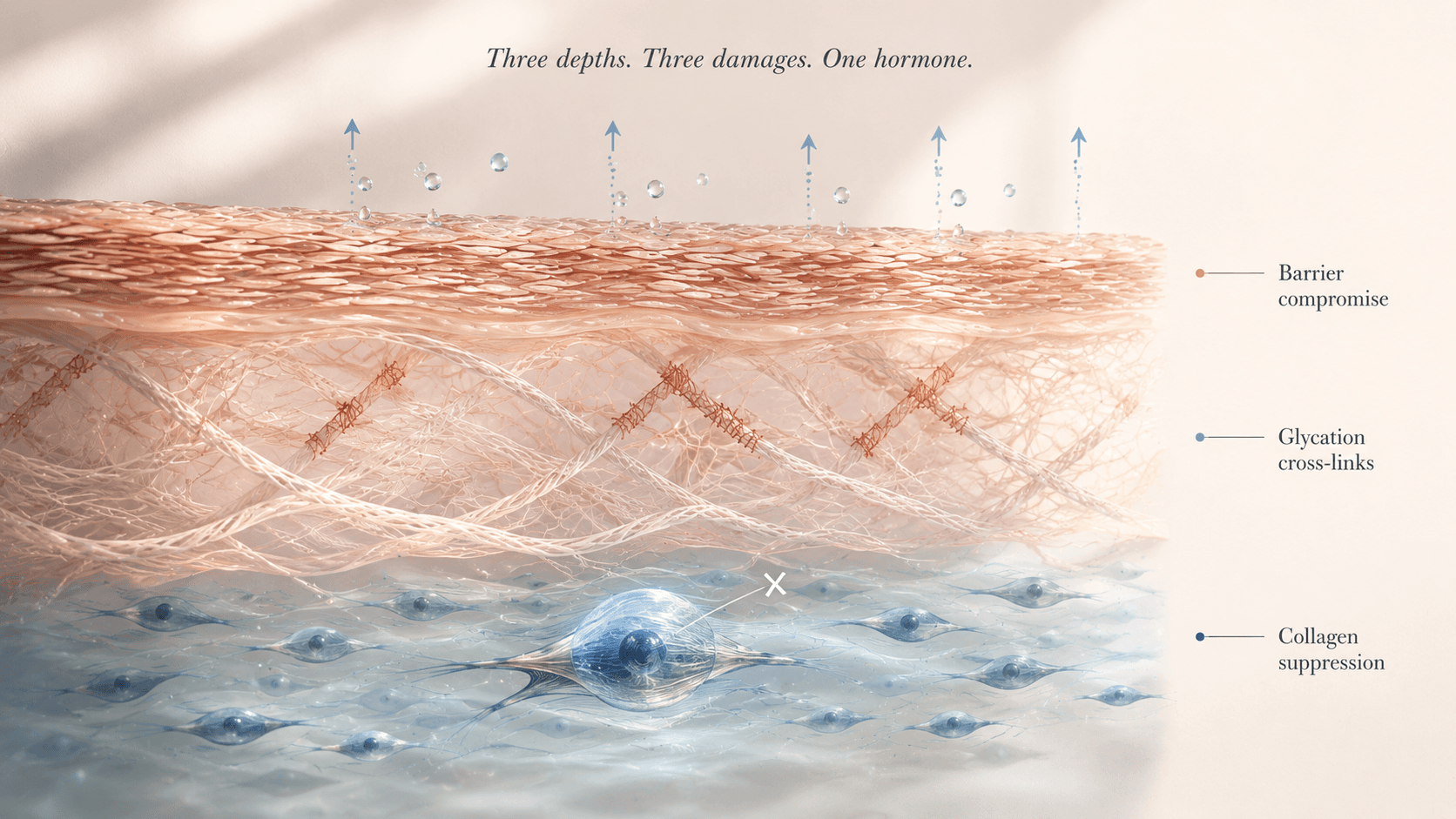
Cortisol face went viral describing puffiness and roundness. That is not the actual cortisol face pattern. What chronic stress really does to your skin is run three parallel damage programs at once. Cortisol enters your dermal fibroblasts (the cells whose only job is to build collagen) and blocks the internal signal that tells them to work. Elevated blood glucose from the same stress response hardens whatever collagen remains. Systemic low-grade inflammation compromises the skin barrier from underneath. A 2025 clinical study measured a 32.9 percent increase in fine surface aging in moderately stressed subjects compared to controls. This is why cortisol-driven aging looks different, moves faster, and needs a different fix than ordinary aging.
You have probably scrolled past cortisol face at least a dozen times. Before-and-after videos of women deflating puffy cheeks. Green juice recipes. Faces getting sharper in twenty-eight days. The trend has racked up over five million views on some posts and turned a technical stress hormone into a beauty concern women can name.
Here is the useful truth. Chronic stress absolutely reshapes your skin, and women who feel their face changed under a stressful season are not imagining it. Here is the misleading half. The TikTok version of cortisol face (puffy, round, resolved with matcha) mostly describes a different pattern (moon face) that appears under a specific medical condition. The everyday version of cortisol showing up on your face is subtler, more architectural, and much harder to bounce back from with morning routines alone.
This piece separates the two. What the trend got right. What it got wrong. And the three mechanisms behind the actual damage, translated from research language into something you can recognize in your own mirror.
What TikTok gets right, and where the science parts ways
The trend gets one thing exactly right. Chronic stress changes how skin looks and feels, sometimes fast, and women often notice it before doctors do. That validation is not small. For years, if you told a dermatologist your face had changed during a hard year, the answer was usually sleep and sunscreen. The stress angle was missing.
So if your face has changed during a hard season, believe yourself. But if you have been searching cortisol face and finding advice that centers on lymphatic drainage and puffiness alone, you are treating a symptom that may not even be the main one. The next section is the actual pattern.
The three parallel damage programs stress runs on your face
Chronic cortisol does not do one thing to your skin. It does three things at the same time, at different depths, using different mechanisms. This is why the aging pattern looks specific once you know what to see, and why fixing one layer without the others produces disappointing results.
Program 1: Collagen suppression at the source
The scaffolding that holds your face in shape is a protein called collagen. Your skin makes it constantly, in a deep layer called the dermis, using specialized cells named fibroblasts. Fibroblasts have essentially one job: build collagen when the body tells them to build collagen. When that instruction goes quiet, fibroblasts stop. And chronic cortisol is exactly that quiet instruction, delivered every hour of every day of a stressful year.
Here is how it works mechanically. Cortisol crosses into the fibroblast and clicks into a receptor called the glucocorticoid receptor. Think of that receptor as an internal switch. When cortisol activates it, the switch blocks a chemical signal called TGF-beta, which is the exact signal fibroblasts wait for to start making collagen. With TGF-beta blocked, collagen production drops. The cell also takes in fewer amino acids, which are the raw building blocks of collagen, so even the ingredients become scarce.
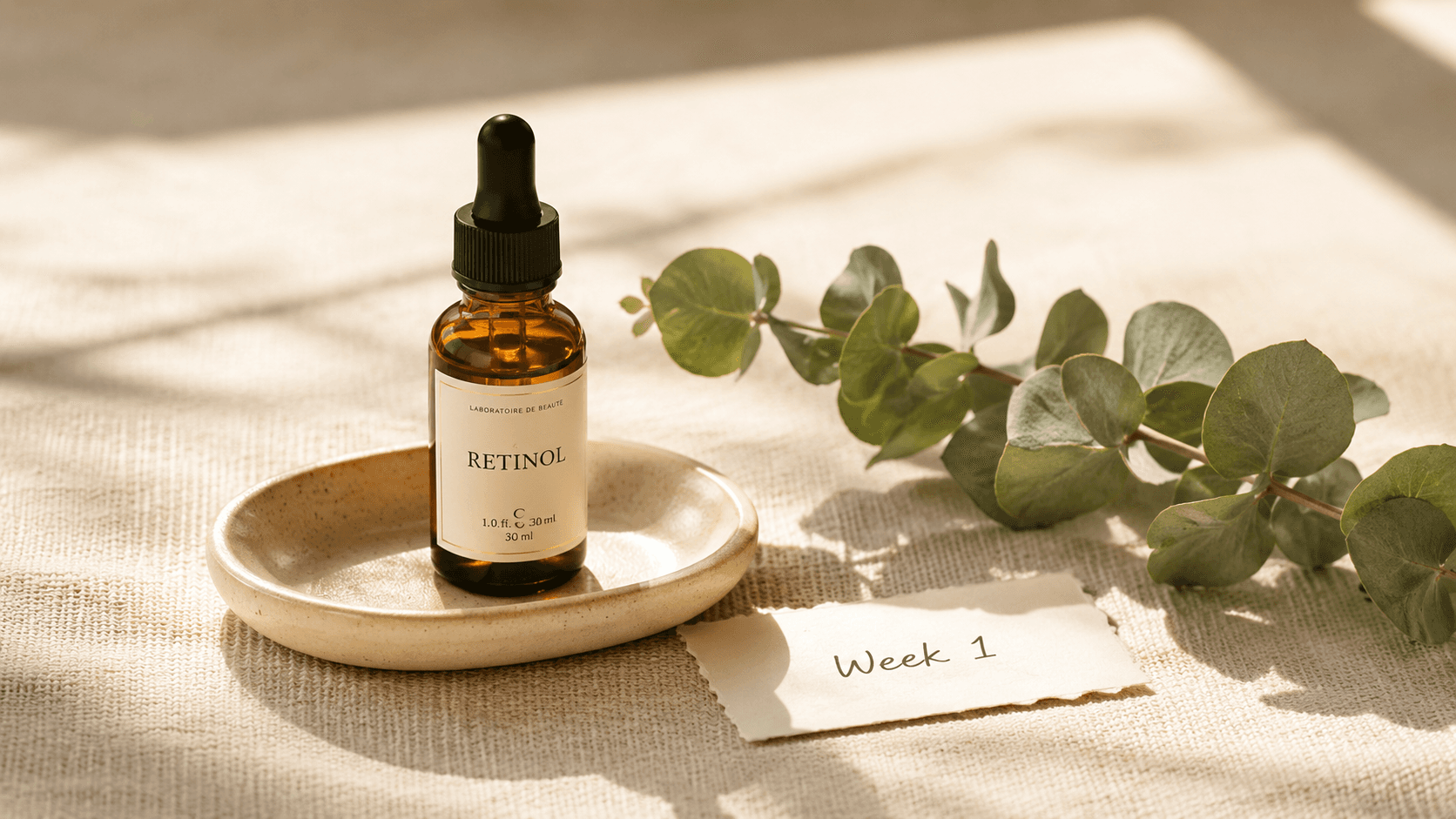
This mechanism is why topical retinol sometimes plateaus during high-stress periods. Retinol pushes fibroblasts to work harder. Cortisol tells them to work less. The two signals collide inside the same cell. The product is doing its job. The hormone is undoing it.
·2025·Frontiers in PharmacologyProgram 2: Glycation, or how stress hardens the collagen you have
The second program runs on sugar. Every time your body releases cortisol, blood glucose rises. That is what cortisol is for during a real emergency, to make sure your muscles have fuel to sprint. In a modern life where the emergency is deadlines and doomscrolling, blood glucose still rises but no sprinting happens. The sugar circulates. And sugar that circulates too long starts sticking to proteins in a process called glycation.
When glucose sticks to collagen, it changes the collagen. The fibers cross-link, become stiff, lose the springy elasticity your skin depends on for the way it bounces back from expression. The end products of this process are called advanced glycation end products, or AGEs, which is a fitting acronym. Once collagen has been glycated, your body has a very hard time repairing or replacing it. The damage tends to stay.
Chronic stress raises blood sugar, blood sugar reacts chemically with the collagen you already have, and the collagen goes from springy to brittle without any visible warning until the day you notice your skin does not bounce back the way it used to.
Program 3: The barrier gives way
The third program is the one most people misdiagnose as sensitive skin. Chronic cortisol elevation produces a state researchers call inflammaging, low-grade inflammation that never fully resolves. Inflammation degrades the outermost layer of your skin, called the stratum corneum, which is a thin protective wall of dead cells and lipids that keeps water in and irritants out. When the wall thins, water evaporates faster, and the skin underneath becomes reactive to things it used to tolerate.
The give-away that this is a stress-driven barrier problem rather than a product problem is that it tracks the stress rather than the products. Skin that has been stable for years suddenly starts stinging with familiar serums during a hard month, then quietly settles down again when the season resolves. This is not you being suddenly allergic. This is your barrier telling you what your hormones are doing.
The visible cluster that actually shows in the mirror
The trend got the general area right and the specific signs mostly wrong. Ordinary chronic stress rarely produces the dramatic puffiness TikTok videos show. What it produces is a subtler cluster that women often describe as feeling like their face suddenly stopped being theirs. Here is what to actually look for.
The real cortisol face cluster
Morning puffiness around the eyes that resolves by afternoon and returns next morning. Subtle softening or blurring of the lower face and jaw contour. New fine lines that appeared in the last six to twelve months. Skin that looks tired even after sleep, with a dull cast no serum seems to fix. Products that used to work now sting, do nothing, or produce sudden congestion.
The three parallel programs are running at once. Fluid retention shows around the eyes from sodium held by cortisol. Fine lines settle because new collagen has stopped being made. Dullness reflects a compromised barrier and poor microcirculation. Product reactivity reflects a stratum corneum that no longer buffers active ingredients the way it used to.
Your face is not aging you. Your face is reading your cortisol. The changes you see are downstream of a signal you can influence.
The pattern differs from ordinary aging in two ways worth naming. It arrives faster (months rather than years). And it responds partially to skincare and fully to nothing until the systemic stress lifts. Ordinary aging is measured in decades and is stable day to day. Cortisol aging is measured in seasons and moves with the stress load.
The 2025 study that finally put a number on it
Until recently, most claims about stress and skin aging relied on interpretation of population studies and dermatology intuition. A group of researchers ran a controlled clinical trial in 2025 that changed that. They recruited subjects, classified them by measured stress levels using validated psychological instruments, and then examined their skin across multiple markers. The comparison was between moderately stressed subjects and low-stress controls.
“Moderately stressed subjects had significantly decreased antioxidant potential and impacted skin barrier integrity, as well as significantly increased signs of microrelief alterations reaching an increased severity of about 32.9 percent.”
That 32.9 percent number matters not because it is exact for any individual, but because it is the first time researchers have cleanly measured the pace of stress-driven surface aging in a controlled setting. What used to be intuition, that stressed people look older, now has a percentage attached and a mechanism explained. Microrelief, for context, is the fine surface texture of your skin visible under magnification, and it degrades early in the aging process. When microrelief severity jumps 32.9 percent in a stressed group, that is the earliest measurable marker of the trend accelerating.
What actually reverses this, and what quietly wastes your money
There is a hard truth and a hopeful one in this section. The hard truth is that no cream, serum, or in-office treatment fully reverses cortisol-driven aging while cortisol stays elevated. Fibroblasts can only respond to skincare instruction to the extent cortisol allows. The hopeful truth is that fibroblasts recover their capacity fairly quickly once cortisol regulation returns, usually within eight to sixteen weeks of the stress load easing. The tissue is still there. The instructions to build come back online.
Real reversal is two-tiered. The topical layer supports what can be supported: barrier repair, collagen stimulation, antioxidant defense, sun protection. The systemic layer addresses the driver: restoring the cortisol rhythm so fibroblasts can respond to what your routine is asking them to do. Neither layer works fully without the other.
| Approach | What it actually does | Effect under chronic stress |
|---|---|---|
| Retinol or retinal nightly | Stimulates fibroblasts to make more collagen | Partial. Fibroblasts hit cortisol ceiling. |
| Ceramide moisturizer | Repairs barrier lipid layer | Meaningful. Barrier repair works independently of hormones. |
| Vitamin C serum morning | Antioxidant defense against oxidative damage | Meaningful. Reduces amplifiers. |
| Sunscreen daily | Blocks UV amplification of the same damage | Essential. UV compounds cortisol damage. |
| Facial massage and lymphatic drainage | Temporarily reduces fluid retention | Cosmetic only. Does nothing to fibroblasts. |
| Cortisol rhythm restoration | Removes the ceiling holding fibroblasts down | Foundational. Everything else amplifies once this is in place. |
The women who reverse cortisol skin aging are almost never the ones with the most elaborate skincare routines. They are the ones who recognized their skin was speaking about a system and started treating the system alongside the surface. Morning light. Protected first sleep cycles. Coffee delayed past the natural cortisol peak. Movement that does not add stress load. Blood sugar stability. The systemic layer is not glamorous, but it decides how much your skincare can actually do.
→The systemic side of the equationThe Complete Cortisol Guide: What Chronic Stress Actually Does to Your Body→The topical foundationThe Skin Barrier Explained: How Ceramides Actually Repair What Retinol DisruptsUnderstand the mechanism, not just the routine
This site publishes research-based skincare that explains the biology behind the ritual. Subscribe to receive new pieces on the systems that actually decide how your skin ages.
Get research digestsThe cortisol face trend did something important, even if it got the specific signs wrong. It gave a generation of women permission to name a stress-skin connection they had felt for years without vocabulary. That naming is real progress. The next step, the one this article is trying to do, is to trade the wrong signs for the right ones and the wrong fixes for the ones that actually align with how skin aging under stress physically works.
Your face is not aging you. Your face is reading your cortisol. That reframe is uncomfortable for a minute and then it becomes the most useful thing you can carry into your next routine, because it means the changes that felt uncontrollable are downstream of a signal you can actually influence. Not perfectly. Not overnight. But meaningfully, and in a direction that no amount of serum layering could ever reach on its own.
GetClariSync Skin Desk
Editorial Research · Dermatological Science
The GetClariSync Skin Desk reviews research in dermatological science, cosmetic chemistry, and skin biology. We follow journals including the Journal of the American Academy of Dermatology, the British Journal of Dermatology, JAMA Dermatology, and the International Journal of Cosmetic Science. We assess ingredients against clinical evidence rather than marketing claims and we are explicit about the concentration, vehicle, and study quality required for an effect. We are editorial researchers, not board-certified dermatologists — please consult a qualified dermatologist for persistent skin conditions, before starting prescription-strength treatments (e.g. tretinoin), or if you have sensitive or compromised skin.