Everyone steams their face to open their pores. The pore has no idea this is happening.
Pores are follicle openings in the skin surface. They have no muscle tissue and no mechanism to open or close. What changes their visible size is not temperature: it is the structural integrity of the collagen surrounding each follicle wall, the volume of sebum pooling inside, and how much surface texture is exaggerating their appearance. Steam does not open pores, but it does soften sebum and make cleansing more effective. That is a real effect. It just works for an entirely different reason than every skincare instruction has ever said.
The advice has been around for decades. Steam your face first, then cleanse. Open the pores, clean them out, close them with cold water after. It appears on face mask packaging, in beauty magazines, in routines passed between generations. It describes a biological process that does not exist in human skin.
Your pores do not have muscles. There is no sphincter, no valve, no contracting tissue around a follicle opening that responds to heat or cold. Dermatologists have been saying this for years. Steam will not open your pores any more than a warm bath opens your nostrils.
What Your Pores Actually Are
A pore is not quite what the word suggests. It is a follicle opening: a channel running from a hair follicle and its attached sebaceous gland, up through the dermis and epidermis, to the skin surface. Its job is to deliver sebum, the skin's own natural oil produced inside the gland, to the surface, where it spreads and forms part of the skin's protective layer.
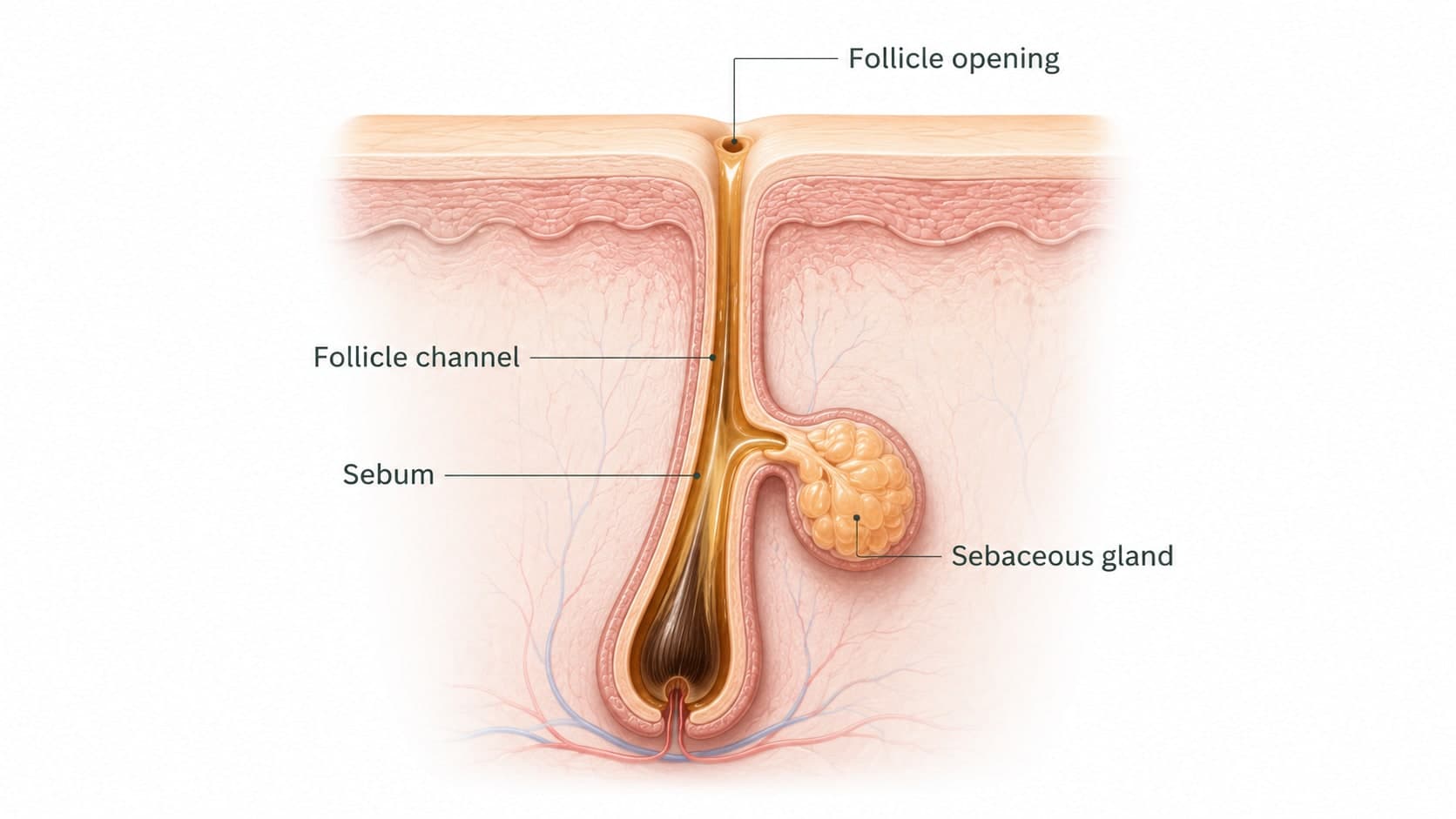
Sebum is a mixture of fatty acids, wax esters, triglycerides, and other lipids. It is pale and transparent when fresh. When it reaches the skin surface and meets air, it undergoes oxidation, the same reaction that turns a cut avocado brown or a sliced apple dark. The black color in a blackhead is oxidized sebum, not trapped dirt, not embedded grime: oxidized fat sitting in a follicle opening at the surface of the skin.
The clinical name for a blackhead is an open comedone: 'open' because the sebum plug is exposed to air. The dark color is the oxidation reaction. It has nothing to do with how often you wash your face.
This reframe changes what you are actually trying to do when you cleanse. You are not extracting dirt from a hole. You are dissolving a lipid plug and clearing a channel that will refill within days, because the sebaceous gland never stops producing. The tools that work best are designed to work with lipids: surfactants that emulsify oil, chemical exfoliants that break down dead surface cells, and ingredients that modulate how much sebum is produced at the source.
Why Steam Works, Just Not the Way You Think
Steam does something useful to skin. Just not what the instructions say.
Sebum is a lipid, and lipids change viscosity with temperature: they become more fluid when warm, more solid when cool. The same principle that makes cold butter stiff and warm butter spreadable applies here. When you apply heat to skin, the sebum sitting inside the follicle channel becomes less viscous, more pliable, easier to dislodge during cleansing. That is a real physical effect.
What steam is actually doing: softening the oil inside your follicles so it moves more easily. Not opening a muscular structure that does not exist. The practical outcome can resemble what the myth promises, skin that feels cleaner after steaming and cleansing, but the biology behind it is entirely different. This distinction matters when you are choosing what tools actually help: anything that softens or dissolves lipids will produce the same result, and anything marketed to open or close a structure with no opening mechanism is offering nothing.
What Actually Changes How Pores Look
Two things determine whether a pore looks larger or smaller on your face. Neither of them is temperature.
The first is the collagen matrix surrounding each follicle wall. Collagen is the structural protein that gives skin its density and firmness, and follicle walls rely on it for support. When this matrix is healthy, each opening is held taut and appears small. When it degrades, whether from cumulative UV exposure, the natural slowdown of collagen production with age, or chronic inflammation, the walls lose their backing. The opening widens visually, not because the follicle itself grew, but because the structure holding it closed has softened. This is why chronically sun-damaged skin and older skin typically show more visible pores: the issue is not the pore. It is the collagen around it.
Researchers at the University of Michigan enrolled patients with clinically assessed photodamaged skin in a controlled trial, treating one side of the face with tretinoin, a prescription-strength retinoid, and the other with a vehicle cream over several months. They collected dermal biopsies at intervals to measure structural collagen changes between the two treatment conditions.
“Tretinoin treatment was associated with significant new collagen formation in the papillary dermis, a finding not observed in vehicle-treated photodamaged skin.”
The second factor is sebum volume: how much oil is pooling inside each follicle at any given time. More sebum means a visibly wider opening. This is why pores on the nose and the T-zone, the areas where sebaceous glands are densest and most active, are consistently the most visible. There is simply more material sitting in each channel.
Three Ingredients That Have Real Evidence
Most products marketed for pores are competing on the same vague promise. Three ingredients have peer-reviewed data that explains why they work, and each one targets a different part of the mechanism.
Retinoids, from over-the-counter retinol to prescription tretinoin, bind to retinoic acid receptors inside skin cells. They stimulate fibroblasts, the cells responsible for collagen production in the dermis, and accelerate cell turnover at the surface. The combined effect over 12 to 16 weeks of consistent use: denser collagen matrix around follicle walls, providing structural support to each opening, and a thinner layer of dead cells at the surface, reducing the visual exaggeration of pore size. They are the only topical ingredient class with NEJM-level evidence for collagen restoration in photodamaged skin.
Niacinamide, a form of vitamin B3, targets the second mechanism directly. It modulates sebaceous gland activity and reduces how much sebum the glands produce over time. Researchers recruited participants with measurably elevated facial sebum output and applied a 2% niacinamide formulation twice daily for 12 weeks, measuring sebum production at regular intervals using a gravimetric collection method.
“Niacinamide produced a statistically significant reduction in casual sebum levels compared to the vehicle control, with a reduction of approximately 30% observed by the 12-week endpoint.”
AHAs, acids like glycolic and lactic acid, work at the surface. They dissolve the bonds holding dead skin cells together, allowing the outermost layer to shed more evenly. Dead cell accumulation around follicle openings makes them appear visually wider than they actually are: this is a surface texture issue, not a pore size issue. Regular AHA use smooths this over several weeks, and the visible result is often described as smaller-looking pores, not because the follicle dimensions changed, but because the skin texture around each opening became more uniform.
- Expecting pore strips to produce lasting results: they extract the top of a sebum plug, but the gland refills the channel within days
- Using cold water to close pores: cold temporarily constricts surface blood vessels and reduces redness, but follicle dimensions are unchanged
- Over-cleansing to reduce oil: skin compensates by increasing sebum production when its surface lipids are stripped repeatedly
- Expecting any product to permanently reduce pore size: the follicle itself does not shrink
- Skipping SPF while using retinoids: retinoids increase photosensitivity, and UV exposure actively undoes the collagen work they are building
The Better Question to Ask About Your Pores
The question most people start with, how do I make my pores smaller, has no useful answer. Pore size is largely determined by genetics and by how much collagen damage has accumulated over years of UV exposure. Neither changes quickly, and neither is addressable with a single product.
The better version of the question is: what is preventing my pores from looking as small as they could? Sometimes the answer is excess sebum production. Sometimes it is weakened collagen from cumulative sun exposure. Sometimes it is a buildup of dead cells at the surface that is visually exaggerating what is there. Each of those has a specific answer. The answers are not the same ingredient.
Your follicles are the size they have always been. What changes, over years and with a consistent approach, is the skin around them: how tightly the collagen matrix holds each opening, how much oil is currently sitting inside, and how evenly the surface is presenting it. The pore is not the problem. The framing is.
Want to understand your skin barrier next?
Read our deep dive into what the skin barrier actually is, why it breaks down, and the one ingredient class with real mechanism behind barrier repair.
Explore Skin ScienceGetClariSync Skin Desk
Editorial Research · Dermatological Science
The GetClariSync Skin Desk reviews research in dermatological science, cosmetic chemistry, and skin biology. We follow journals including the Journal of the American Academy of Dermatology, the British Journal of Dermatology, JAMA Dermatology, and the International Journal of Cosmetic Science. We assess ingredients against clinical evidence rather than marketing claims and we are explicit about the concentration, vehicle, and study quality required for an effect. We are editorial researchers, not board-certified dermatologists — please consult a qualified dermatologist for persistent skin conditions, before starting prescription-strength treatments (e.g. tretinoin), or if you have sensitive or compromised skin.