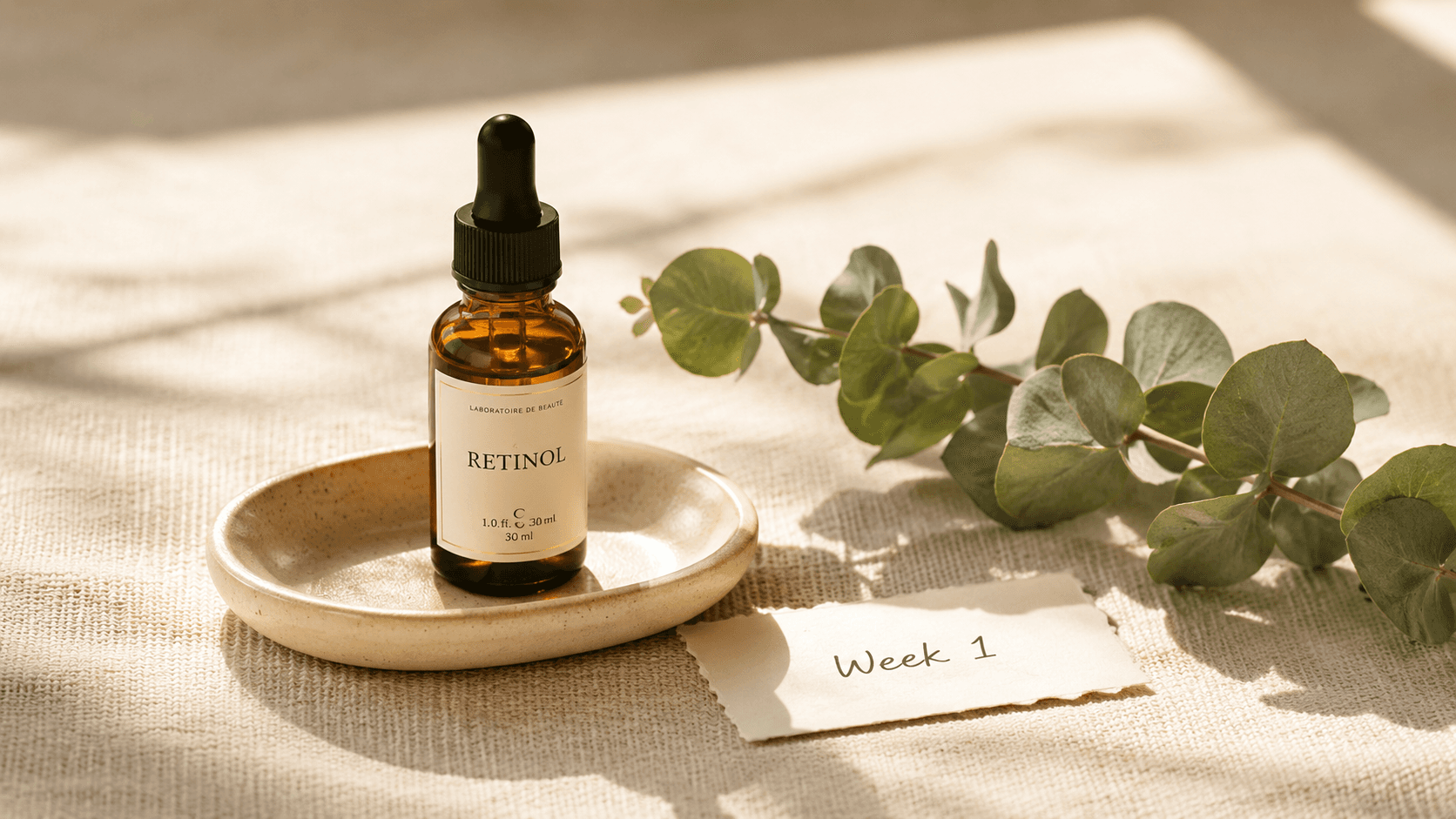
The retinol tutorials skip five things. Each one is why your results stall.
Retinol works through a two-step conversion inside your skin. Retinol becomes retinaldehyde, then becomes retinoic acid. Each step loses potency, which is why retinol takes six months to do what tretinoin does in six weeks. Correct use means starting at 0.025 to 0.1 percent, applying two nights per week to dry skin, waiting fifteen minutes after cleansing, and pairing with a ceramide moisturizer. The purge lasts four to six weeks. Visible results appear at twelve weeks. Plateau at six to twelve months is normal and means it is time to consider escalation.
Most people using retinol have no idea what actually happens inside their skin when they apply it. That gap in understanding is why so many routines stall at week four, get abandoned during the purge, or plateau after a year of consistent use with no visible change.
The problem is not the ingredient. It is that skincare marketing sells retinol as a step in a routine, not as a metabolic process that follows biological rules with specific timelines, specific failure modes, and specific ceilings. Once you understand those rules, the routine writes itself.
Five things almost every retinol tutorial skips. The conversion mechanism behind the timeline. The purge decoded with real numbers. The sandwich method with its critical caveat. The reason results plateau. And the exact moment to escalate to something stronger. Every rule you have already heard becomes obvious once you see the biology underneath.
The conversion mechanism that explains everything
Retinol is not the active ingredient. Retinoic acid is. Every effect you want from retinol, including collagen synthesis, epidermal thickening, and pigmentation regulation, happens when retinoic acid binds to receptors inside your skin cells. Retinol itself does none of that directly.
When you apply retinol to your skin, keratinocytes absorb it and convert it in two enzymatic steps. First, alcohol dehydrogenases convert retinol to retinaldehyde. Then a second enzyme converts retinaldehyde to retinoic acid. Each conversion step loses potency, a pathway documented in a 2025 Frontiers in Cell and Developmental Biology review on retinoid mechanisms (doi: 10.3389/fcell.2025.1683851). This is why a 1 percent retinol product delivers roughly the same effect as 0.05 percent tretinoin, which is retinoic acid applied directly.
Tretinoin at 0.1 percent is approximately twenty times more potent than the strongest over-the-counter retinol at 1 percent, and ten times stronger than the strongest over-the-counter retinal at 0.1 percent. This is not marketing. It is the direct consequence of skipping the conversion steps. Tretinoin arrives ready to bind receptors. Retinol has to be metabolized first, and the metabolism has a ceiling.
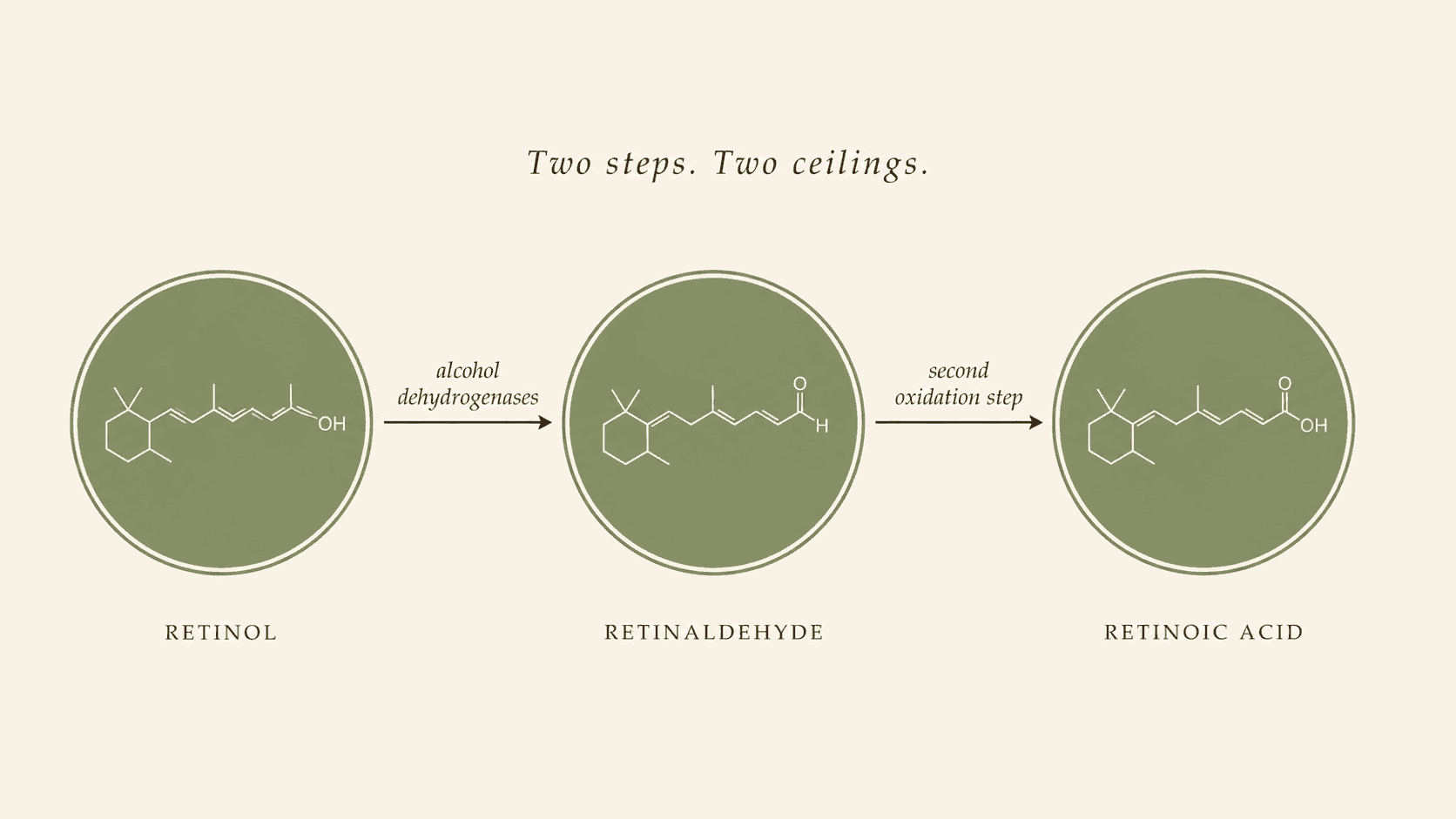
That ceiling matters for one practical reason. Doubling your retinol dose does not double the retinoic acid that reaches your receptors. Your skin can only convert so much before the enzymes saturate. This explains why beginners who start at 0.5 percent often get more irritation than benefit, while people who start at 0.025 percent and build up over months see steadier long-term results.
The concentration you should actually start with
Beginner routines fail most often because the starting concentration is wrong. Not too weak. Too strong. The skin barrier disrupts before the receptors get to work, which triggers redness, peeling, and often complete abandonment of the routine before the tolerance window closes.
The correct starting range for a beginner is between 0.025 and 0.1 percent. This is enough to trigger cellular response without overwhelming the barrier. Anything above 0.3 percent for a first-time user creates more downside than upside.
As of 2026, EU cosmetic regulations cap retinol face products at 0.3 percent. Any bottle above that concentration is either pre-regulation stock or non-EU market. In the US, up to 1 percent remains legal but the science does not support that concentration for beginners. If your product is above 0.5 percent, you are past the point where more concentration means more results and firmly in the zone where more concentration means more irritation.
The concentration decision by skin type
Start at 0.025 to 0.05 percent
- Sensitive skin or history of reactions
- Rosacea-prone or barrier-compromised
- Perimenopause skin with dryness
- Combination skin new to actives
- Any face that reacts to niacinamide over 5 percent
Start at 0.1 to 0.3 percent
- Oily or resilient skin
- Previously used AHA or BHA without issue
- Younger skin under 30 with acne concerns
- No history of eczema or dermatitis
- Warm climate residents with a stronger barrier
Why two nights a week is not a suggestion
Every reliable retinol protocol starts at two nights a week for the first four weeks. This is not conservative advice. It is biology. Your skin needs time between doses to complete barrier repair and receptor recycling.
When you apply retinol, retinoic acid binds to retinoid receptors called RAR and RXR. Those receptors trigger the cellular changes you want, then they downregulate briefly to prevent overstimulation. This downregulation window is roughly forty-eight to seventy-two hours. Applying retinol nightly during the first month means the second dose lands during downregulation, which produces irritation without additional benefit.
The twelve-week ramp that actually works
- Weeks 1-4Expected
Two nights per week. Barrier calibration. Expect mild dryness the morning after a retinol night.
- Weeks 5-8Patience
Three nights per week. Skin has learned the cycle. Purge peaks and resolves during this window.
- Weeks 9-12Visible result
Four to five nights per week if tolerated. First visible smoothness. Fine lines beginning to soften.
The purge, decoded with real numbers
The purge terrifies more people out of retinol than any other side effect. What most articles do not tell you is that the purge is not caused by retinol creating breakouts. It is caused by retinol accelerating existing microcomedones that were already forming beneath the surface.
Cell turnover speeds up. Clogged pores that would have surfaced over the next three months surface in three weeks instead. It looks like the retinol is causing acne. It is actually clearing acne that was already programmed.
What a real purge looks like versus a real reaction
Real purge (continue)
- Breakouts appear where you normally break out
- Small closed comedones surfacing
- Timeline improves by week 4-6
- Skin texture between breakouts improving
- No burning, no sustained redness
Real reaction (stop)
- Breakouts appear in new areas
- Cystic or deep painful lesions
- Persistent redness beyond 2 weeks
- Burning sensation on application
- Peeling combined with weeping or crusting
“The initial phase of inflammation and barrier disruption is followed by reparative processes and progressive suppression of inflammatory signals, paving the way for retinol tolerance.”
The sandwich method and the caveat nobody mentions
The sandwich method has trended on skincare TikTok for two years now. Moisturizer, wait, retinol, moisturizer. The claim is that this reduces irritation while preserving results. Half of that claim is true.
The sandwich method absolutely reduces irritation. The initial moisturizer buffers the retinol from direct contact with the stratum corneum, which is where most of the barrier disruption happens. The second moisturizer prevents the transepidermal water loss that follows retinol application. For sensitive skin, this is a legitimate tolerance strategy.
A thick moisturizer applied before retinol dilutes the retinol and slows penetration. For pure anti-aging comfort, this is a fine trade. For treating acne, melasma, or significant photoaging, this trade weakens the treatment. If your goal is aggressive results, do not sandwich. If your goal is barrier-friendly maintenance, sandwich freely.
How to sandwich correctly if you decide to use it
- Cleanse and pat skin until just barely damp.
- Apply a thin layer of a lightweight, non-comedogenic moisturizer.
- Wait for the first layer to fully absorb (five to ten minutes minimum).
- Apply a pea-sized amount of retinol to the entire face.
- Wait another five to ten minutes for the retinol to absorb.
- Follow with a second layer of moisturizer, ideally ceramide-rich.
Why your retinol stopped working (and what actually solves it)
Six months to a year in, most retinol users hit a plateau. Skin looks better than before, but improvements stop. This is not user error. It is a metabolic ceiling built into how retinol works.
Remember the two-step conversion from earlier. Alcohol dehydrogenases convert retinol to retinaldehyde. A second enzyme converts retinaldehyde to retinoic acid. Both enzymes have a maximum output. Once your skin is converting at that maximum, doubling the concentration does not increase retinoic acid production. You have hit the ceiling.
Clinical trials have long documented what many users notice on their own. Topical retinol applied consistently produces measurable improvement in fine wrinkles and skin texture over twelve to twenty-four weeks, and the improvements plateau while higher concentrations do not proportionally extend the effect.
·2007·Archives of DermatologyAdding more retinol past the conversion ceiling adds only irritation. Escalating to retinal or tretinoin adds actual result.
The escalation ladder
When retinol plateaus, the answer is not more retinol. It is a form of vitamin A that skips one or both conversion steps. Retinal, also known as retinaldehyde, skips the first step. Tretinoin skips both.
| Form | Steps to retinoic acid | Time to visible result | Availability |
|---|---|---|---|
| Retinol | 2 conversions | 12-24 weeks | OTC |
| Retinal (Retinaldehyde) | 1 conversion | 8-11 weeks | OTC |
| Tretinoin | 0 conversions (is retinoic acid) | 6-12 weeks | Prescription |
Retinol and vitamin C together, correctly
The advice you have seen repeated everywhere is correct but almost never explained. Vitamin C in the morning, retinol at night. Why this works and why applying them at the same time cancels both requires understanding pH.
L-ascorbic acid, the most studied form of vitamin C, needs a pH below 3.5 to remain stable and penetrate skin. Retinol prefers a neutral to slightly acidic pH around 5.0 to 6.0 for optimal conversion. Applied together, the pH of both products shifts toward each other, destabilizing the vitamin C and impairing retinol conversion. You get less of both, plus more irritation from the pH clash.
The proven pairing routine
- 1Morning cleanse
Gentle low-pH cleanser
- 2Morning treat
Vitamin C serum, 10-20 percent L-ascorbic acid or 5-10 percent THD
Wait 2 min before next step - 3Morning hydrate
Lightweight moisturizer with niacinamide
- 4Morning protect
Mineral or hybrid SPF 30-50
Wait 5 min before next step - 5Evening cleanse
Same gentle cleanser or oil cleanse first
- 6Evening treat
Retinol on dry skin, pea-sized amount
Wait 15 min before next step - 7Evening seal
Ceramide moisturizer
The six mistakes that stall almost every retinol routine
- Starting at 0.5 percent or higher and abandoning after week 3 from irritation
- Applying nightly from day one instead of building the twice-weekly foundation
- Layering retinol on damp skin, which increases penetration but also increases irritation past what most beginners can tolerate
- Using a bottle past 6 months of opening, when oxidation has degraded up to half of the active ingredient
- Combining with AHA, BHA, or benzoyl peroxide the same evening, which triples barrier stress
- Skipping SPF the next morning, which reverses every collagen gain retinol produced overnight through UV-induced enzyme upregulation
The oxidation window nobody warns you about
Retinol is famously unstable. Exposed to light, air, and heat, it oxidizes. Once oxidized, it does not become retinoic acid. It becomes an inactive breakdown product that irritates without delivering benefit.
Most retinol bottles lose significant potency within three to six months after opening, even when stored correctly. If your retinol has darkened from pale yellow to orange or brown, it has oxidized. The bottle is now delivering irritation without result. This alone explains a meaningful percentage of the plateau reports online.
Buy retinol in opaque bottles with airless pumps, not droppers. Store in a drawer, never on a shelf near light. Keep away from steam sources like showers. Replace the bottle within six months of first use even if product remains. These four habits preserve up to twice the effective potency over the product life.
There is a seventh factor that reverses retinol gains from the inside rather than the outside. Chronic elevated cortisol suppresses collagen synthesis by the same fibroblasts retinoic acid is trying to stimulate. If your routine is dialed in but progress still stalls, the confounder may be systemic rather than topical.
→The internal factor most skincare guides missThe Cortisol Reset Protocol: What the HPA Axis Research Actually ShowsWhen to consider retinal or tretinoin
There are four signals that suggest your retinol has done what it can and further gains require escalation. These are patterns visible in the routines of people who use retinol for years without changing formulation.
- You have used 0.3 percent or higher retinol nightly for six or more months and no longer notice new changes.
- Your original concern, whether fine lines, uneven tone, or acne, has partially improved but plateaued.
- You tolerate retinol without any irritation, redness, or peeling on nightly application.
- You have consistently replaced product every six months so oxidation is not the confounder.
If three or more apply, retinal at 0.05 to 0.1 percent or tretinoin at 0.025 percent is the next step. Retinal is available over the counter and skips the first conversion step. Tretinoin requires a prescription or a legitimate telehealth service in the US and delivers roughly twenty times the potency of retinol at equivalent doses.
Understand the mechanism behind every skincare choice
This site publishes research-based skincare that explains why, not just what. Subscribe to receive new pieces on the ingredients and protocols that actually work.
Get research digestsThe reason retinol tutorials feel repetitive and yet nothing quite works is that they describe the surface behavior without explaining the biology underneath. Every apparent rule (start low, go slow, moisturize, use SPF, be patient) is downstream of two facts: retinol converts through enzymes with a ceiling, and receptors need rest between activations. Once those two facts are visible, the rules stop feeling arbitrary.
The mistake to avoid is not the wrong concentration or the wrong frequency. Those are correctable in days. The mistake to avoid is treating retinol like a moisturizer, expecting a routine of application to produce a routine of result. Retinol is a metabolic intervention. Slow, deliberate, respectful of receptors, cumulative over years. When you approach it that way, the plateau at year one is not a failure. It is a signal that you have used retinol correctly and that it is time for the next form of vitamin A.
GetClariSync Skin Desk
Editorial Research · Dermatological Science
The GetClariSync Skin Desk reviews research in dermatological science, cosmetic chemistry, and skin biology. We follow journals including the Journal of the American Academy of Dermatology, the British Journal of Dermatology, JAMA Dermatology, and the International Journal of Cosmetic Science. We assess ingredients against clinical evidence rather than marketing claims and we are explicit about the concentration, vehicle, and study quality required for an effect. We are editorial researchers, not board-certified dermatologists — please consult a qualified dermatologist for persistent skin conditions, before starting prescription-strength treatments (e.g. tretinoin), or if you have sensitive or compromised skin.