One study. A million TikTok videos built on it. Almost nobody citing it has actually read it. Here is what it really says.
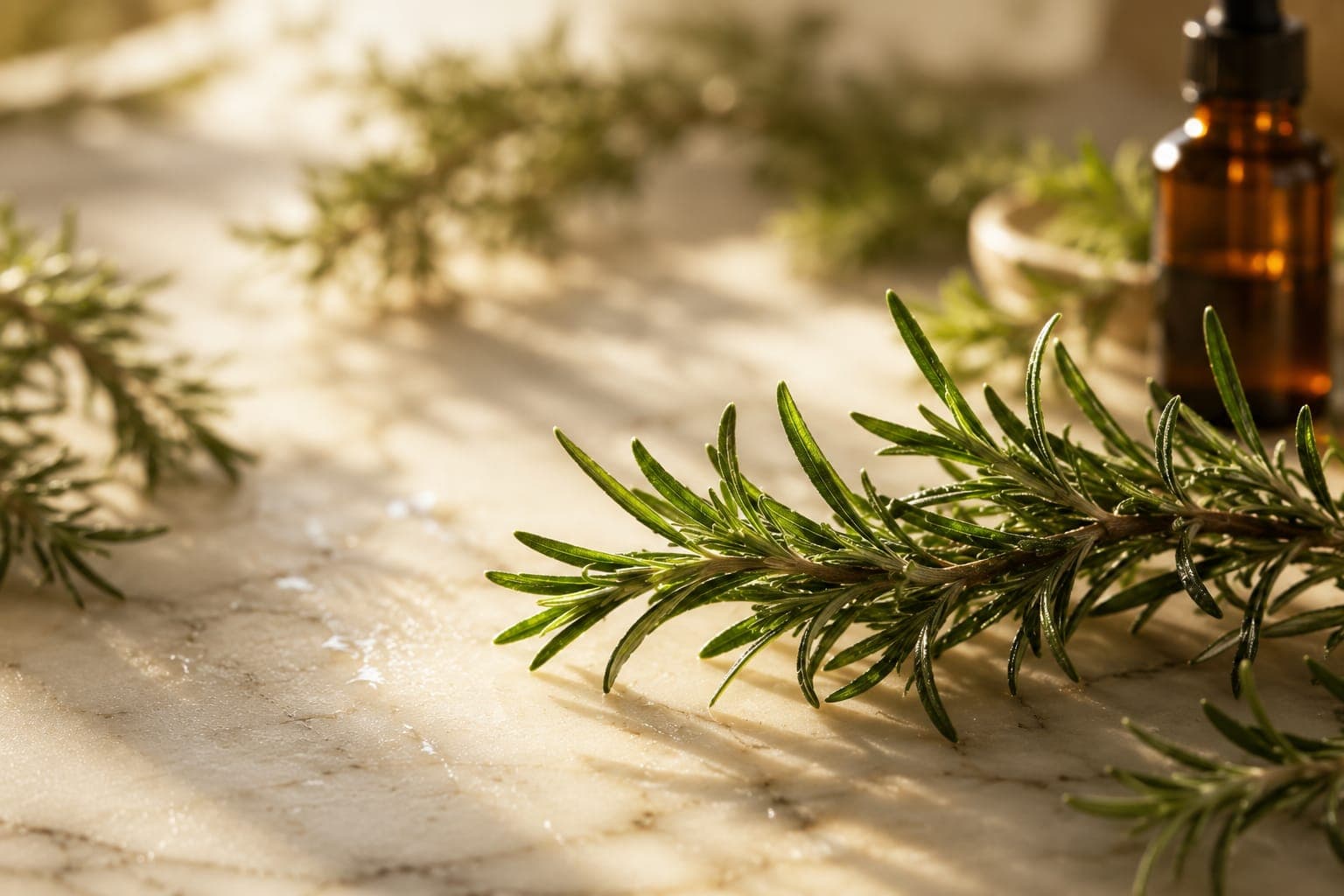
A 2015 randomized trial found rosemary oil performed comparably to minoxidil 2% for androgenetic alopecia after six months of consistent use. The proposed mechanism blocks the enzyme that turns testosterone into DHT, the hormone that shrinks susceptible hair follicles over time. The science holds up. What gets lost online is everything that determines whether it works for you: the six month timeline, the correct dilution, and the fact that it only treats one specific type of hair loss. Most people who see nothing quit around month two, right before the earliest signal was ever supposed to appear.
Somewhere in 2023, a study published eight years earlier climbed out of academic obscurity and became one of the most cited papers in the history of beauty TikTok. The study itself is solid. The results are real. But the version circulating online has been trimmed down to a single sentence, minoxidil alternative found, and stripped of everything that actually determines whether it works for you.
This is not a takedown. Rosemary oil earns a serious look. Few natural compounds come with a genuinely plausible mechanism and a head to head clinical trial behind them. It deserves that serious look. Not a fifteen second one.
The Study Everyone Cites, and Almost Nobody Actually Read
In 2015, Panahi and colleagues ran a randomized comparative trial published in the journal Skinmed. They recruited one hundred people with androgenetic alopecia and split them into two groups for six months. One group applied a rosemary oil preparation twice daily. The other applied minoxidil 2%, the standard over the counter treatment, under identical conditions. The trial was not built to test rosemary oil against doing nothing. It was built to see whether rosemary oil could hold its own against the treatment already sitting on pharmacy shelves.
“Both groups experienced a significant increase in hair count at the 6-month endpoint, with no significant difference between the groups. Scalp itching was more frequent in the minoxidil group.”
This was a comparative trial, not a placebo controlled one. Both groups improved, but neither was measured against a group doing nothing at all. That detail matters because scalp massage alone has been linked to thicker hair in separate research, and both groups massaged the product into their scalp daily. The trial also used one standardized rosemary preparation at a fixed concentration, not whatever bottle happens to be on a store shelf. None of this erases the finding. It just means the honest reading is narrower than the viral one: rosemary oil looked at least as effective as minoxidil 2% for androgenetic alopecia, with fewer people reporting scalp itching. That is a real result. It is not proof that rosemary oil regrows hair for everyone.
There is a second detail the viral version skips entirely. The trial enrolled people with one specific condition: androgenetic alopecia, the pattern hair loss driven by DHT sensitivity. It says nothing about hair lost to stress, illness, autoimmune activity, or a tight ponytail. Reaching for rosemary oil for those causes is applying the right tool to the wrong problem.
The Mechanism: A Kitchen Herb Aimed at a Prescription Drug's Target
Androgenetic alopecia starts with a hormone, not a follicle. Testosterone gets converted into dihydrotestosterone, DHT, by an enzyme called 5 alpha reductase. In genetically susceptible follicles, DHT binds to receptors and repeats the same instruction cycle after cycle: grow back a little smaller. Do that enough times and a full, coarse hair becomes a fine, short one, then nothing at all.
Prescription treatments attack this from two different angles. Finasteride blocks the 5 alpha reductase enzyme directly. Minoxidil mostly skips the hormone problem and works as a vasodilator, widening blood vessels and prying open potassium channels to keep follicles active. Rosemary oil's proposed mechanism sits closer to finasteride's lane: 5 alpha reductase inhibition, driven mainly by three compounds, carnosic acid, carnosol, and ursolic acid.
That hypothesis sent researchers looking for evidence at the cellular level, testing whether rosemary extract could do more than sit on the surface of the skin.
“Rosmarinus officinalis leaf extract promoted hair growth in vivo and stimulated dermal papilla cell proliferation in vitro, suggesting a mechanism relevant to follicle activation.”
A second, less discussed pathway skips DHT altogether.
Some researchers took a more direct route. Instead of theorizing about hormones, they compared bald scalp tissue to haired scalp tissue side by side under a microscope, hunting for a local chemical signal specific to the follicle itself, something that might tip the balance toward shedding independent of DHT.
“PGD2 levels were elevated threefold in balding scalp tissue compared with haired scalp, and topical application of PGD2 inhibited hair growth in a murine model.”
PGD2, in other words, is not a passive bystander in bald scalp. In the same research, applying it directly to skin actively suppressed hair growth in animal models. PGE2, its close relative, appears to push in the opposite direction. Whether rosemary oil meaningfully shifts that balance in human scalp is still an open question. It is a real biological lead, not a settled fact.
The pathway rosemary oil is thought to touch is the same one finasteride was engineered for. The difference is not the target. It is precision. Finasteride is a selective, potent inhibitor built for one job. Rosemary oil is a mild plant extract carrying a dozen overlapping compounds, none of them as sharp as a drug designed in a lab.
The Timing Problem Nobody Explains
Here is where the TikTok version does the most damage. People quit around month two or three because nothing visible has happened yet. That timing is not a sign of failure. It is exactly when the biological groundwork is supposed to be invisible.
A hair follicle does not respond overnight. It runs on a cycle: an active growth phase lasting two to seven years, a short transition of a few weeks, then a resting phase of roughly three months before the old hair sheds and the follicle starts over. Think of it less like flipping a switch and more like redirecting a river. The water does not change course the moment you move the first rock. It changes course once enough rocks are in place, and that takes time you cannot see happening.
No visible change yet. Compounds are being absorbed. Enzyme activity and dermal papilla signaling are shifting under the surface, where you cannot see it.
Reduced shedding may show up first. This is the earliest measurable signal, and the point where most people have already given up.
Fine new hairs may appear in previously thinning areas. Hair count was measurably different from baseline at this stage in the Panahi trial.
Visible density improves in responding cases. Consistency from here decides whether progress continues or stalls.
The most common failure pattern is simple: stop at month two, notice the usual number of hairs in the shower drain, and conclude the oil does nothing. Reduced shedding, the earliest real signal, typically shows up between months three and four. Most people are already back to buying shampoo by then.
Who This Actually Helps, and Who Is Wasting Their Time
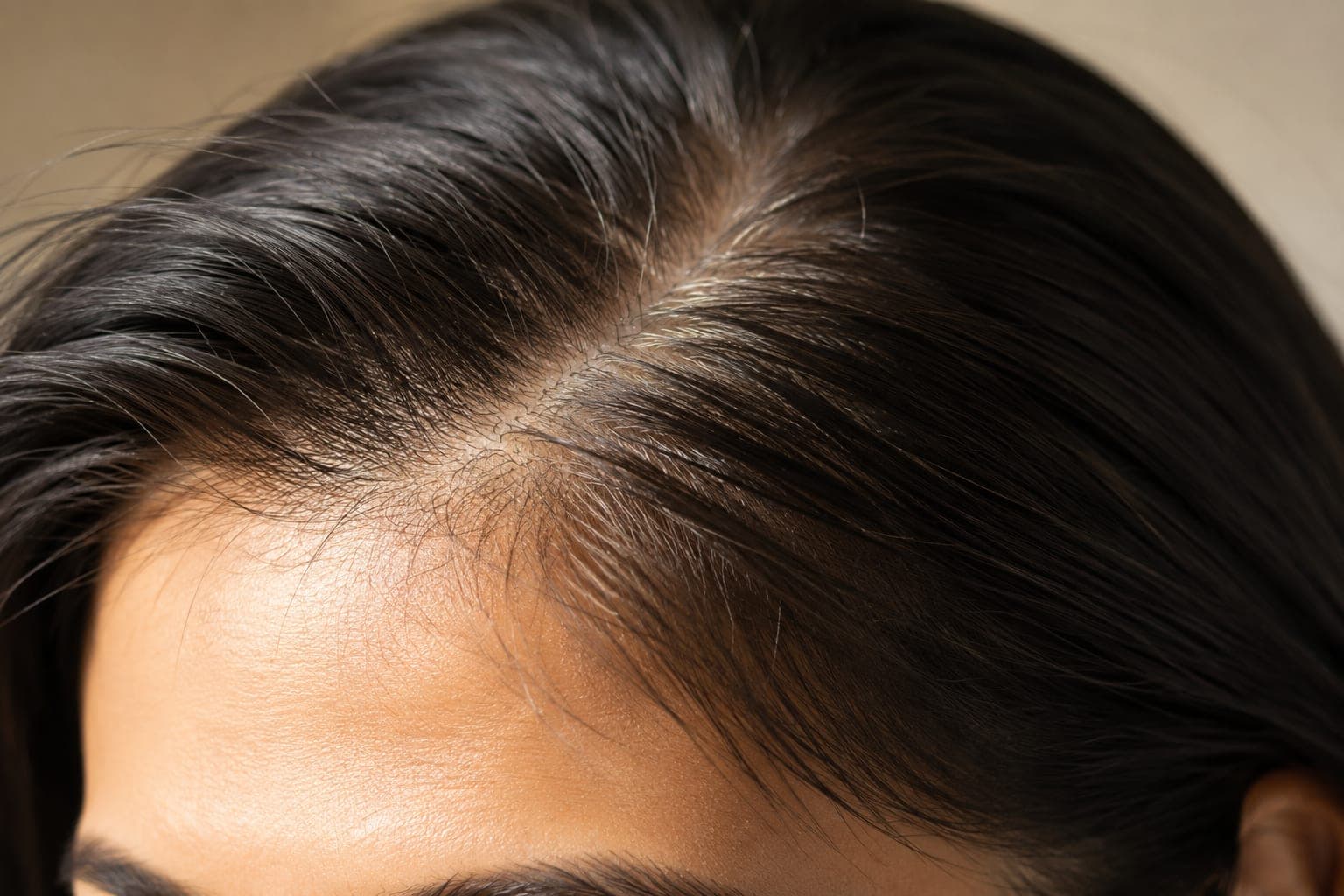
Rosemary oil's proposed mechanism is specific to androgenetic alopecia: genetic, DHT driven, and the single most common cause of hair loss in both men and women. It shows up as gradual recession at the temples and crown in men, and diffuse thinning across the crown and a widening part in women.
Several other common causes of hair loss look similar on the surface and have nothing to do with DHT.
Where rosemary oil may be relevant
- Androgenetic alopecia (genetic, DHT-driven pattern hair loss)
- Gradual onset over months to years
- Family history of hair thinning
- Diffuse thinning at crown or temples
- No sudden triggering event
Where rosemary oil is not the right approach
- Telogen effluvium (stress, illness, postpartum, or dietary changes causing sudden diffuse shedding)
- Alopecia areata (autoimmune, patchy loss)
- CCCA (central centrifugal cicatricial alopecia)
- Traction alopecia (mechanical damage)
- Thyroid-related hair loss (requires treating the underlying thyroid condition)
If hair loss appeared suddenly over weeks rather than months, followed a specific trigger such as illness, major stress, childbirth, rapid weight loss, or a medication change, or shows up in clearly defined patches, a dermatologist or trichologist is worth more than any bottle on a shelf. Telogen effluvium alone explains a large share of hair loss concerns in women under 40, and it typically resolves on its own within three to six months once the trigger is addressed. Rosemary oil will not speed that up.
The Protocol the Study Used, Not the One on Your For You Page
The study's protocol and the way most people actually apply rosemary oil are not the same thing. Undiluted essential oil straight onto the scalp is far more likely to cause irritation than growth. Essential oils run roughly 40 to 70 times more concentrated than the compounds naturally present in the fresh herb. Skip the dilution and you are stripping the scalp barrier, not feeding the follicle.
Always dilute: the non-negotiable step
2 to 3 drops of rosemary essential oil per tablespoon of carrier oil. Jojoba sits closest to sebum in composition and absorbs well into scalp tissue. Grapeseed and argan work as good alternatives. Coconut oil is effective but can leave residue, so plan on washing more thoroughly. The dilution is not a safety formality. It is the delivery mechanism. An undiluted essential oil sitting on the scalp surface does not penetrate. A lipid-dissolved compound does.
High impactApply to scalp, not hair. Massage deliberately.
The target is the dermal papilla cells at the follicle base, not the hair shaft. Apply the diluted mixture to the scalp in thinning areas and massage for three to four minutes with fingertip pressure. Scalp massage carries its own independent evidence for increasing hair thickness, and likely contributes to what studies measure through improved blood flow to follicle tissue, separate from anything rosemary oil is doing chemically. Apply two to three times per week. Leave it on for at least thirty minutes before washing; overnight works fine too.
High impactMeasure the right thing at the right time
Do not judge results by hair length or overall appearance at month two. Photograph the thinning area in consistent lighting before starting, then again at three months and six months. What you are looking for at three months is reduced shedding, not new growth. Counting hairs in the shower drain or on a pillow over a week gives a more reliable signal than staring in the mirror. Less shedding before visible growth is the correct order of events, not proof the treatment is falling short.
High impact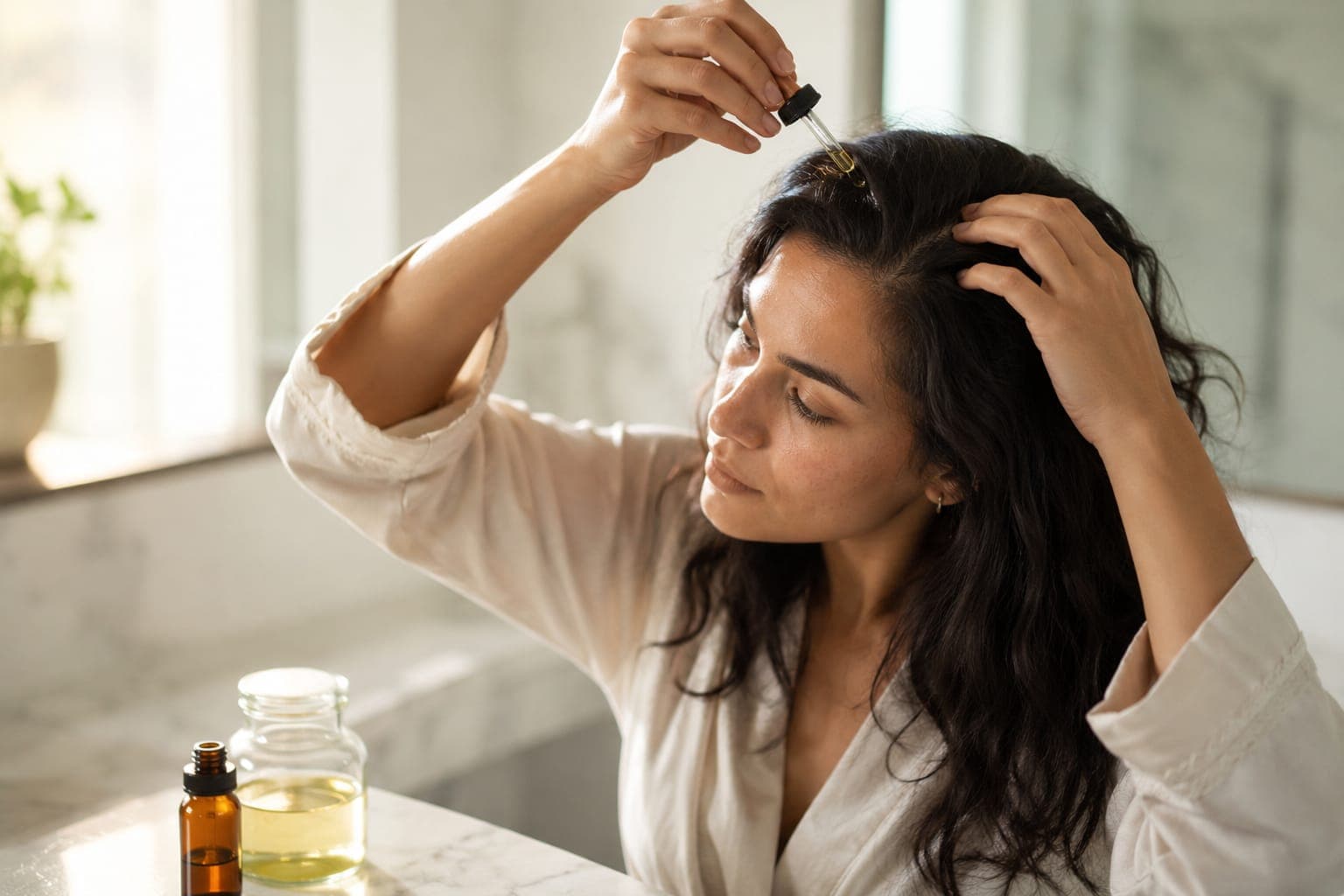
When Six Months of Doing It Right Still Isn't Working
Six months of consistent, correctly applied rosemary oil with zero change in shedding is worth acting on. Not because the oil has failed for certain, but because a handful of conditions mimic pattern hair loss on the surface while being driven by something entirely different underneath: thyroid dysfunction, iron deficiency, scalp inflammation, or autoimmune activity. Those need investigation, not another bottle of oil.
Rosemary oil holds a legitimate spot in the evidence, not as a proven treatment in the pharmaceutical sense, but as a promising compound with a plausible mechanism and one solid comparative trial behind it. For early androgenetic alopecia, and for anyone who wants to try something well tolerated before moving to a pharmaceutical option, six months of consistent, correct use is a reasonable bet.
When it fails, the oil is rarely the actual problem. It is the wrong type of hair loss, the wrong protocol, or a timeline nobody warned you about.
The study ran for six months. The version on your For You page forgot to mention that part.
Science-Backed Wellness, Weekly
Research summaries on skin, hair, and body science: the mechanisms most wellness content skips over.
Get the weekly dispatchGetClariSync Skin Desk
Editorial Research · Dermatological Science
The GetClariSync Skin Desk reviews research in dermatological science, cosmetic chemistry, and skin biology. We follow journals including the Journal of the American Academy of Dermatology, the British Journal of Dermatology, JAMA Dermatology, and the International Journal of Cosmetic Science. We assess ingredients against clinical evidence rather than marketing claims and we are explicit about the concentration, vehicle, and study quality required for an effect. We are editorial researchers, not board-certified dermatologists — please consult a qualified dermatologist for persistent skin conditions, before starting prescription-strength treatments (e.g. tretinoin), or if you have sensitive or compromised skin.