
You are standing in your bathroom at seven in the morning with six bottles in front of you. And you have officially forgotten which one goes first.
There is no single correct skincare order. There are three simple rules that generate the correct order for any routine you will ever have. Water before oil. Thin before thick. Actives need their own pH and their own timing. Learn the three rules and you never need to check a chart again. Below are the morning and night charts, the active pairing table, and the three-question checklist for placing any new product you buy.
You have watched the TikTok. You have saved the Pinterest chart. You have memorized the list on the back of your moisturizer box. And still, every morning, there is that half-second of hesitation. Does the vitamin C go before or after the hyaluronic. What about the niacinamide. Did the last article you read say to wait between products, or was that a different article. You are not alone in this. Layering skincare has become one of the most confusing rituals in modern life, and it is not because the products are complicated. It is because everyone teaches the what and almost nobody teaches the why. Once you know the why, the what stops needing to be memorized.
The problem with the skincare chart you already memorized
Every skincare chart on the internet is technically correct. The problem is that they all assume your routine is the same as the routine used to build the chart. The moment you add a new product, or subtract one, or switch to a different active for the season, the chart no longer applies exactly. And because the chart never explained why the products go in that order, you have no way to adapt it. You either memorize another chart, or you guess.
This is why the same person can read three different skincare articles and get three different orders. Not because one of them is wrong. Because they are all reciting a list, and each list assumes a specific set of products. A chart is a result. It is not the underlying logic.
The order is not a rule. It is the consequence of three simple laws.
The three rules that generate every correct skincare order
Almost all skincare layering confusion disappears when you learn three things. Two of them are about how molecules physically move through skin. The third is about how chemistry between actives works. Each rule is short and easy to remember. Once you have them, you can look at any product you have never seen before and know where it goes.
Rule 1. Water before oil
Skin absorbs water-based products through hydration channels. It absorbs oil-based products by moving through the skin's own natural lipid layer. The two do not cooperate well in either direction. If you apply an oil-based product first, whether that is a facial oil, a rich cream, or an occlusive balm, it forms a thin film on your skin surface. Anything water-based applied on top of that film has to fight through the oil to reach the skin, and it mostly fails. So water-based products first (toners, essences, water-based serums, hydrating gels). Oil-based products last (rich moisturizers, face oils, balms).
Rule 2. Thin before thick
The size of the molecules in a product determines how deeply the product penetrates. Small molecules pass through the skin barrier and reach lower layers. Large molecules sit on the surface. A thin runny serum has small molecules and needs direct contact with skin to work. A thick cream has large molecules and works partly by sealing in what is already there. If you put the thick cream on first, you have created a physical barrier that the thin serum cannot cross. So thin products before thick ones. It is not about texture aesthetically. It is about physics.
Rule 3. Actives have their own pH and their own timing
This is the rule that most charts get wrong or leave out. Vitamin C, glycolic acid, salicylic acid, and other acidic actives work at a low pH, usually around 3 to 4. Most of your other products, including moisturizers, hydrators, and non-acid serums, sit at a neutral pH around 5 to 6. If you apply a neutral pH product on top of an acid too quickly, you buffer the acid up and it stops working properly. This is where the fifteen to thirty minute wait time between certain products comes from. Additionally, some actives destabilize each other if they meet too closely in time. Retinol and AHA together in the same layer is a barrier disaster waiting to happen. Vitamin C and copper peptides oxidize each other on contact. Knowing which actives cooperate and which fight is the third part of the rule.
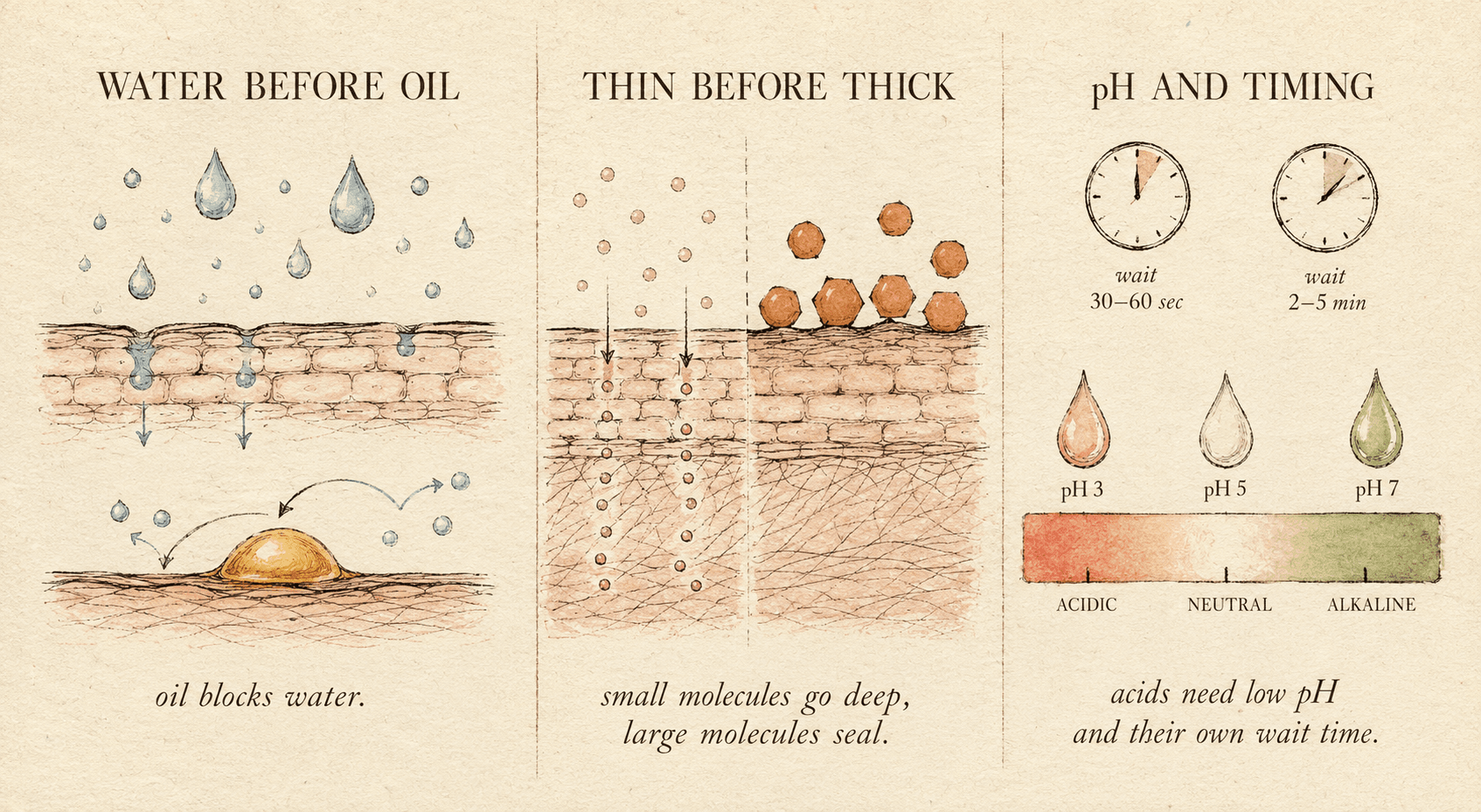
Learn the three rules once. Every future product places itself.
Your morning chart
The morning routine is about protection. Your skin has just spent the night repairing itself, and the day ahead exposes it to UV, pollution, and environmental stress. Everything you apply in the morning should either hydrate, protect, or brighten. Nothing transformative and photosensitive goes here. That gets saved for the night.
Morning routine, in order
- 1Cleanser or splash of water
The goal is to remove what accumulated overnight, not to strip. Skip harsh cleansers in the morning if your skin is not oily.
- 2Vitamin C serum (optional)
Water-based and acidic, so it goes first after cleansing. If it stings, lower the concentration or use every other day.
Wait 15 min before next step - 3Hydrating serum
Hyaluronic acid, glycerin base, or a water-based essence. Thin and water-based, needs direct skin contact to work.
- 4Moisturizer
Seals in the water layers below. Choose by skin type: gel for oily, cream for dry, ceramide-focused if barrier is compromised.
- 5Face oil (optional)
Always last of the skincare steps because oil blocks anything water-based behind it. Skip if your moisturizer is already rich enough.
- 6SPF
Non-negotiable if the sun exists where you live. Always the last thing on your face before makeup. Reapply every two hours in strong sun.
Your night chart
The night routine is about transformation. Your skin repairs itself while you sleep, and the actives that would damage your skin under sunlight (retinol, most exfoliants, some brightening agents) can work safely in the dark. This is where the transformative work of a routine happens. The morning protects. The night rebuilds.
Night routine, in order
- 1Double cleanse if needed
If you wore makeup, SPF, or heavy sunscreen: oil cleanser first (dissolves oil-based products), then water cleanser. If you wore neither, one gentle cleanse is enough.
- 2Hydrating toner or essence
Preps skin for what comes next. Thin and water-based. Not the astringent alcohol toners of the 90s. Modern hydrating toners actually hydrate.
- 3Treatment active
Retinol on retinol nights. AHA or BHA on exfoliant nights. Never both the same night. Apply to fully dry skin, not damp, to reduce irritation.
Wait 20 min before next step - 4Moisturizer
After the active has absorbed. Barrier repair cream (ceramide-focused) if your skin is currently reactive, otherwise your usual night cream.
- 5Face oil or occlusive (optional)
Seals the night's work. Squalane, jojoba, or a slugging balm if barrier repair is the priority.
Why the night order is different
The night skips one thing and adds another. It skips SPF because the sun is not out. It adds the treatment active because retinol, most exfoliants, and other transformative ingredients are either photosensitive (damage skin under sunlight) or degrade too fast when exposed to UV. Everything transformative in your routine belongs at night. Everything protective belongs in the morning. If you understand that split, you already understand the deeper logic of AM versus PM skincare.
The active pairing table (what works, what does not)
Beyond the order, the specific actives in your routine have their own compatibility rules. Some pair beautifully. Some fight. Some need dedicated slots. The table below covers the pairings that show up most often in Reddit skincare threads and Google searches.
| Pairing | Verdict | Why |
|---|---|---|
| Vitamin C + Niacinamide | Compatible | The old red-flushing myth was based on outdated formulations. Modern versions coexist. Vitamin C first (lower pH), niacinamide after. |
| Vitamin C + Retinol | Split AM/PM | Both potent. Combining causes irritation for most. Vitamin C in the morning, retinol at night. |
| Retinol + AHA or BHA | Avoid same night | Both irritate the barrier. Alternate nights instead. |
| Retinol + Peptides | Compatible | Peptides pair well with almost everything. Apply after retinol has absorbed. |
| AHA + BHA | Alternate | Both exfoliate. Stacking equals irritation and barrier damage over time. |
| Niacinamide + almost anything | Compatible | The most forgiving active in your cabinet. Rarely causes conflicts. |
| Retinol + Ceramides | Compatible and supportive | Ceramides help skin tolerate retinol. Apply moisturizer with ceramides after the active. |
| Vitamin C + Copper peptides | Avoid mixing | They oxidize each other on contact. Use on different days or split AM/PM. |
The myths you keep encountering
What actually happens if you get the order wrong
The internet has taught you to fear layering mistakes. The truth is calmer. Most order mistakes cost you a small percentage of product effectiveness. Your vitamin C works slightly less well if buffered by the moisturizer applied too quickly. Your hydrating serum reaches slightly less deep if trapped behind a cream. Neither is a disaster.
The real problems come from pairing incompatible actives (retinol plus AHA together, causing barrier damage over weeks), or skipping SPF (causing real photodamage). Order mistakes with hydrators, moisturizers, and non-active products are cosmetic inefficiencies, not skin disasters. Do not let strict online charts give you skincare anxiety.
Do not let strict charts give you skincare anxiety. Skin is more forgiving than the internet says.
What to do when you get a new product
You do not need to check a chart. Ask three questions.
- Is it water-based or oil-based? Water goes earlier. Oil goes later.
- Is it a thin serum or a thick cream? Thin goes before thick.
- Does it contain an active with a specific pH (vitamin C, AHA, BHA, retinol)? If yes, it needs its own wait time and possibly its own dedicated slot in AM or PM.
Answer those three and you know where the product belongs. This is why the three rules are worth learning once. They fit every product you will ever own.
When to see a dermatologist
Skincare is largely self-manageable, but the line between reactive skin from over-layering and a genuine dermatological issue is not always obvious. When in doubt, see the professional. There is no protocol that replaces a dermatologist when a dermatologist is what the situation needs.
→Related scienceThe skin barrier and why ceramides matter for every skin typeThe takeaway
The order is not the answer. The rules that generate the order are the answer. Once you have them, every skincare chart becomes a helpful reminder rather than the truth you have to memorize. Your routine can shrink or expand, your products can rotate seasonally, and you can walk into a store and pick up a new serum with confidence. The freedom is not knowing more products. It is knowing the logic that any product has to fit into.
The chart is not the answer. The chart is the answer to a question. Learn the question, and every chart writes itself.
One skincare essentials article every week.
Next in this series: the vitamin C serum form comparison (L-ascorbic vs THD vs SAP), the ceramide versus hyaluronic acid decision guide, and the barrier repair 4-week protocol.
Join the newsletterGetClariSync Skin Desk
Editorial Research · Dermatological Science
The GetClariSync Skin Desk reviews research in dermatological science, cosmetic chemistry, and skin biology. We follow journals including the Journal of the American Academy of Dermatology, the British Journal of Dermatology, JAMA Dermatology, and the International Journal of Cosmetic Science. We assess ingredients against clinical evidence rather than marketing claims and we are explicit about the concentration, vehicle, and study quality required for an effect. We are editorial researchers, not board-certified dermatologists — please consult a qualified dermatologist for persistent skin conditions, before starting prescription-strength treatments (e.g. tretinoin), or if you have sensitive or compromised skin.