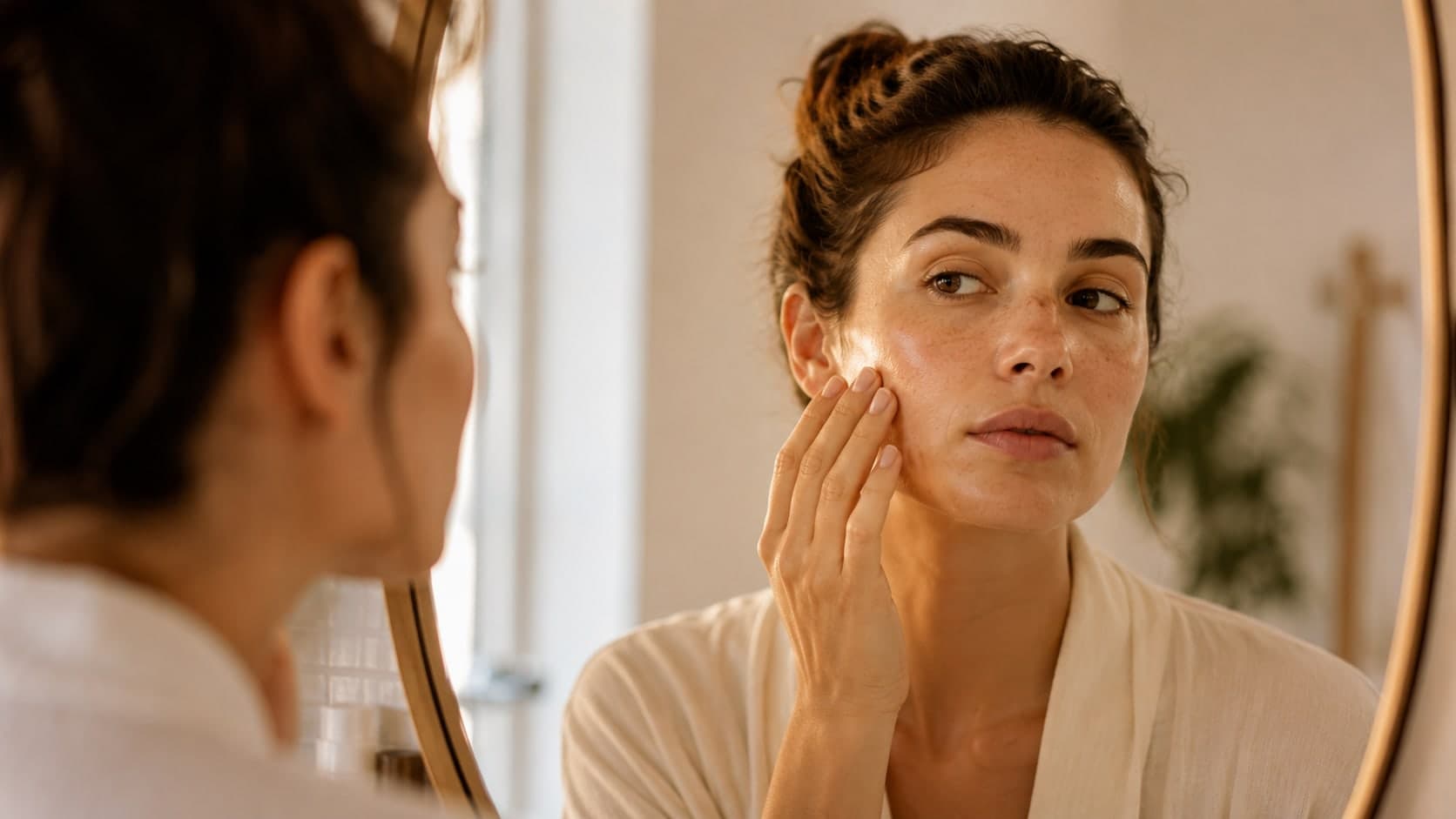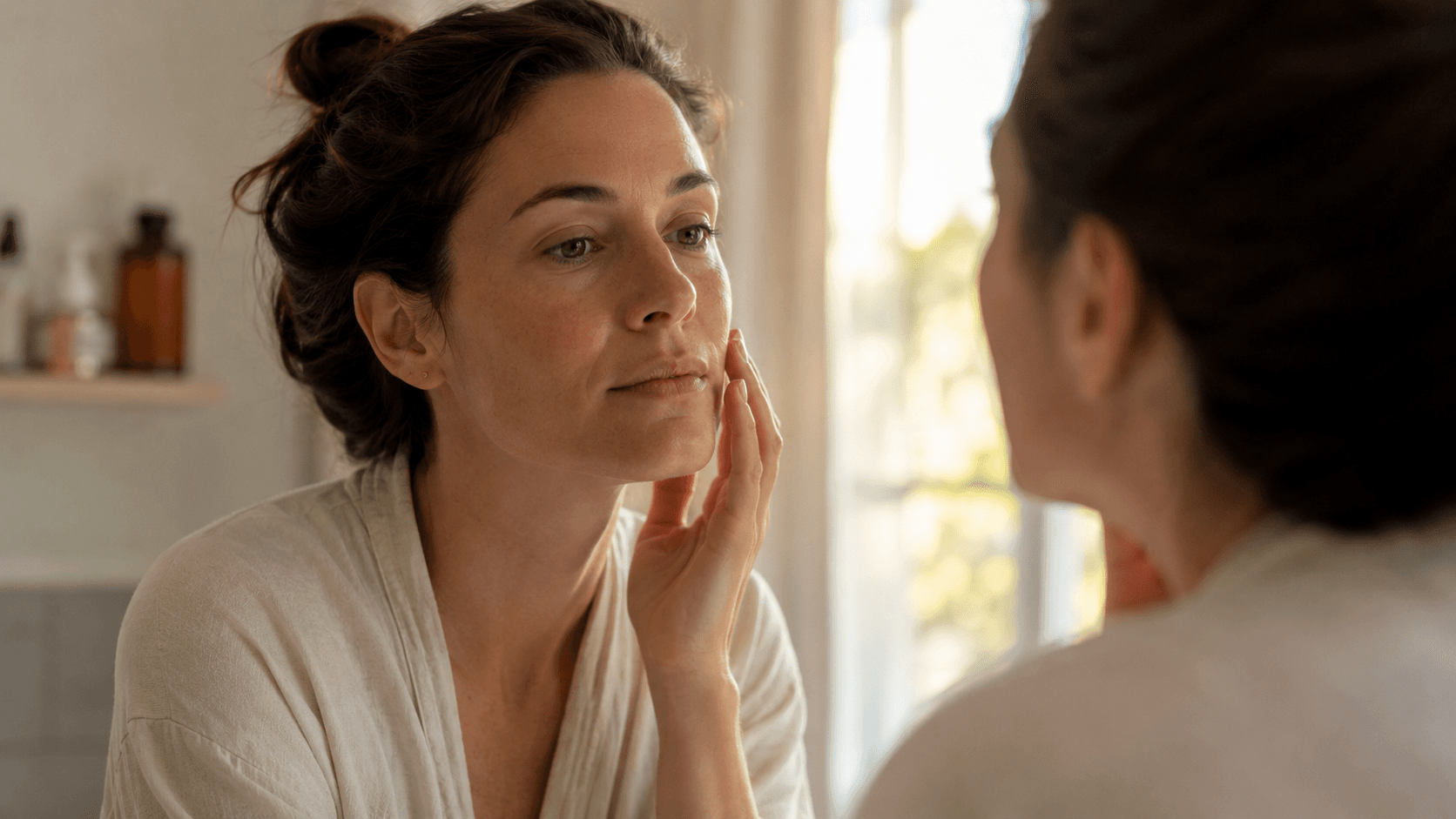
You look in the mirror at 7 AM. Your face looks fuller, softer, slightly inflated. By 10 AM it has settled. By noon it looks like your face again. You did not gain three pounds overnight. Something else was at work while you slept.
The puffiness you see in the morning is not weight gain, water retention from salt, or evidence that something is wrong. It is fluid that accumulated in your face overnight because the lymphatic system, your body's primary fluid drainage mechanism, depends on gravity and muscle movement to work. Lying horizontally for hours stops both. Fluid that would normally drain downward by gravity settles into the soft tissues of the face. As soon as you are upright and moving, the drainage resumes. The puffiness fades over the next two to three hours.
It is the same face every morning. Slightly fuller around the eyes. Slightly softer along the jawline. A little less defined than the face you went to sleep with. By the time you have finished breakfast, the puffiness has begun to settle. By midmorning your face has returned to its usual shape. You do not need an explanation for the puffiness itself. You want to know what is happening.
Most people assume the answer involves salt, water, or something they ate. Almost none of it is about that. The answer is about how the body moves fluid when it is lying down.
What Most People Blame, and Why It's Mostly Wrong
The usual suspects in any conversation about morning puffiness are sodium, alcohol, and either drinking too much water before bed or too little. Each of these contributes a small amount. None of them is the main story. Sodium can slightly increase overnight water retention. Alcohol causes vasodilation and mild dehydration that contribute to inflammation. Drinking too little water can sometimes push the body to retain more fluid. The puffiness still happens at roughly the same scale in people who ate sensibly, drank water, and avoided alcohol. The mechanism is structural, not dietary.
What the morning face is showing you is something most people do not know they have: a quiet drainage system running through the face, neck, and head that depends on you being upright to do most of its work.
Your Face Has a Drainage System You've Never Met
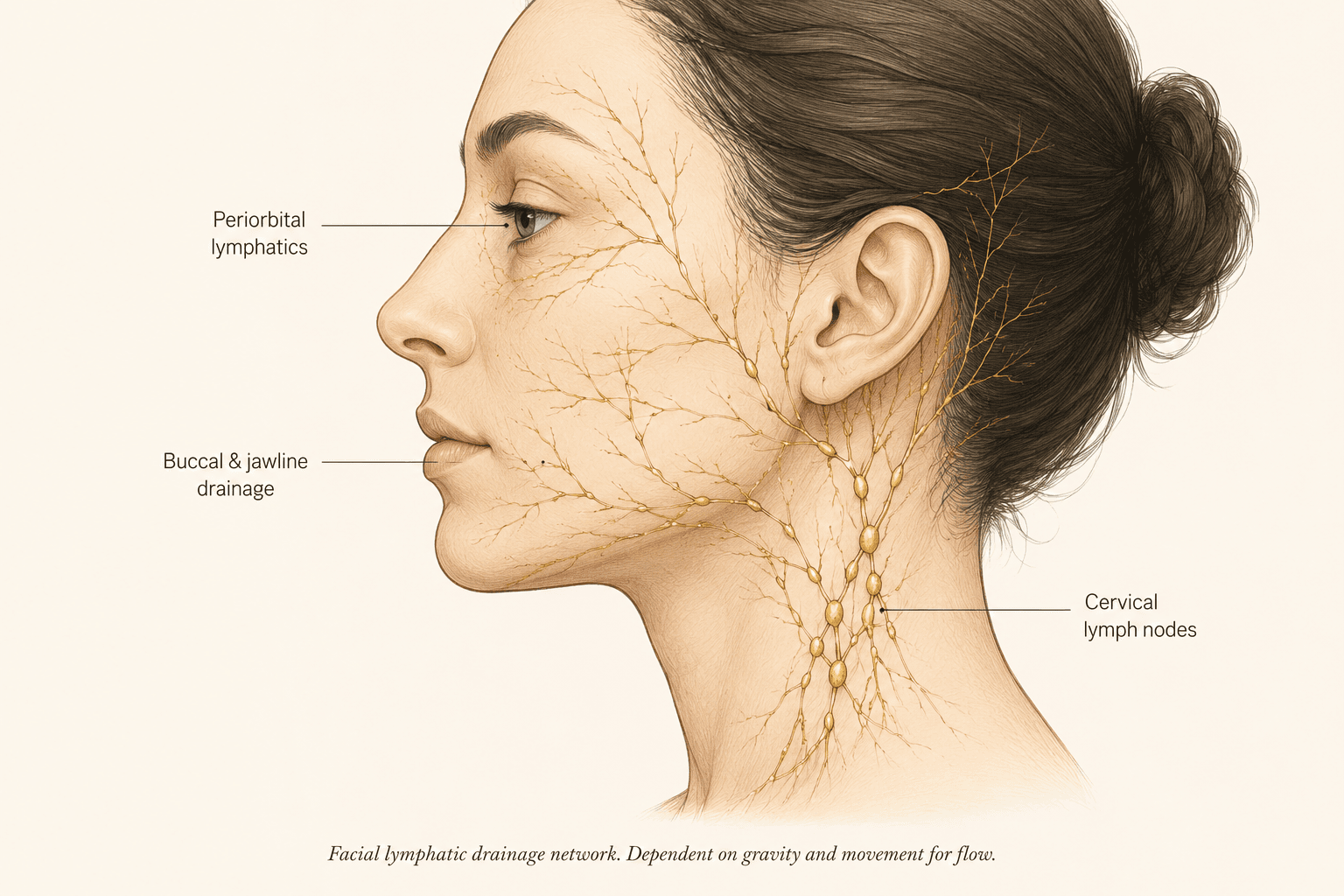
The lymphatic system is a network of thin vessels that runs through almost every tissue in the body. Its job is to collect the fluid that constantly leaks out of small blood vessels into the surrounding tissues, filter it through small structures called lymph nodes, and return it to the bloodstream. The system handles a substantial portion of the body's interstitial fluid every day. Without it, fluid would accumulate in tissues until they swelled visibly. The face has its own dense network of lymphatic vessels, especially around the eyes, jaw, and front of the neck.
A clinical review of the lymphatic system examined the biological mechanisms responsible for moving lymph fluid through the body, asking what specific forces drive lymph propulsion from peripheral tissues back toward the central circulation, given that the system operates differently from the heart-pumped cardiovascular network.
“The lymphatic system functions as the principal mechanism for the return of interstitial fluid and macromolecules from peripheral tissues. Unlike the cardiovascular system, the lymphatic system lacks a central pump and depends on extrinsic forces, including skeletal muscle pumping, respiratory movements, and postural changes, to drive lymph propulsion.”
What this means for your face every night is direct. The lymphatic system has no heart. It does not have a single beat that pumps lymph forward. It has instead a one-way valve system that opens when the surrounding tissue is moved by muscle contractions, breathing, or gravity pulling fluid downward. During sleep you stop moving. You breathe more shallowly. Your face is no longer above your heart. The pumps that keep facial drainage running are mostly turned off.
Why the Position You Sleep In Matters
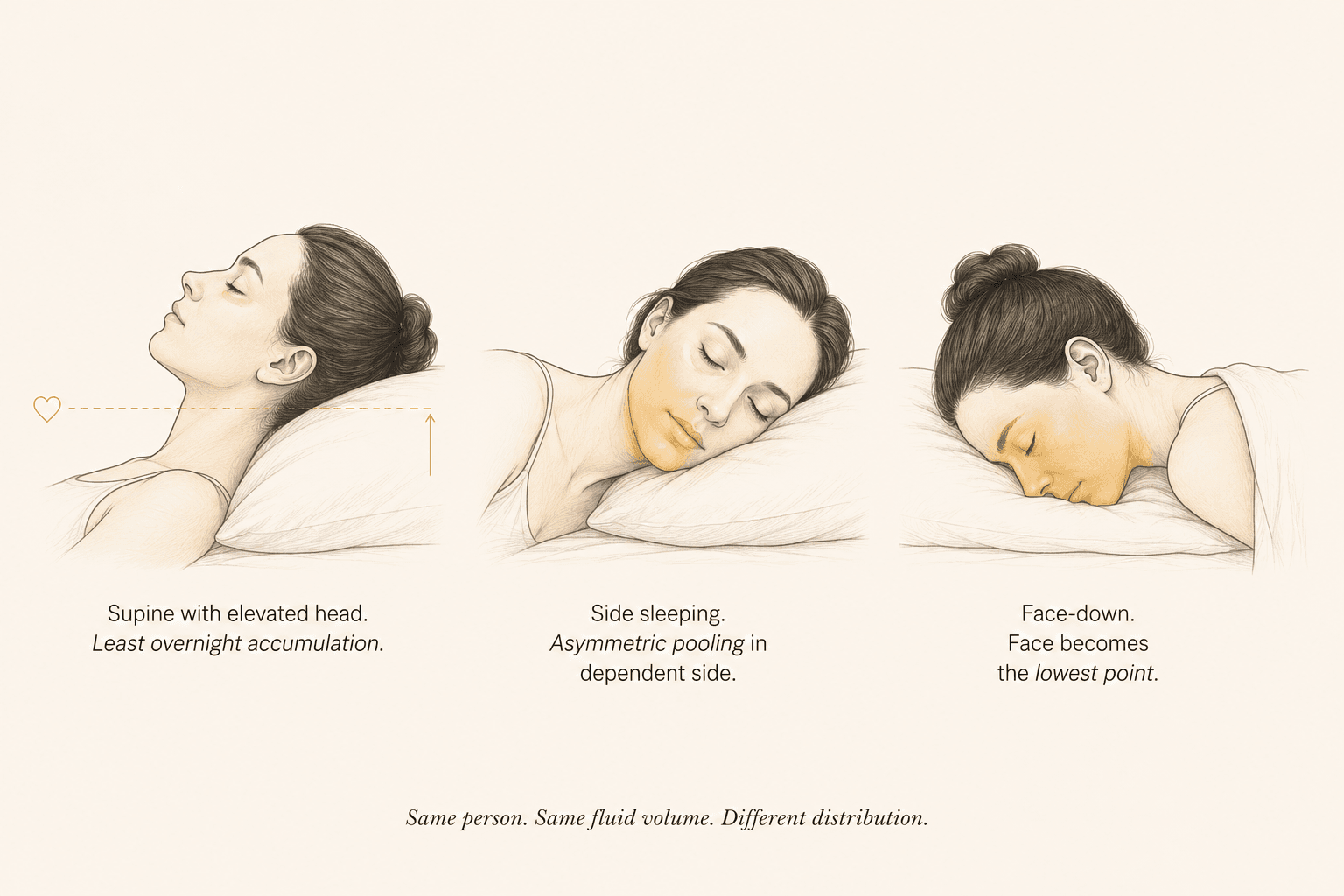
Sleep position is the single largest controllable factor in how much puffiness you wake up with. When you sleep on your back with your head slightly elevated, gravity still pulls some fluid downward away from the face, even with minimal active drainage. When you sleep on your side, the lower half of the face presses into the pillow and fluid settles unevenly into the dependent side. When you sleep face-down, the entire face becomes the lowest point in the body for hours, and fluid pools throughout. The differences in morning puffiness across positions can be substantial in the same person on different nights.
Pillow height contributes for the same reason. A flat pillow keeps the head near horizontal, eliminating the small gravity gradient that would otherwise help. A slightly higher pillow recreates some of the drainage advantage of being upright without disrupting sleep architecture, as long as it does not put strain on the neck. The most consistent finding in dermatology and sleep research is that supine sleep with a slightly elevated head produces the least morning facial puffiness.
What Cortisol Does the First Hour After You Wake
There is a second piece to why puffiness fades so quickly. Cortisol, the hormone that begins climbing in the hour before you wake and peaks roughly thirty minutes after, has a powerful anti-inflammatory effect. Among the things it suppresses is the mild inflammatory response that accumulates in tissues overnight while you are not moving. The cortisol curve and the morning return to upright posture work together. By the time you have had coffee, used the bathroom, and walked around for half an hour, your lymphatic system is draining again and your cortisol is reducing the residual inflammation. The puffiness retreats by the same biology that produced it.
The puffy morning face is not damage. It is a feature of being still and horizontal. The same body that produced the puffiness while sleeping is solving it within hours of waking, using a combination of gravity, movement, breathing, and a hormone curve timed to the start of the day.
What Helps if Your Morning Face Bothers You
Most morning puffiness resolves on its own within two to three hours of being upright. If managing the morning face matters to you, the interventions are quiet ones. Sleeping on your back with a slightly elevated head reduces overnight accumulation. Drinking a glass of water and walking for a few minutes shortly after waking restarts lymphatic drainage. Cold water on the face produces a brief vasoconstriction that visibly reduces puffiness for the next thirty minutes or so, which is why generations of beauty advice have recommended it. Gentle facial massage moves lymph downward through the same physical action that walking does for the rest of the body.
What does not help is restricting evening fluids. Going to bed dehydrated tends to make the body retain more fluid, not less. The advice to drink less water at night is one of the most persistent pieces of beauty folklore and one of the least supported by actual physiology.
The Face Asleep Is a Face Doing Its Job
There is something quietly funny about the morning puffy face. It is one of the small ways the body announces that it spent the last eight hours at rest. Not broken. Not failing. Just paused. The drainage will resume. The shape will return. None of this is happening to you. It is the body in a state most people forget it can be in: still.
By the time you are dressed and out of the house, the face you remember will be back. The puffy morning was a sign that you slept. The flat afternoon will be a sign that you are moving again. Both belong to the same person, and both are working exactly as the system was designed.
Want to understand more about skin science?
Read our breakdown of the skin barrier, ceramides, and what actually holds your skin's surface together.
Explore Skin ScienceGetClariSync Skin Desk
Editorial Research · Dermatological Science
The GetClariSync Skin Desk reviews research in dermatological science, cosmetic chemistry, and skin biology. We follow journals including the Journal of the American Academy of Dermatology, the British Journal of Dermatology, JAMA Dermatology, and the International Journal of Cosmetic Science. We assess ingredients against clinical evidence rather than marketing claims and we are explicit about the concentration, vehicle, and study quality required for an effect. We are editorial researchers, not board-certified dermatologists — please consult a qualified dermatologist for persistent skin conditions, before starting prescription-strength treatments (e.g. tretinoin), or if you have sensitive or compromised skin.