You follow the routine. Cleanser, treatment, moisturizer, sunscreen, every day, without skipping. And still, almost on schedule, the same three or four spots show up along your jaw. Not your forehead. Not your nose. The jaw, the chin, sometimes creeping just under the corner of the mouth. If your skincare is genuinely consistent and the breakouts are this specific, the explanation probably has nothing to do with your routine at all.
That specificity is the clue everyone skips past. A face has dozens of places skin could break out, yet the pattern keeps returning to the same narrow strip of geography. Dermatologists have a name for this kind of localized, recurring, adult-onset breakout: hormonal acne. But naming it doesn't explain why stress, a psychological event happening in your brain, would show up as a physical event happening specifically along your mandible. That gap, between what's felt and where it lands, is where the real mechanism lives.
Your Skin Runs Its Own Stress Response
The stress response most people know starts in the brain: a threat is perceived, the hypothalamus releases corticotropin-releasing hormone (CRH), the pituitary responds, and eventually the adrenal glands release cortisol into the bloodstream. That system is slow by skin standards, taking minutes to hours to fully mobilize. What almost nobody realizes is that sebaceous glands, the oil-producing structures inside hair follicles, build a miniature version of that exact same alarm system locally, inside the skin itself, without waiting for a signal from the brain.
In 2002, researchers cultured human sebocytes, the specialized cells that manufacture skin oil, and tested what happened when the cells were exposed directly to CRH in a dish, isolated from any brain or bloodstream involvement.
The sebaceous gland, it turned out, doesn't just receive stress signals. It manufactures its own CRH locally and responds to it directly, triggering increased oil production without needing cortisol to arrive from the bloodstream at all. Your skin isn't just downstream of your stress response. In a narrow, specific sense, it has one of its own.
Psychological stress (exams, deadlines, conflict, sleep loss)
Central stress axis releases cortisol into the bloodstream
Sebaceous glands independently synthesize their own local CRH
Local CRH binds CRH-R1 receptors on sebocytes
Sebocytes increase lipid (sebum) synthesis and slow their normal shedding cycle
Excess sebum mixes with dead skin cells and blocks the follicle
Trapped material inflames, and C. acnes bacteria proliferate in the blocked environment
A visible, often tender breakout, typically days after the stressful period itself
Why the Breakout Lands on the Jaw, Not the Forehead
If every sebaceous gland on the face had the same sensitivity to hormonal signals, stress breakouts would show up randomly, scattered wherever pores happened to be largest. They don't. Adult, hormonally-driven acne has a well-documented clinical pattern: it clusters along the jawline, chin, and lower cheeks, tracing something close to the outline of a beard. Dermatologists sometimes call it the mandibular or lower-face distribution, and it's recognized as clinically distinct from the broader forehead-and-nose pattern typical of teenage acne.
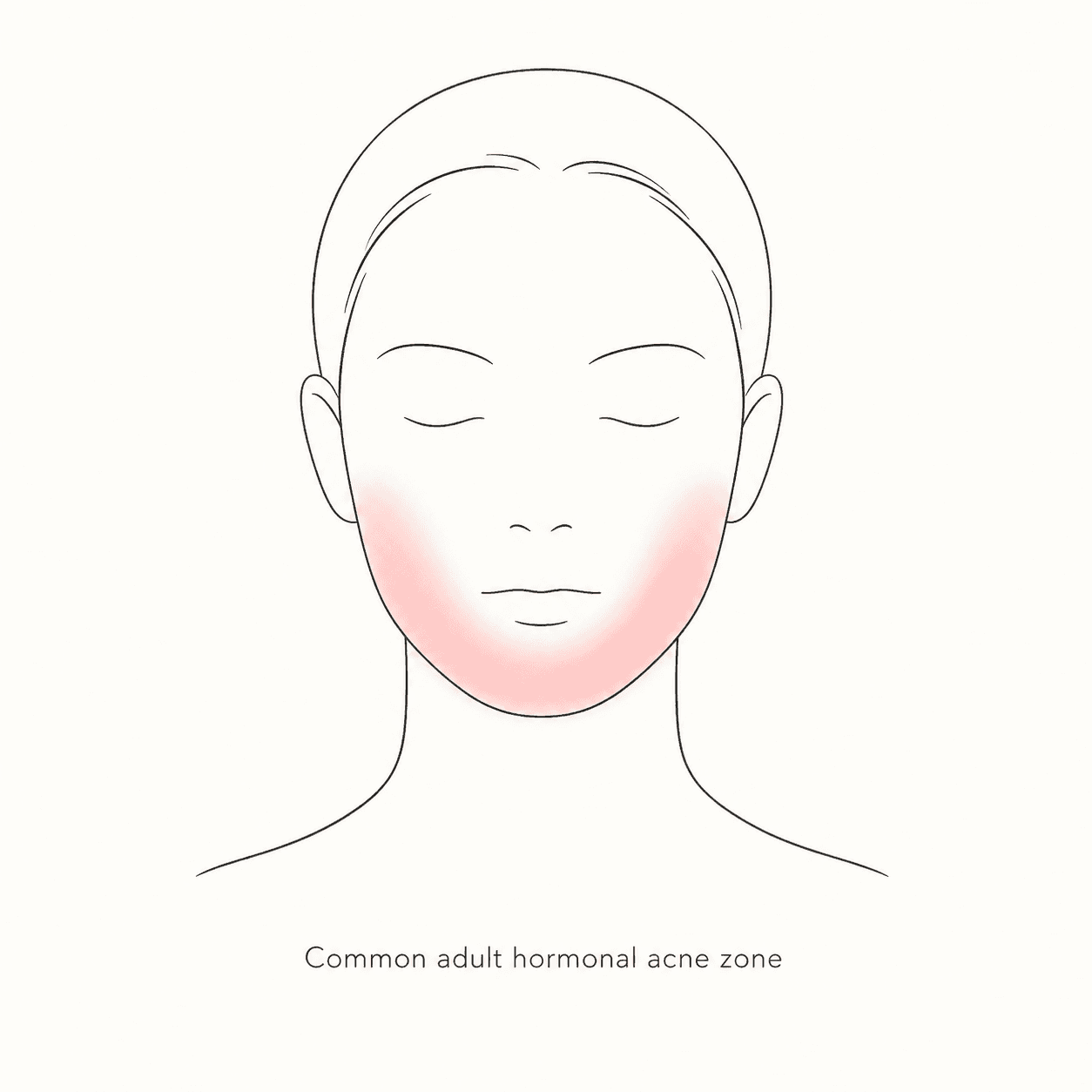
The exact mechanism behind that pattern is still being mapped, but sebocyte research offers a strong candidate. A 2014 study on facial skin found that androgen receptor expression, meaning how strongly a patch of skin responds to hormones like testosterone, differs measurably from one region of the face to another. Skin is not uniformly reactive to the same hormonal signal. That regional unevenness is a plausible reason a hormonal or stress-driven shift would show up as a breakout in one specific area rather than spread evenly across the whole face, even though researchers are still refining exactly which zones respond most, and why.
·2014·Experimental DermatologyHere's what most skincare articles get wrong: they'll tell you flatly that the jawline has more hormone receptors than anywhere else on the face. The honest answer is messier. Some sebocyte research actually places the chin in the same high-reactivity zone as the forehead. What's solidly established is the clinical pattern, not yet the precise cellular map behind it.
Typical teenage acne
- Concentrated on forehead, nose, and upper cheeks
- Often improves by the mid-to-late twenties
- Closely tied to puberty-driven androgen surges
- Responds well to standard over-the-counter treatment
Adult hormonal acne
- Concentrated along the jaw, chin, and lower cheeks
- Frequently begins or worsens in the mid-twenties to thirties
- Tracks with stress cycles and, in women, the menstrual cycle
- Often resistant to treatments that worked in the teenage years
Why You Never Connect the Stress to the Breakout
Sebum doesn't turn into a visible, inflamed bump overnight. Oil has to accumulate, mix with dead skin cells, block the follicle, and then trigger an inflammatory response before anything becomes visible on the surface. That whole sequence takes days. Which means the breakout that shows up on a random Tuesday is very rarely caused by whatever happened on that Tuesday. It's usually the visible tail end of a stressful stretch that already ended, which is exactly why the pattern is so easy to miss.
To test whether this connection was real and not just anecdotal, researchers tracked a group of university students through a period most of them would already describe as stressful: exam season. Acne severity was scored using a standardized clinical scale at multiple points, and researchers separately tracked self-reported stress, sleep, and diet to see which factor actually moved with the breakouts.
Acne severity moved with stress levels, not with diet and not with sleep changes. Stress on its own was enough to make existing acne worse, independent of the other variables competing for blame. For anyone who has ever been told their breakout must be a food they ate or a night they stayed up too late, that finding is worth sitting with.
Your skin isn't reacting to what you ate this week. It's reporting on what your nervous system carried the week before.
For Women, Two Clocks Run at Once
Stress isn't the only hormonal input hitting the jaw and chin. Across the menstrual cycle, androgen levels rise relative to estrogen in the days before a period, independent of stress entirely. That's why breakouts in the same jaw-and-chin zone often cluster in a predictable window before menstruation. When a stressful week happens to overlap with that premenstrual hormonal shift, the two signals stack, which is often why the worst breakouts of the month land during the worst week of the month for two separate physiological reasons that happen to point at the same patch of skin.
What Has Actual Evidence Behind It
None of this means the breakout is untouchable. It means the interventions that work are the ones that interrupt sebum production or follicle blockage rather than the ones aimed at hygiene. A small number of ingredients have direct trial evidence behind them for exactly this mechanism.
Niacinamide
Reduces the rate at which sebaceous glands secrete oil, measured directly as a lowered sebum excretion rate in controlled trials.
- oily and combination skin
- jawline and chin congestion
- use alongside barrier-supporting moisturizers
- already using multiple strong actives that irritate the skin barrier
Salicylic Acid
Penetrates into the oil-filled follicle itself and loosens the mixture of sebum and dead skin cells that blocks it, rather than only exfoliating the surface.
- clogged, congested jaw and chin skin
- recurring closed comedones and small inflamed bumps
- skin barrier is already compromised, dry, or actively irritated
For breakouts that seem clearly hormonal, tied to the cycle or unusually resistant to topical treatment, some research has looked beyond the skin itself, at whether reducing circulating androgens systemically could help. One small controlled trial gave hirsute women spearmint tea twice daily for five days and measured hormone levels before and after.
·2007·Phytotherapy ResearchFree testosterone dropped measurably, from an average of 5.49 to 3.92 picograms per milliliter. That's a real, statistically significant shift, though it's worth being honest about the limits: the study was small, it measured hirsutism rather than acne directly, and it hasn't been replicated at scale. It's a genuinely interesting, low-risk option worth knowing about. It is not a proven acne treatment on its own.
An evening routine built around this specific mechanism
- 1Cleanse
Gentle, low-foam cleanser, once, without scrubbing the jaw and chin harder than the rest of the face
- 2Treat
Salicylic acid leave-on treatment focused on the jaw, chin, and any recurring congestion zones
Wait 10 min before next step - 3Regulate
Niacinamide serum applied to the full face
Wait 5 min before next step - 4Hydrate
Non-comedogenic, ceramide-based moisturizer to protect the barrier the acids are working through
What a realistic timeline looks like
- Week 1-2Expected
No visible change yet. Sebum output is adjusting before anything is visible on the surface.
- Week 3-4Patience
Measurable drop in oiliness through the day. New breakouts may still appear, since existing clogged follicles haven't cycled out yet.
- Week 6-8Visible result
Fewer new breakouts forming. Existing ones fading rather than being replaced.
- Week 10-12Visible result
The jaw-and-chin pattern noticeably thinner, assuming the underlying stress or cycle-driven trigger hasn't intensified.
The jaw and chin aren't unlucky. They're specific. A part of the face built to respond harder to the exact hormonal signal that stress and the menstrual cycle both produce, running its own local version of a system most people assume only exists in the brain. Once that clicks, the breakout stops feeling like a mystery and starts feeling like something with an actual, addressable cause. Not more willpower. Not a cleaner face. Just the right target.
GetClariSync Skin Desk
Editorial Research · Dermatological Science
The GetClariSync Skin Desk reviews research in dermatological science, cosmetic chemistry, and skin biology. We follow journals including the Journal of the American Academy of Dermatology, the British Journal of Dermatology, JAMA Dermatology, and the International Journal of Cosmetic Science. We assess ingredients against clinical evidence rather than marketing claims and we are explicit about the concentration, vehicle, and study quality required for an effect. We are editorial researchers, not board-certified dermatologists — please consult a qualified dermatologist for persistent skin conditions, before starting prescription-strength treatments (e.g. tretinoin), or if you have sensitive or compromised skin.