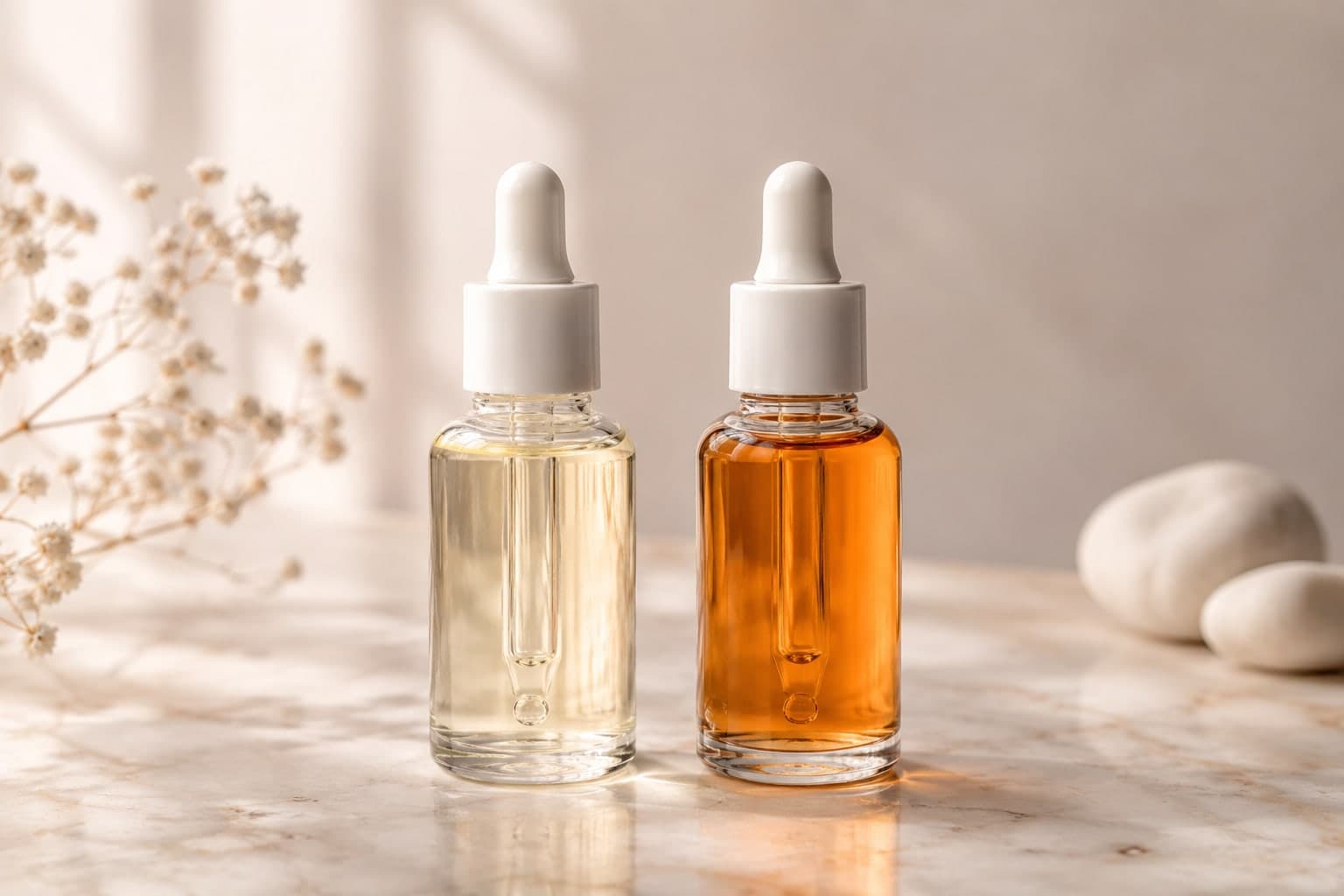
The orange tint in your serum is not a cosmetic change. It is the visible record of a chemical transformation that has already ended the molecule's ability to do its job.
L-ascorbic acid, the active form of vitamin C in most serums, is chemically unstable. It oxidizes on contact with air, light, and trace metals, converting to dehydroascorbic acid, which cannot perform the same biological functions in skin. The pH required to slow this process, below 3.5, creates a direct tradeoff with skin barrier integrity. Stable derivatives like 3-O-ethyl ascorbic acid (EAA) and sodium ascorbyl phosphate (SAP) bypass the problem through different chemistry and do not require acid conditions. Efficacy depends almost entirely on oxidation state at the moment of skin contact, not the concentration number on the packaging.
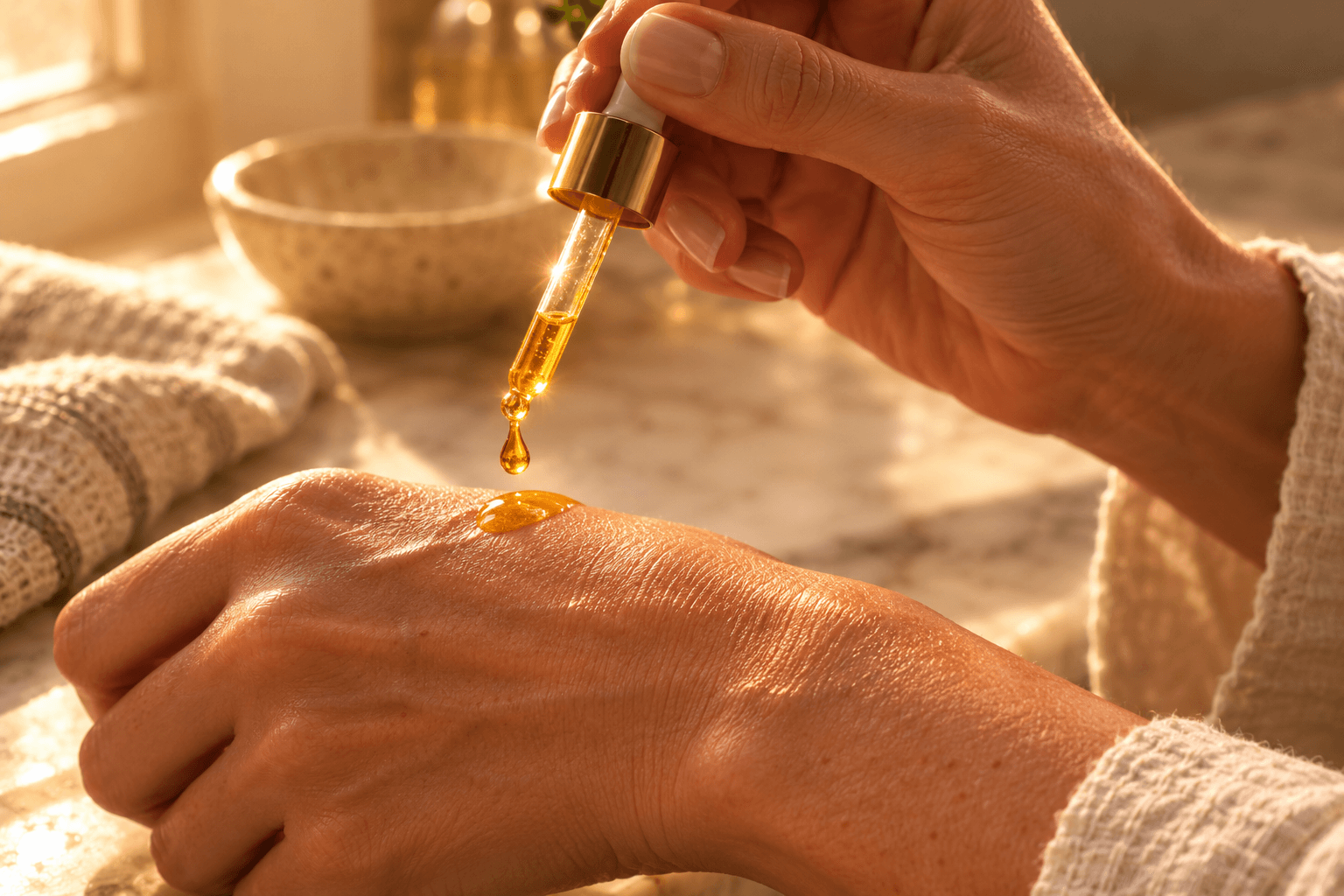
Every vitamin C serum starts active. Most do not stay that way. The color change from pale yellow to orange that appears within weeks of opening is not an aging artifact or a sign of botanical pigment shifting in the formula. It is evidence that the molecule responsible for the product's core claims has been chemically transformed into something that no longer performs the same functions. The industry describes this as oxidation. The biochemistry describes it as the irreversible loss of electron-donating capacity.
What Vitamin C Is Actually Doing in Your Skin
The word antioxidant undersells the role. Vitamin C, specifically L-ascorbic acid, is a cofactor for two enzymes that are structurally required for collagen production: prolyl hydroxylase and lysyl hydroxylase. Without it, newly synthesized procollagen chains cannot be properly hydroxylated. They cannot fold correctly into stable triple-helix structures. They cannot be cross-linked into functional connective tissue. This is not a supplementary benefit. It is a rate-limiting step in the synthesis process.
Prolyl and lysyl hydroxylases require four cofactors: molecular oxygen, alpha-ketoglutarate, ferrous iron (Fe2+), and ascorbic acid. The ascorbate keeps the iron in its reduced Fe2+ state by donating electrons each time the enzyme completes a reaction cycle. When ascorbate is absent or oxidized, the iron converts to Fe3+, the enzyme stalls, and hydroxylation stops. The result is unstable procollagen that cannot be normally secreted. This is the mechanism behind scurvy: not vitamin C deficiency in general, but the specific failure of two hydroxylation enzymes, producing collagen that literally falls apart.
Topically applied vitamin C also inhibits tyrosinase, the enzyme that catalyzes melanin synthesis, by reducing the copper cofactor that tyrosinase requires for activity. This is the mechanism behind its brightening effect on hyperpigmentation and uneven tone. And it regenerates oxidized vitamin E back to its active form in the lipid bilayer, extending antioxidant capacity in the outermost skin layers. Each of these functions depends on the same property: the ability to donate electrons freely. That is precisely what oxidation eliminates.
The Instability Is Not a Formulation Error
L-ascorbic acid oxidizes through a two-step reaction. It first converts to the radical intermediate semidehydroascorbate, then to dehydroascorbic acid (DHA). In living tissue, both steps are reversible through enzymatic recycling. In a serum bottle, without those enzymes, the reaction runs in one direction only. Dissolved oxygen drives it. UV light accelerates it. Trace copper and iron from water or packaging catalyze it. Alkaline pH removes the only meaningful brake. At pH 7, which is close to neutral water, L-ascorbic acid oxidizes almost completely within hours. The molecule is not unstable because of bad manufacturing. It is unstable because of what it is.
“Ascorbate is a powerful reducing agent capable of rapidly scavenging a number of reactive oxygen species. However, in the presence of free metal ions, ascorbate can act as a pro-oxidant, generating reactive oxygen species such as hydroxyl radicals via Fenton-type chemistry.”
A 20% L-ascorbic acid formula at pH 7, stored in a clear bottle on a bathroom shelf, may deliver less active vitamin C after three weeks of use than a freshly opened 5% formula stored correctly. The concentration printed on packaging describes what was in the bottle when it was sealed, not what reaches your skin.
The pH Paradox That Formulation Cannot Fully Solve
Cosmetic chemists have established that L-ascorbic acid is meaningfully stable only below pH 3.5. At that acidity, the oxidation rate slows enough to allow reasonable shelf life in controlled conditions, though not indefinitely and not after opening. The problem is that pH 3.5 is also the threshold at which many skin types begin to show barrier disruption. The stratum corneum maintains its protective lipid matrix at a surface pH between 4.5 and 5.5. Products that consistently acidify the skin surface below this range can gradually erode the lipid structure that holds corneocytes together.
Research on L-ascorbic acid stability consistently shows that meaningful oxidation begins within days of opening under typical consumer conditions: room temperature, repeated air exposure, and indirect light. Formulas designed for stability must operate at pH 3.0 to 3.5. Formulas designed for tolerability move toward pH 4.5 to 5.5, which is more comfortable for most skin but dramatically accelerates oxidation. There is no formulation that solves both problems simultaneously for L-ascorbic acid. Every existing product is a compromise positioned somewhere on that tradeoff.
This is why many users experience tingling, flaking, or sustained redness during early weeks of using a high-potency vitamin C formula. The irritation is not from vitamin C itself. It comes from the pH of the environment required to keep the vitamin C active. The serum is not poorly formulated in the sense of poor intent. It is formulated around a chemistry problem that has no clean solution within the constraints of L-ascorbic acid.
What Oxidized Vitamin C Actually Becomes
Dehydroascorbic acid, the primary oxidation product, can still enter skin cells via glucose transporters and may be partially reduced back to ascorbic acid intracellularly. In fresh dietary contexts this recycling is significant. In a topical formula, the concern is different and more serious. DHA in aqueous solution continues to degrade, hydrolyzing to 2,3-diketogulonic acid, which has no antioxidant function and cannot be recycled by any known skin enzyme. The same research that established vitamin C's antioxidant benefits also documented that under certain conditions, specifically in the presence of free transition metals, oxidized ascorbate can participate in reactions that generate rather than neutralize free radicals.
Trace copper and iron are present in low concentrations in almost every water-based cosmetic formula. They arrive in water used during manufacturing. They leach from packaging over time. They are not a formulation failure but an unavoidable reality. At the concentrations typically present, the pro-oxidant effect is likely small. But the direction is meaningful: an oxidized serum is not simply neutral. In the best case it is inactive. In less favorable conditions it may be working against the reason you applied it.
Active L-ascorbic acid
- Donates electrons to prolyl and lysyl hydroxylases for collagen synthesis
- Reduces copper cofactor, inhibiting tyrosinase and melanin production
- Regenerates oxidized vitamin E in the lipid layer
- Neutralizes hydrogen peroxide and singlet oxygen
- Colorless to very pale yellow in solution
Oxidized (dehydroascorbic acid)
- Cannot function as enzyme cofactor, no collagen synthesis support
- Cannot reduce copper ion, no tyrosinase inhibition
- Cannot recycle vitamin E
- May participate in pro-oxidant reactions in presence of trace metals
- Orange to brown color visible without testing
Why Concentration Is the Wrong Number to Optimize
The range of 15% to 20% became the industry benchmark largely because of a clinical study by Pinnell et al. that demonstrated measurable increases in collagen synthesis with 20% L-ascorbic acid at pH 3.5 over 12 weeks. What that study tested was freshly prepared formula, applied under controlled conditions, at a concentration that was fully active at the moment of contact. The study established an effective concentration range. It did not test what happens to that concentration over the shelf life of a consumer product.
A 20% formula that is half oxidized delivers 10% active vitamin C. A 10% formula with a stable derivative delivers 10% active vitamin C. The numbers converge. But one requires perfect handling from production through to daily use. The other does not. For anyone using their serum over more than four weeks, storing it in a bathroom, or working with clear glass packaging, the percentage on the label is a description of intent more than delivery.
The Derivatives Were Not Created for Marketing
Cosmetic chemists developed vitamin C derivatives specifically because L-ascorbic acid is difficult to work with reliably. Each derivative modifies the molecule at specific positions to slow oxidation, raise the stable pH range, or change the conversion pathway in skin. They are not inferior substitutes positioned at lower price points. Several show comparable or equivalent outcomes in the uses most people care about, with substantially better stability profiles under real-world conditions.
3-O-Ethyl Ascorbic Acid (EAA)
The most stable derivative in common use. An ethyl group is attached at the 3-position of the ascorbic acid molecule, which is the site most vulnerable to oxidation. This modification does not eliminate biological activity: intracellular esterase enzymes cleave the ethyl group after absorption, releasing active ascorbic acid inside keratinocytes. EAA is stable at pH 4 to 7, which means it does not require the acid environment that disrupts the skin barrier. Multiple in vitro and clinical studies support brightening and antioxidant efficacy comparable to L-ascorbic acid, with a stability advantage that is substantial under normal consumer storage conditions.
High impactSodium Ascorbyl Phosphate (SAP)
A phosphate ester that is stable at near-neutral pH, eliminating barrier disruption concerns entirely. Converted to ascorbic acid by phosphatase enzymes present in the epidermis. A 2005 study in the International Journal of Cosmetic Science found SAP effective for acne-prone skin in addition to brightening, likely because of antimicrobial properties specific to the phosphate form. The tolerability profile makes it the most consistent choice for sensitized or compromised barriers. The tradeoff is that conversion to active ascorbic acid is enzyme-dependent and may be slower than EAA conversion.
High impactAscorbyl Glucoside (AA2G)
A glucoside derivative that releases ascorbic acid gradually through glucosidase enzyme activity in skin. Very stable, water-soluble, and gentle enough for reactive or post-procedure skin. The slow-release mechanism means available active concentration at any moment is lower than EAA or SAP conversions. This creates a gentler and more gradual effect, which suits users who have previously experienced irritation from any acid-based formula. Clinical data on collagen synthesis outcomes is thinner than for L-ascorbic acid, but tolerability and stability are well established.
High impact
What This Means for an Actual Routine
The first question is not which vitamin C to buy. It is what your skin barrier is doing right now. A compromised, sensitized, or recently over-exfoliated barrier cannot benefit from a pH 3 formula regardless of concentration. The irritation compounds the exact oxidative stress the vitamin C is supposed to address. Starting with EAA or SAP is not a concession for sensitive skin. For most people, it is simply the choice that maintains barrier function while delivering consistent active vitamin C.
If you are committed to L-ascorbic acid, storage conditions determine whether you are getting real benefit. Room temperature, clear glass, repeated air exposure, and bathroom humidity will oxidize most formulas within three to four weeks of opening. Refrigeration slows the reaction meaningfully. Dark glass or an airtight pump applicator extends the stability window further. The color shift from pale yellow to orange is a visible threshold: beyond it, the active concentration has dropped enough to question whether the formula is doing what it was designed to do.
- Storing an L-ascorbic acid serum in a clear bottle on a bathroom shelf exposed to light, heat, and humidity
- Continuing to use a formula that has turned orange or brown
- Choosing a formula based on concentration percentage without considering pH or derivative form
- Applying an acid-pH vitamin C formula to recently exfoliated, sensitized, or compromised skin
- Assuming a high price guarantees stability — many premium brands still formulate with unstable L-ascorbic acid without sufficient stabilizing technology
“Topical vitamin C has multiple applications in dermatology including photoaging, hyperpigmentation, and melasma. Its clinical utility is however significantly limited by its intrinsic instability in aqueous solution and the requirement for low pH formulations.”
“Sodium ascorbyl phosphate demonstrated significant efficacy in reducing both inflammatory and non-inflammatory acne lesions in clinical evaluation, while maintaining a favorable tolerability profile attributable to its pH-neutral stability characteristics.”
Get weekly skin science from the GetClariSync Skin Desk
Formulation research, ingredient evidence, and skin biology explained clearly. Free, every week.
Subscribe freeGetClariSync Skin Desk
Editorial Research · Dermatological Science
The GetClariSync Skin Desk reviews research in dermatological science, cosmetic chemistry, and skin biology. We follow journals including the Journal of the American Academy of Dermatology, the British Journal of Dermatology, JAMA Dermatology, and the International Journal of Cosmetic Science. We assess ingredients against clinical evidence rather than marketing claims and we are explicit about the concentration, vehicle, and study quality required for an effect. We are editorial researchers, not board-certified dermatologists — please consult a qualified dermatologist for persistent skin conditions, before starting prescription-strength treatments (e.g. tretinoin), or if you have sensitive or compromised skin.