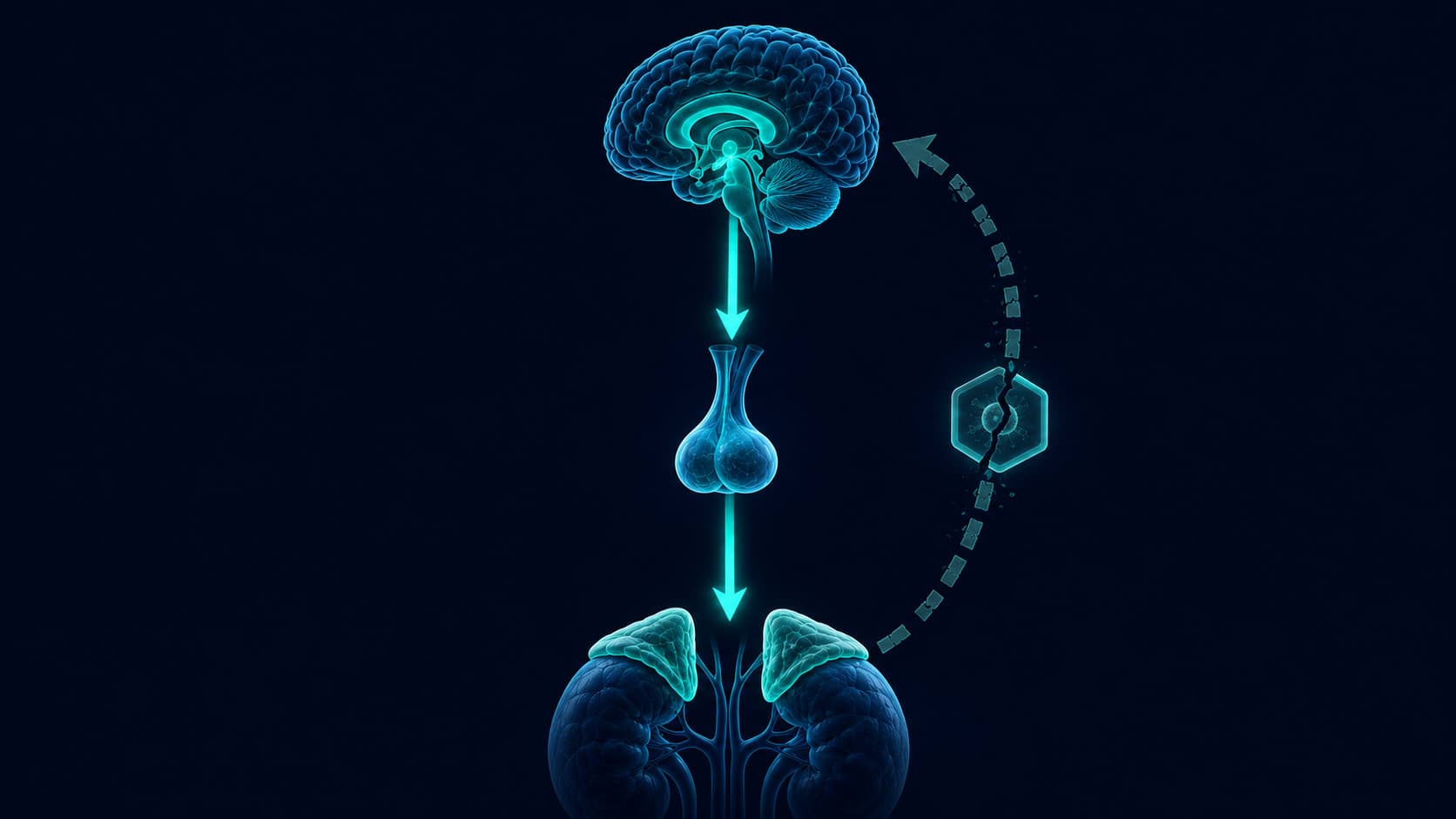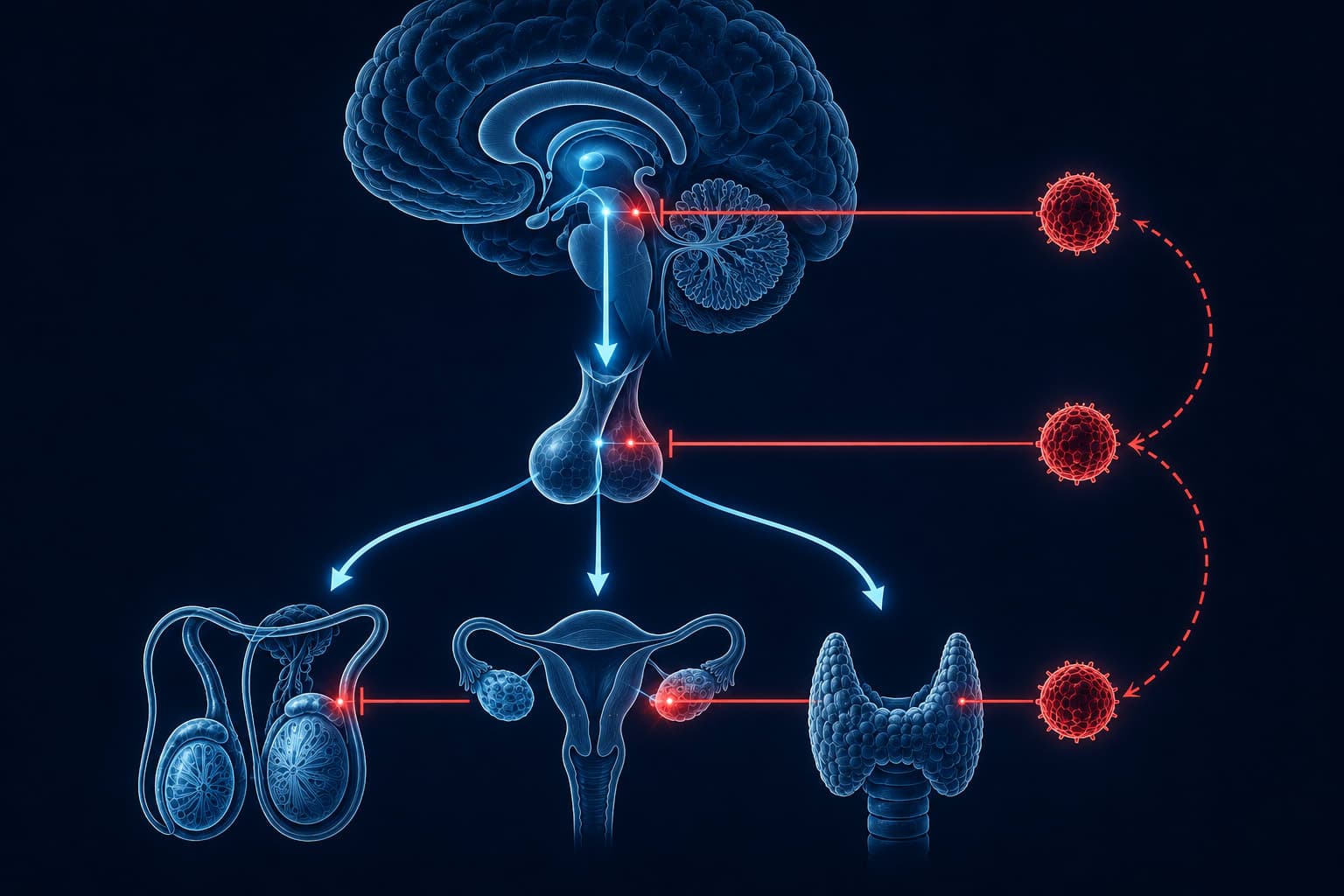
You walked into the room and had no idea why. You re-read the same paragraph three times without the words landing. You said yes to something you meant to think about first. This is not tiredness. This is cortisol doing something structural to your brain.
Chronic cortisol exposure reduces hippocampal volume, impairs prefrontal cortex executive function, and shifts decision-making toward faster, amygdala-driven responses. The hippocampus carries the highest density of glucocorticoid receptors in the brain and is disproportionately affected, producing measurable deficits in memory encoding, working memory, and impulse regulation. Research indicates these structural changes are largely reversible, but only with sustained behavioral intervention — not just temporary stress relief.
The standard explanation for stress-related brain fog is both technically accurate and completely unhelpful: cortisol floods glucocorticoid receptors, function declines, rest more. What that explanation skips entirely is why the fog is so specific. Why names vanish before facts. Why you can execute mechanical tasks but cannot strategize. Why decisions under chronic stress track toward the immediate and the regrettable rather than the deliberate and the patient. These are not random cognitive failures. They are the precise signature of what chronic glucocorticoid exposure does to three brain structures, each with a different receptor profile and a different timeline for damage and recovery.
Cortisol Was Designed to Make You Sharper
Before examining what goes wrong, the mechanism that makes it go wrong deserves credit. Acute cortisol — the kind released in response to a real, immediate threat — does not impair cognition. It enhances it. Selectively and deliberately.
A cortisol surge in response to genuine danger temporarily sharpens attention, accelerates threat detection, and consolidates fear memories with unusual precision. You remember exactly where you were when something frightening happened because cortisol prioritizes that trace. It narrows your attentional field to what matters right now and suppresses processing of everything irrelevant. In an acute emergency, this is flawless engineering. The prefrontal cortex receives a moderate activation boost for rapid decisions. Working memory sharpens for the immediate task.
Neuroscientist Amy Arnsten's research at Yale demonstrated that moderate acute cortisol activates prefrontal cortex circuits, improving focused attention and working memory for immediate challenges. The same PFC circuits are progressively impaired under sustained glucocorticoid exposure — not because the mechanism breaks down, but because chronic activation physically alters the dendritic architecture of prefrontal neurons over weeks and months of continuous signaling.
The problem is that this system was calibrated for threats that end. A predator. A confrontation. A flood. Modern chronic stress — financial pressure, relationship conflict, sustained overwork — never issues an all-clear signal. The cortisol keeps arriving. And what works as a 40-minute sharpening tool becomes a months-long structural remodeling process.
The Hippocampus Pays the Highest Price
The hippocampus is the brain's indexing system for declarative memory: the kind you use to encode new information, navigate, and place events in context. It is also, by a significant margin, the brain region most exposed to glucocorticoids. Hippocampal neurons express a higher density of glucocorticoid receptors than almost any other structure in the brain — a functional design under acute stress, since the hippocampus uses cortisol signals to tag experiences as emotionally significant and sharpen their encoding.
Under sustained cortisol exposure, that receptor density becomes a liability. Glucocorticoids suppress the production of BDNF (brain-derived neurotrophic factor), the protein that supports synaptic plasticity and new dendritic growth. Hippocampal neurons retract their dendritic branches. Neurogenesis in the dentate gyrus, one of the few regions where new neurons continue forming in adults, slows measurably. Over months of chronic elevation, the structure becomes physically smaller.
“Stress hormones profoundly alter synaptic plasticity in the hippocampus. Glucocorticoids suppress long-term potentiation and facilitate long-term depression — effects that collectively impair the hippocampus's capacity to encode new information.”

What Chronic Cortisol Does to Your Prefrontal Cortex
The prefrontal cortex is where the version of you that thinks before acting lives. Working memory, strategic planning, impulse regulation, the ability to weigh long-term consequences against immediate rewards: all of it runs through PFC circuits. It is also the region that takes the longest to mature (not fully developed until the mid-20s) and among the most sensitive to sustained glucocorticoid disruption.
Chronic cortisol does not destroy the PFC. It reorganizes it. The apical dendrites of layer II/III pyramidal neurons in the medial PFC retract under sustained glucocorticoid exposure, reducing the synaptic connections available for complex cognition. The result is precise: reduced working memory capacity, difficulty holding competing ideas simultaneously, measurably increased impulsive responding. Not diffuse mental tiredness. Specific executive function losses tied to specific structural changes.
Acute Cortisol (minutes to hours)
- Focused attention sharpened for immediate threat
- Faster threat detection and response time
- Fear memories encoded with heightened precision
- PFC moderately activated for rapid decision-making
- Irrelevant processing temporarily suppressed
- Working memory boosted for the current demand
Chronic Cortisol (weeks to months)
- Hippocampal dendritic retraction and volume loss
- PFC synaptic density reduced — working memory impaired
- Amygdala reactivity strengthened, PFC control weakened
- New memory encoding disrupted at hippocampal level
- Sleep-dependent memory consolidation compromised
- Decision-making shifts from deliberative to reactive
“Chronic stress causes loss of PFC dendritic spines and reduced functional connectivity, while simultaneously strengthening amygdala-driven responses — shifting behavior from goal-directed and flexible to habitual and automatic.”
The hippocampus and amygdala share direct anatomical connections — and chronic cortisol strengthens one while structurally weakening the other. The amygdala, which processes threat and emotional urgency, actually grows denser dendrites under sustained glucocorticoid exposure. The balance tips: emotional reactivity up, rational deliberation down. This is not a failure of willpower. It is a structural recalibration with measurable anatomical consequences.
Memory Gets Hit Twice
Memory loss under chronic stress is not a single mechanism. The hippocampus is impaired at encoding — it struggles to create strong initial traces of new information. Simultaneously, the sleep disruption that chronic cortisol causes (elevated evening cortisol delays melatonin onset and fragments deep sleep architecture) compromises consolidation: the overnight replay process during which the hippocampus transfers the day's experiences into long-term cortical storage.
Information that was weakly encoded cannot be fully consolidated. You did not just forget it later. The trace was fragile from the moment it formed, and sleep failed to strengthen it. The loss happens at both ends of the memory formation process. This is why stress-related forgetting feels categorical — not 'I remember this vaguely' but 'I have no memory of this at all.'
The cortisol-anxiety loop compounds this further. Elevated cortisol produces hypervigilance and anxious rumination. Anxious rumination activates the stress response. Which elevates cortisol. The feedback cycle runs independently of the original stressor — which is why cognitive symptoms often persist even after the situation that triggered them has resolved.
“Stress-induced elevations of glucocorticoids impair not only the encoding of new memories but also their subsequent retrieval, with the hippocampus most vulnerable to these effects. The cumulative nature of these impairments suggests a dose-response relationship between chronic stress duration and cognitive deficit severity.”

Why You Make Worse Decisions. It Is Not a Character Flaw.
Decision-making under chronic stress degrades in a specific, predictable direction: toward the immediate, the certain, and the emotionally salient. The amygdala processes threat and urgency. It is excellent at fast decisions in dangerous environments. It is poorly suited to evaluating a contract, composing a difficult message, weighing whether to take on more work, or resisting a short-term reward for a long-term gain.
Research documents consistent patterns in people under sustained high cortisol: increased preference for immediate rewards over larger delayed ones, higher risk tolerance for potential gains, reduced capacity to inhibit the first response that arrives. None of this reflects intelligence or values. It reflects which brain circuits are currently structurally equipped to handle the load.
The most important reframe: a brain under chronic stress is not failing. It has reconfigured itself to survive what it models as a sustained threat environment. The problem is that modern chronic stressors — financial anxiety, deadline overload, relationship conflict — do not require survival cognition. They require exactly the deliberate, patient, consequence-weighing thinking that the reconfiguration suppresses.
What the Research Shows Actually Reverses This
The single most consistent finding across the neuroplasticity literature on cortisol and brain structure is that the changes are not permanent. The hippocampus retains the capacity for dendritic recovery and resumed neurogenesis when glucocorticoid patterns change. The PFC shows comparable structural recovery in animal models when sustained stressors are removed and replaced with adaptive behavioral patterns. The brain is not passively damaged by chronic stress. It is actively remodeled. And active remodeling runs in both directions.
Aerobic Exercise — The Most Consistent BDNF Driver
Exercise is the most reliably replicated BDNF-upregulating intervention in the research literature. A 2011 PNAS study (Erickson et al.) found that 12 months of aerobic exercise increased hippocampal volume by approximately 2% in adults, reversing the 1.4% loss recorded in the sedentary control group over the same period. Twenty to thirty minutes of moderate aerobic activity produces acute BDNF increases. The mechanism is not just 'movement reduces stress' — exercise directly stimulates the neurogenic cascade that chronic cortisol suppresses.
High impactSleep Architecture, Not Just Duration
Hippocampal memory consolidation requires adequate slow-wave sleep. Chronic cortisol specifically impairs slow-wave sleep by elevating CRH activity in the evening. Correcting sleep timing (establishing a consistent wake time first, letting sleep time follow) and reducing evening cortisol inputs — bright overhead light after 9 PM, stimulants after noon, high-stakes decisions after 7 PM — rebuilds the consolidation window the hippocampus requires for structural recovery.
High impactReduce Decision Load, Not Decision Effort
When PFC resources are structurally compromised, protecting the decisions that matter requires reducing the decisions that do not. Pre-committing to routines for lower-stakes daily choices — food timing, schedule structure, default social responses — reduces executive function demand while recovery proceeds. This is not about discipline. It is about preserving impaired PFC capacity for deliberate decisions that require it, rather than dispersing it across choices that do not.
High impact“The structural plasticity of the hippocampus, amygdala, and PFC demonstrates both the vulnerability of the brain to chronic stress and its resilience — dendritic recovery and resumed neurogenesis are documented when stressor conditions normalize and adaptive behaviors are consistently introduced.”

The Brain That Chronic Stress Built Is Not the Brain You Are Stuck With
The fog, the forgetting, the decisions you later cannot believe you made: these are not outputs of who you are. They are outputs of a specific biological state with specific structural correlates in three brain regions. The impairment is real. So is the reversibility.
What does not work: trying harder. Effort applied against a structurally compromised PFC is not leverage. It is friction against a circuit that cannot currently perform the function you are demanding of it. What the research consistently supports is pattern intervention: sustained reduction in cortisol chronicity, BDNF upregulation through exercise, sleep architecture restoration. Not perfect execution. A consistent direction, held long enough for the brain's own plasticity to do the rest.
The Cortisol Files continues.
Articles on cortisol and sleep disruption, cortisol and the immune system, and the complete reset protocol — all landing in your inbox the week they publish.
Stay with the seriesGetClariSync Body Desk
Editorial Research · Sports & Movement Science
The GetClariSync Body Desk reviews research in exercise physiology, recovery science, and sports nutrition. We follow journals including Medicine & Science in Sports & Exercise, the Journal of Applied Physiology, the British Journal of Sports Medicine, and the European Journal of Applied Physiology. We separate findings from trained-athlete populations from those relevant to recreational readers, and we flag when transferring a protocol across populations is unsupported. We are editorial researchers, not certified trainers, physiotherapists, or sports physicians — please consult a qualified professional before starting new exercise programs, especially with existing injuries, pregnancy, cardiovascular conditions, or chronic disease.