A study spanning 17 countries and nearly 140,000 people found that how hard you can squeeze predicts how long you'll live better than your blood pressure does. Not a metaphor. An actual measured comparison.
Grip strength, measured with a simple handheld device called a dynamometer, has been shown in large population studies to predict all-cause mortality and cardiovascular death more strongly than systolic blood pressure, one of the most established health markers in medicine. It isn't magic, and squeezing harder doesn't directly cause longer life. Grip strength works as an easily measurable proxy for overall skeletal muscle health and neuromuscular function, which is why the leading European clinical consensus on sarcopenia, age-related muscle loss, recommends it as the primary screening tool. It can be roughly tested at home without special equipment, and it improves most reliably through compound strength training, not by squeezing a hand gripper.
Doctors have measured blood pressure at nearly every checkup for decades, for good reason: it is one of the most reliable, well-validated predictors of cardiovascular risk in modern medicine. So it says something when a much simpler measurement, one that takes ten seconds and requires nothing more sophisticated than squeezing a handheld device, outperformed it.
That comparison did not come from a small pilot study or a wellness influencer's personal theory. It came from one of the largest population health studies ever conducted, and it has quietly reshaped how researchers think about measuring the risk of dying from something other than the disease that eventually gets listed on the certificate.
The Study That Compared Grip Strength to Blood Pressure
Researchers running the Prospective Urban Rural Epidemiology study, a massive international effort tracking health outcomes across dramatically different economies and healthcare systems, set out to test something specific: among a long list of measurements taken at enrollment, which ones actually predicted who would die and from what, over the years that followed.
“Grip strength was inversely associated with all-cause mortality and cardiovascular mortality, and was a stronger predictor of both outcomes than systolic blood pressure, across a cohort of 139,691 participants from 17 countries.”
It is worth being precise about what this does and does not mean. It does not mean weak hands cause death, or that blood pressure stopped mattering. It means that, statistically, grip strength captured something about a person's overall risk that blood pressure alone missed, across an enormous and genuinely diverse population.
Why a Hand Squeeze Predicts So Much
The honest explanation is less dramatic than the headline, and more useful. Grip strength is not a mysterious lever connected directly to lifespan. It functions as a proxy, a stand-in measurement that correlates closely with something much harder to measure directly: the overall health and mass of a person's skeletal muscle, along with how well the nervous system is still able to recruit it.
Think of it like a canary once carried into coal mines. The canary's distress didn't cause the dangerous air. It revealed it early, faster than a miner could sense it directly, because the bird's small body responded to declining air quality before humans noticed anything wrong. Grip strength works similarly. It doesn't cause frailty or muscle loss. It reveals it early, in a measurement that takes seconds, long before someone notices they've become weaker in ways that matter.
Why Doctors Actually Use This Number
This isn't a fact that stayed confined to one large study. A working group of European researchers and clinicians, tasked with formally defining sarcopenia, the age-related loss of muscle mass and function, updated their clinical guidance around this exact measurement.
“Low muscle strength is the primary characteristic used to identify probable sarcopenia, and grip strength is recommended as a practical, low-cost measurement to detect it in both clinical and community settings.”
In other words, this is not a wellness trend borrowing scientific language. It's an actual clinical screening tool, recommended by an international medical consensus, precisely because it's fast, cheap, and closely tracks something that used to require far more complicated testing to detect.
How to Get a Rough Read at Home
A clinical-grade dynamometer isn't sitting in most homes, but two accessible proxies give a reasonable sense of where things stand, and both are worth tracking over time rather than treating as a single verdict.
The dead hang test
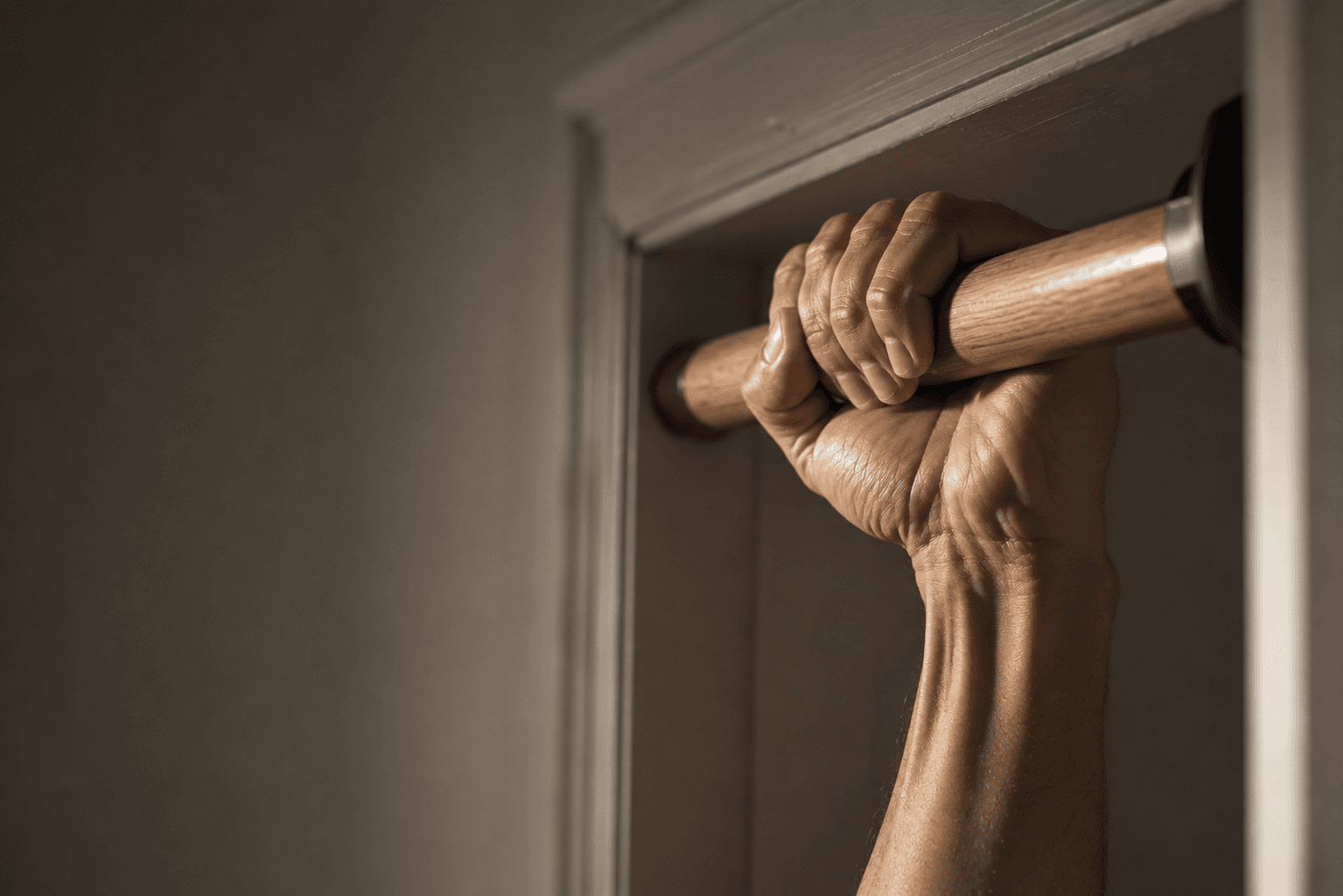
Hang from a sturdy pull-up bar or doorframe pull-up bar with straight arms, feet off the ground, for as long as possible while maintaining good shoulder position. Time it. This tests grip endurance under real bodyweight load, a closer real-world equivalent to what grip strength is protecting against than a quick squeeze test.
High impactThe towel or jar test
Notice how a stubborn jar lid, a tightly wound towel being wrung out, or a heavy grocery bag feels compared to a year ago. These aren't precise measurements, but a clearly noticeable decline in everyday tasks like these is a more honest early signal than most people give it credit for.
High impactWhat Actually Improves It, Not What Most People Assume
The Protocol
Dead hangs, twice a week, building duration over time
Start with whatever duration is currently achievable with good form, even 10 to 15 seconds, and aim to add a small amount of time every week or two. This alone meaningfully improves grip endurance within a few weeks of consistent practice.
High impactFarmer's carries, once or twice a week
Carry a genuinely heavy weight in each hand, a loaded suitcase, filled water jugs, or dumbbells if available, for 30 to 60 seconds of walking. This is one of the most direct ways to train grip endurance under load that mirrors how it's actually used day to day.
High impactLet grip strength ride along with general strength training
Deadlifts, rows, and pull-ups all demand significant grip work as a byproduct. Someone doing regular compound strength training rarely needs a separate grip routine at all, since the hands are already being trained hard as a supporting player in nearly every major lift.
High impactWhen a Weak Grip Signals Something More
A single low reading, especially without a clear point of comparison, isn't a diagnosis. A clear, sustained decline over time, especially alongside other changes, is worth a closer look.
None of this turns grip strength into a diagnosis you can make on your own kitchen floor. It turns it into something worth noticing, an easy, honest check-in that doctors already trust for exactly this reason, available to anyone willing to hang from a bar for a few seconds and pay attention to the number that comes back.
It was never really about the hands. It was always about everything the hands happened to be revealing.
Science-Backed Wellness, Weekly
Research summaries on body science, longevity, and physical performance: the mechanisms most wellness content skips over.
Get the weekly dispatchGetClariSync Body Desk
Editorial Research · Sports & Movement Science
The GetClariSync Body Desk reviews research in exercise physiology, recovery science, and sports nutrition. We follow journals including Medicine & Science in Sports & Exercise, the Journal of Applied Physiology, the British Journal of Sports Medicine, and the European Journal of Applied Physiology. We separate findings from trained-athlete populations from those relevant to recreational readers, and we flag when transferring a protocol across populations is unsupported. We are editorial researchers, not certified trainers, physiotherapists, or sports physicians — please consult a qualified professional before starting new exercise programs, especially with existing injuries, pregnancy, cardiovascular conditions, or chronic disease.