7:12 AM. You reach for the coffee before anything else. Your cortisol has been rising for ninety minutes already. Now it is about to double.
Most breakfasts spike cortisol instead of lowering it. Three simple rules generate every anti-cortisol breakfast that actually works: 25 to 30 grams of protein first, 15 to 20 grams of fat present, eaten within 60 minutes of waking. Below are five recipes that follow all three rules, each ready in under 10 minutes, plus a breakfast builder for improvising your own and the grocery list to prep them for the week. Read this once. Screenshot the list. Change your morning tomorrow.
The morning goes like this. You wake up already tense. You reach for the coffee before anything else. You skip breakfast or grab a banana and a granola bar around ten. By eleven you crash. By two in the afternoon you cannot think. You blame the workload. It is not the workload. It is the fact that your morning breakfast, or the absence of it, has been raising your cortisol for hours while you thought you were being healthy. This article is not another list of cortisol foods. It is the three chemistry rules that decide whether any breakfast raises cortisol or drops it, plus five recipes that follow the rules so you can start tomorrow.
Why breakfast is the biggest cortisol lever you have
Your cortisol runs on a curve. It starts rising three hours before you wake up and peaks 30 to 45 minutes after your eyes open. That surge is called the cortisol awakening response and it exists to get you out of bed. If everything is well timed, it drops back down by mid-morning. What decides whether it drops or stays elevated is what happens in the first hour after waking.
Two morning behaviors keep cortisol elevated when it should be falling. The first is coffee on an empty stomach. Caffeine amplifies your cortisol surge exactly when your body should be starting to lower it. The second is a carb-first breakfast. Toast, oatmeal, cereal, banana, granola. These trigger a fast glucose spike that crashes 60 to 90 minutes later. Your body reads that crash as a stress event and releases more cortisol to raise glucose again. You end up with two cortisol spikes before ten in the morning instead of one clean natural rise and fall.
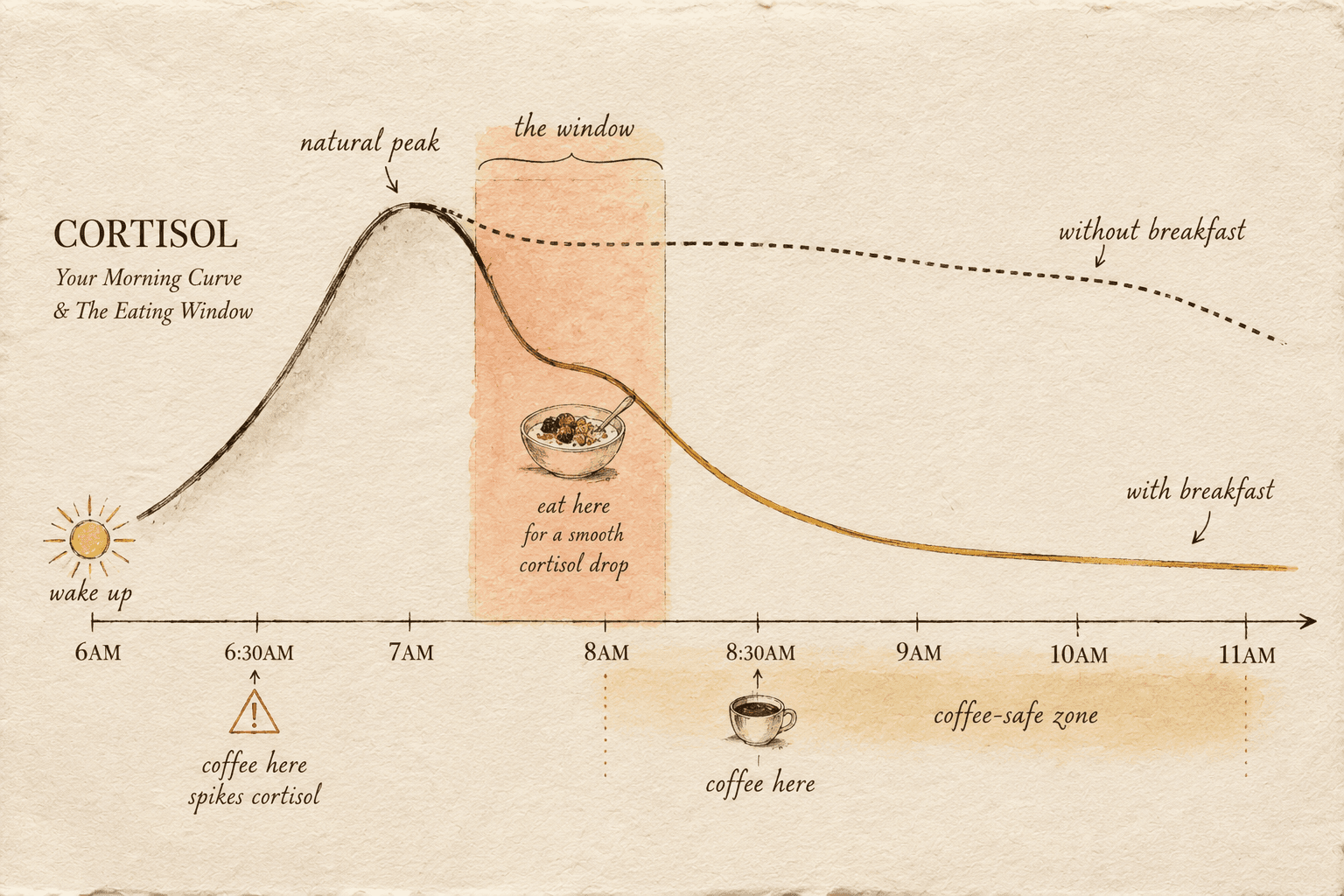
The reason nothing you have tried works is that the popular fixes address the wrong lever. Cortisol tea will not undo a glucose crash. Adrenal cocktails do not slow glucose absorption. Skipping breakfast keeps cortisol elevated longer, not shorter. What actually lowers morning cortisol is the composition of the first meal, and the timing.
You are not eating for hunger. You are eating for cortisol.
The 3 rules that generate every anti-cortisol breakfast
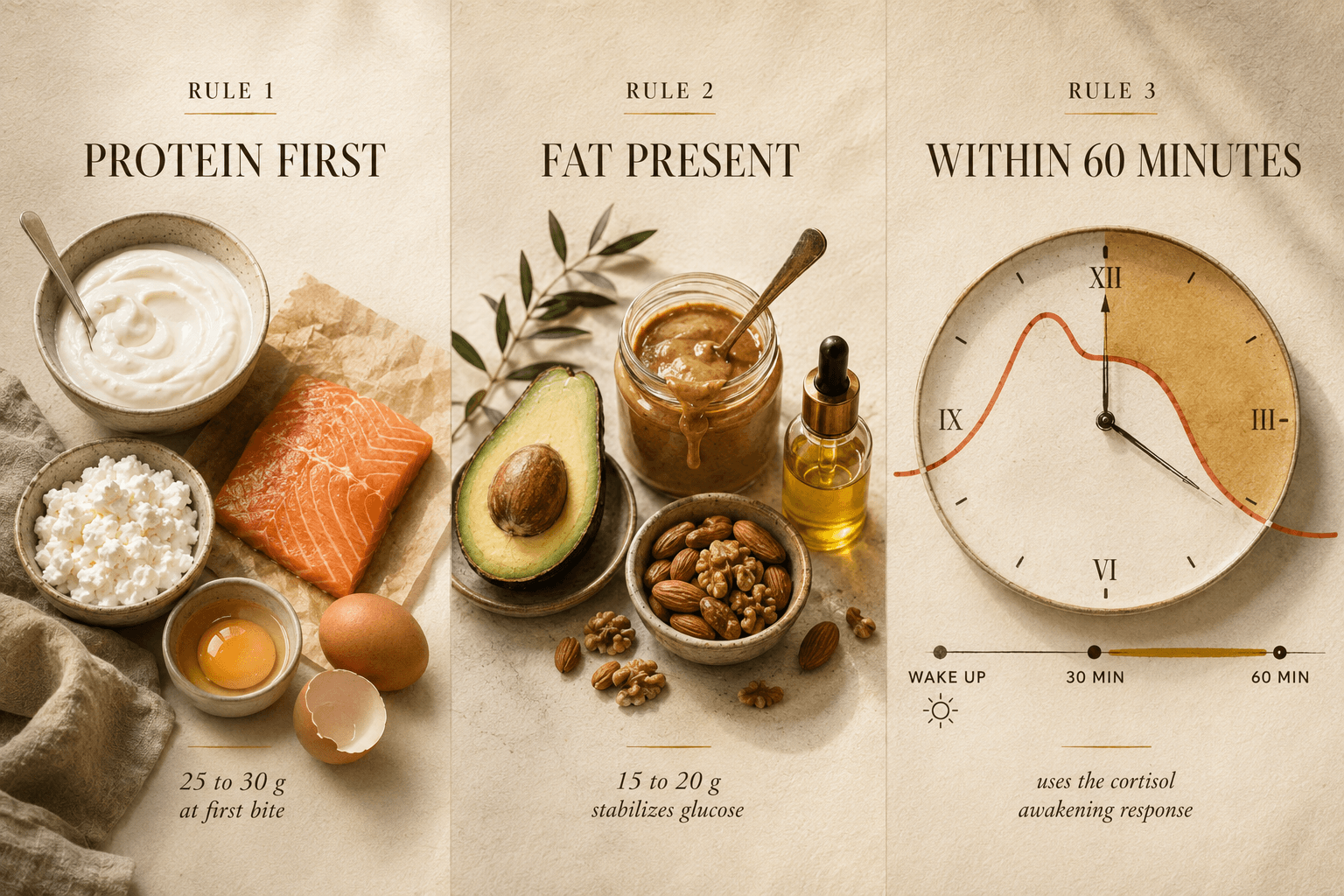
Every anti-cortisol breakfast obeys three chemistry rules. Learn them once and you can walk into any kitchen, look at any set of ingredients, and know whether the meal will raise cortisol or drop it. No memorizing recipes required.
Rule 1. 25 to 30 grams of protein, first bite
Protein triggers the release of satiety hormones and slows carbohydrate absorption. When protein is the first thing your body processes, glucose does not spike as fast, and the reactive dip that would trigger cortisol never fully happens. Twenty grams is the minimum threshold researchers have identified for measurable cortisol reduction. Twenty-five to thirty grams is the sweet spot. Less than fifteen grams behaves as if there is no protein at all in terms of cortisol impact.
Rule 2. 15 to 20 grams of fat, present in the meal
Fat slows glucose delivery into the bloodstream. Even a small amount, 15 to 20 grams, prevents the reactive dip that triggers cortisol release 60 to 90 minutes after eating. This is why avocado toast beats plain toast, why nuts on yogurt beats yogurt alone, why full-fat dairy is often better than fat-free. Fat is not the enemy. Fat is the glucose stabilizer.
Rule 3. Eat within 60 minutes of waking
The natural cortisol awakening response peaks at 30 to 45 minutes after waking. Eating within the following 15 to 30 minutes uses that surge for energy mobilization the way biology intended. Skipping breakfast until 10 or 11 in the morning extends the cortisol peak into a plateau that lasts hours. You feel wired, then crashed. The fix is not more protein. The fix is protein at the right hour.
5 recipes that follow all 3 rules
Each recipe below is labeled by the situation it fits best. Fastest for the 7am rush. Weekend for the sit-down morning. Office for the desk breakfast. Warm for the cooked meal. Prep-ahead for the Sunday night jar. Find the one that fits your Monday, save it, and use it as your default. Every one of them hits all three rules.
The Fastest — Greek Yogurt Cortisol Bowl
Ingredients
- 200 gplain Greek yogurt (2 percent fat, not fat-free)
- 30 gmixed nuts (walnuts, almonds, pistachios)
- 1 tbspchia seeds
- 100 gmixed berries (fresh or frozen)
- 1 tspraw honey (optional)
Steps
- Scoop the yogurt into a bowl.
- Top with nuts, chia seeds, and berries.
- Drizzle honey if you use it.
- Eat within 30 minutes of waking.
Protein: 30 g. Fat: 23 g. Ready in 3 minutes. This is the easiest recipe to start with. Do this one for the first week and see how you feel by Friday.
The Weekend — Salmon and Avocado Sourdough
Ingredients
- 1 slicesourdough bread (thick cut)
- 1/2ripe avocado
- 80 gsmoked salmon or 100 g fresh cooked salmon
- 1soft-boiled or poached egg
- 1 pinchflaky salt, black pepper, lemon zest
Steps
- Toast the sourdough.
- Mash the avocado directly onto the toast.
- Layer the salmon on top.
- Add the egg on top of the salmon.
- Finish with salt, pepper, lemon zest.
Protein: 27 g. Fat: 25 g. This is your Sunday and higher-effort day option. Excellent when you actually want to sit down for breakfast.
The Office — Cottage Cheese, Almond Butter and Apple
Ingredients
- 200 gcottage cheese (2 percent fat)
- 2 tbspalmond butter
- 1apple, sliced
- 1/2 tspcinnamon
Steps
- Scoop the cottage cheese into a container.
- Drop the almond butter on top.
- Arrange the apple slices around the edge.
- Dust with cinnamon. Snap the lid on for the commute.
Protein: 32 g. Fat: 23 g. No cooking. Fits in a container for the car or the office. The travel option.
The Warm — Eggs, Spinach and Feta Scramble
Ingredients
- 3eggs
- 30 gfeta cheese
- 50 gbaby spinach
- 1/2avocado, sliced
- 1 slicesourdough bread, toasted
- 1 tspolive oil
Steps
- Heat olive oil in a pan over medium heat.
- Add spinach, cook until wilted (30 seconds).
- Whisk eggs, pour over spinach.
- Add crumbled feta as eggs start to set.
- Slide onto plate next to sourdough and avocado.
Protein: 31 g. Fat: 37 g (fat runs a bit higher, which is fine). The hot option when you want something warm.
The Prep-Ahead — Overnight Chia Pudding with Almond Butter
Ingredients
- 3 tbspchia seeds
- 250 mlunsweetened almond milk
- 1 scoopvanilla protein powder (whey or plant-based, 20 g protein)
- 2 tbspalmond butter
- 100 gberries
- 1 tspvanilla extract
Steps
- Night before: whisk chia seeds, almond milk, protein powder, vanilla in a jar.
- Refrigerate overnight.
- Morning: top with almond butter and berries.
- Eat straight from the jar.
Protein: 35 g. Fat: 32 g. Make five jars Sunday night. Grab and eat Monday to Friday.
Build your own anti-cortisol breakfast
The five recipes above are examples of the formula. The formula itself lets you build any breakfast around what is in your fridge on a given morning. Use this as your improvisation guide when you want to invent your own.
- 1Pick a protein base — 25 to 30 g Greek yogurt 2 percent (200 g) or cottage cheese 2 percent (200 g) or 3 eggs or smoked salmon (100 g) or a scoop of vanilla protein powder in overnight oats or chia pudding.
- 2Add a fat source — 15 to 20 g Half an avocado, 2 tbsp almond butter or peanut butter, 30 g nuts, 2 tbsp seeds (chia, hemp, flax, pumpkin), or 30 g feta or full-fat cheese.
- 3Add fiber and flavor (optional) Berries, apple, cinnamon, chia seeds sprinkled on top, one slice of sourdough or seeded bread, greens (spinach or arugula), fresh herbs. This step is not required but improves satiety and micronutrient density.
- 4Eat within 60 minutes of waking, coffee after not before If your protein and fat are on the plate and you eat within the window, the meal is anti-cortisol regardless of what else is on it. Coffee 15 to 30 minutes into the meal, or 60 to 90 minutes after waking, avoids the empty-stomach cortisol amplification.
That is the entire formula. Every breakfast on the internet either follows these four steps or breaks one of them. Now you can look at any recipe, any restaurant menu, any pantry, and know instantly whether it will lower or raise your cortisol.
The 3 breakfast mistakes that keep cortisol high
The grocery list (screenshot this)
One grocery run gets you through five days of anti-cortisol breakfasts. Everything below rotates across the five recipes and the breakfast builder. Nothing is exotic. Nothing goes bad in five days.
- 500 g plain Greek yogurt (2 percent fat)
- 500 g cottage cheese (2 percent fat)
- 1 dozen eggs
- 200 g smoked salmon (or 300 g fresh salmon fillets)
- 1 loaf sourdough bread
- 2 to 3 ripe avocados
- 100 g mixed nuts (walnuts, almonds, pistachios)
- 1 jar almond butter
- 200 g chia seeds
- 1 tub feta cheese (150 g)
- 1 bag baby spinach
- 3 to 4 apples
- 500 g mixed berries (fresh or frozen)
- 1 container of vanilla protein powder (if making chia pudding)
- 1 carton unsweetened almond milk (if making chia pudding)
- Cinnamon, olive oil, flaky salt, honey (pantry basics)
When breakfast alone won't fix your cortisol
Anti-cortisol breakfast is the highest-leverage morning intervention you can make. It is not the whole picture. If your cortisol is chronically elevated because of ongoing stress, poor sleep, or hormonal shifts (perimenopause, thyroid issues, ongoing infection), no breakfast will resolve it alone. The breakfast fix works alongside the other levers, not instead of them.
This article is not a substitute for medical care. If breakfast changes do not improve your morning cortisol pattern after 3 to 4 weeks, that is important information to bring to your doctor.
→Related readingThe complete cortisol guide: how chronic stress rewires your bodyWhat actually changes in 2 weeks
Most people who follow the three rules for 14 consecutive days report the same pattern. Morning anxiety drops within the first 5 days. The mid-morning crash disappears by day 7. Afternoon energy stabilizes by day 10. Sleep improves by day 12 to 14 (because morning cortisol regulation and evening cortisol drop are connected in a loop). None of this is dramatic. It is quiet. You notice that mornings feel less desperate. That the coffee no longer feels like survival. That you can think at 11 am without effort.
The best sign that the protocol is working is that you stop needing the second cup of coffee. When the first breakfast covers your energy through 11 am without a crash, you are on the anti-cortisol curve. Keep going.
Anti-cortisol breakfast is not a diet. It is the smallest daily change that pays back the hardest.
One anti-cortisol recipe every Friday morning.
Get the next protocols in this series (evening anti-cortisol dinner, cortisol-friendly snacks, the full weekly grocery framework) direct to your inbox.
Join the newsletterGetClariSync Nutrition Desk
Editorial Research · Nutritional Science
The GetClariSync Nutrition Desk reviews research in nutritional biochemistry, metabolism, and dietary science. We read across the American Journal of Clinical Nutrition, the British Journal of Nutrition, the Journal of Nutrition, Nutrients, and Cochrane Reviews — and we are explicit about what the evidence shows and where it is weak. We do not promote restrictive diets, supplements, or single-food claims unsupported by replicated research. We are editorial researchers, not registered dietitians or physicians — please consult a qualified nutrition professional or your doctor before significant dietary changes, especially if you have a health condition, take medication, are pregnant, or are managing a chronic disease.