
The first cup of coffee felt like rocket fuel. The hands shook a little. The heart sped up. By 10 AM you were tired again, more tired than before the coffee. The drink had not been weaker. The body had been at the wrong end of a curve.
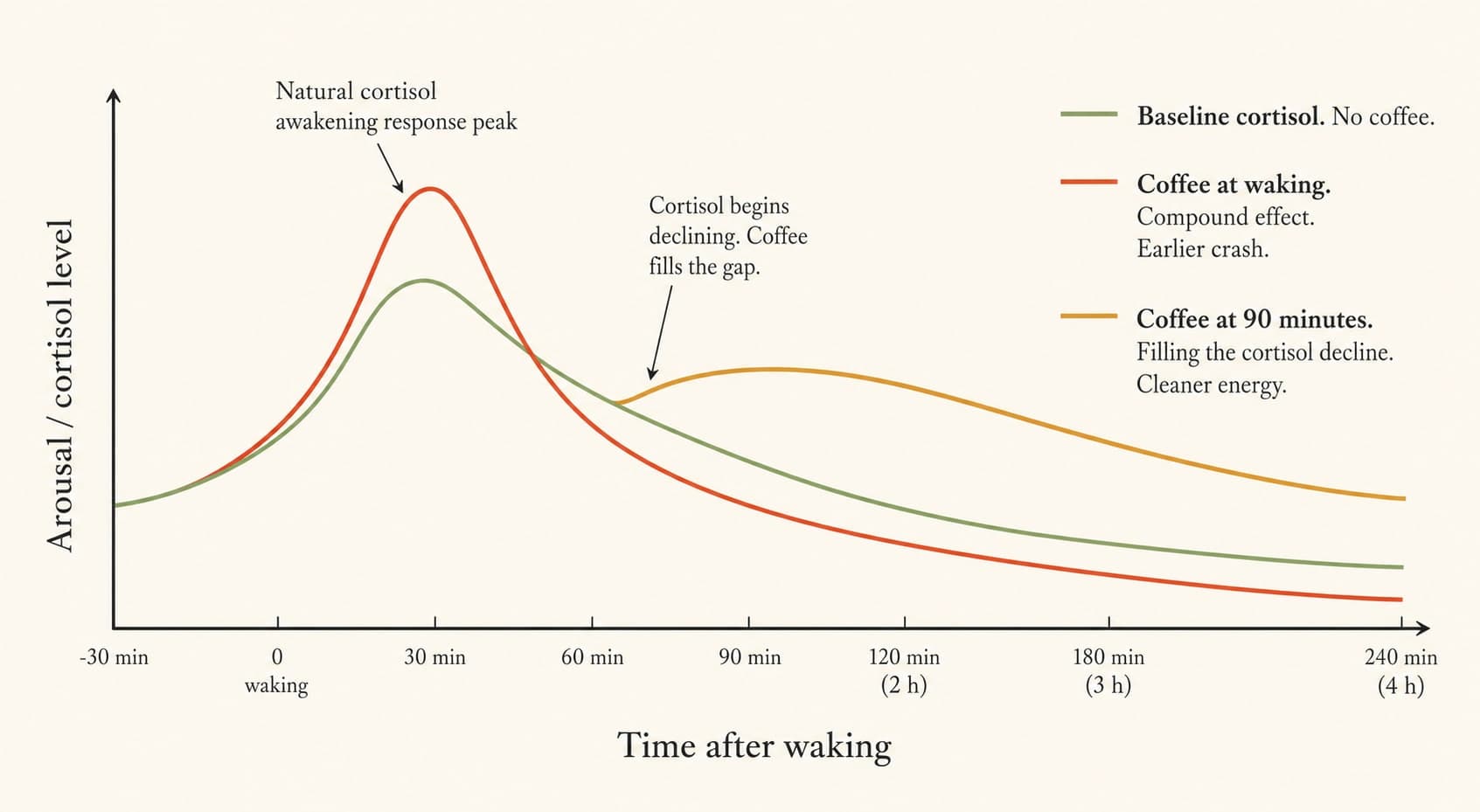
Coffee on an empty stomach first thing in the morning arrives at the worst possible moment biologically. Cortisol, the body's primary arousal hormone, is at its highest point of the day in the thirty to forty-five minutes after you wake. Caffeine layered on top of this peak compounds the effect, often producing the jittery, anxious feeling people associate with strong coffee and the crash that follows. The same coffee consumed sixty to ninety minutes later, when cortisol has begun to decline, feels noticeably cleaner. The drink did not change. The biology underneath it did.
Most people learn this experience without being taught it. The morning coffee, taken immediately after rolling out of bed, hits hard, feels uneven, and is sometimes followed by a crash an hour or two later. The same coffee, taken at the office mid-morning, lands smoothly and lifts your attention without the wobble. The brand was the same. The cup was the same. Something else changed.
What changed was a hormone curve happening underneath the cup. The body's morning chemistry is engineered to be maximally alert in the first hour of waking. Adding caffeine to a system already running at peak is not what most people imagine when they pour the first cup.
What the Body Was Already Doing Before the Coffee
The hour after you wake is a hormonal event. The hypothalamic-pituitary-adrenal axis, which manages the release of stress and arousal hormones, has been quietly preparing for the transition out of sleep for the previous hour. Cortisol levels begin climbing before your eyes open. By thirty to forty-five minutes after waking, cortisol reaches its highest level of the entire twenty-four-hour cycle, a phenomenon called the cortisol awakening response. The hormone is doing the work of switching the body from a sleeping state to a waking one. The brain comes online. The body mobilizes its energy stores. By the time you reach the kitchen, your attention has sharpened. None of this requires coffee.
By around sixty to ninety minutes after waking, cortisol has started declining from its peak. The natural alertness of the early morning begins fading. This is when most people would benefit from caffeine. It is also exactly when most people have already finished their first cup.
What Caffeine Does on Top of Peak Cortisol
Caffeine works by blocking adenosine receptors in the brain, the molecular system that normally slows neural activity as the day progresses. With adenosine blocked, alertness increases and fatigue retreats. The effect is real and well-documented. What is less commonly discussed is that caffeine also has effects on the body's hormone systems, and the size of those effects depends on when in the day it arrives.
A research team studying the interaction between caffeine intake and the body's stress hormone system asked whether caffeine consumed at different times of day produces different cortisol responses, and whether the time-of-day pattern persists in people who drink coffee daily and in those who do not. They measured cortisol output across a group of habitual users and abstainers in multiple morning and afternoon conditions.
“Caffeine produced significant cortisol responses across the day in both abstainers and habitual users, with the largest absolute cortisol elevations occurring during the morning hours when baseline cortisol was already at its diurnal peak.”
What this means in plain terms is that morning coffee adds cortisol to a system already maximally producing cortisol. The two effects stack. The jittery feeling, the slightly anxious edge, the racing heart that some people get from morning coffee but not from afternoon coffee is the body responding to two parallel sources of arousal at once. The same dose at three in the afternoon, when cortisol is much lower, produces a subjectively smoother lift because there is no compounding.
Why Timing Also Affects How the Body Handles Glucose
There is a second piece to the empty-stomach equation. Coffee consumed before breakfast, particularly black coffee on a body that has not eaten in twelve hours, transiently impairs the body's ability to regulate blood glucose. Research published in the British Journal of Nutrition in 2020 measured glucose tolerance in healthy adults who drank strong black coffee before a standardized breakfast versus those who drank water and ate the same breakfast (Smith et al., 2020, DOI: 10.1017/S0007114520002948). The coffee group showed a meaningfully reduced ability to handle the carbohydrate load that followed. The interpretation is that the morning cortisol-plus-caffeine combination puts the body in a brief state of stress-pattern glucose handling, where insulin responsiveness is temporarily blunted.
The effect is modest and short-lived. It is not a reason to stop drinking coffee. It does suggest that pairing morning coffee with food, rather than drinking it on a completely empty stomach, is more compatible with how the body normally regulates fuel in the first hours after waking.
What Happens When You Wait Sixty to Ninety Minutes
The simplest change is timing. Waiting roughly an hour to ninety minutes after waking allows the cortisol awakening response to peak and begin its descent. By the time you reach for coffee, the body's own arousal system has already done most of its morning work and is naturally winding down. Caffeine arriving at this point is not stacking with cortisol. It is filling a gap that the cortisol decline has just opened. The subjective effect is cleaner energy without the jitters, longer-lasting focus, and noticeably less of an afternoon crash.
The other quiet benefit is that the body becomes less tolerant to caffeine when it is not constantly receiving the drug at the worst possible moment. People who shift their first coffee to mid-morning often report needing less caffeine over time to produce the same effect. The receptors are not being asked to work against a hormone they were already doing the job of.
The reason the same coffee feels stronger on a Saturday morning than a Tuesday afternoon is not the coffee. It is the curve of cortisol underneath it. The Saturday cup is climbing on top of a hormone already at peak. The Tuesday cup is filling a quiet space that the morning curve has long since vacated.
The Cup Was Never the Whole Story
What this changes, if you let it, is how you think about your relationship with coffee. The drink was never the whole story. The body was always doing something underneath it. The cup that lands smoothly at ten in the morning and the cup that makes you anxious at seven contain the same caffeine in the same dose. The biology underneath the cup is what shifted.
The next time the first coffee feels too sharp or the crash arrives sooner than expected, it might be worth pausing for a second. Not to give up the cup. To notice when the body is most ready for it. The simplest adjustment is also one of the few in modern life that costs nothing and works almost immediately. Drink the coffee an hour later than you usually do, and see what changes.
Want to understand more about morning biology?
Read our breakdown of the cortisol awakening response and why your body starts preparing to wake an hour before your alarm rings.
Explore Sleep & Hormone ScienceGetClariSync Nutrition Desk
Editorial Research · Nutritional Science
The GetClariSync Nutrition Desk reviews research in nutritional biochemistry, metabolism, and dietary science. We read across the American Journal of Clinical Nutrition, the British Journal of Nutrition, the Journal of Nutrition, Nutrients, and Cochrane Reviews — and we are explicit about what the evidence shows and where it is weak. We do not promote restrictive diets, supplements, or single-food claims unsupported by replicated research. We are editorial researchers, not registered dietitians or physicians — please consult a qualified nutrition professional or your doctor before significant dietary changes, especially if you have a health condition, take medication, are pregnant, or are managing a chronic disease.