
An hour ago you ate something sweet. You felt fine. Now you want sugar again. You did not lose your willpower in that hour. Your glucose dropped below where it was when you started.
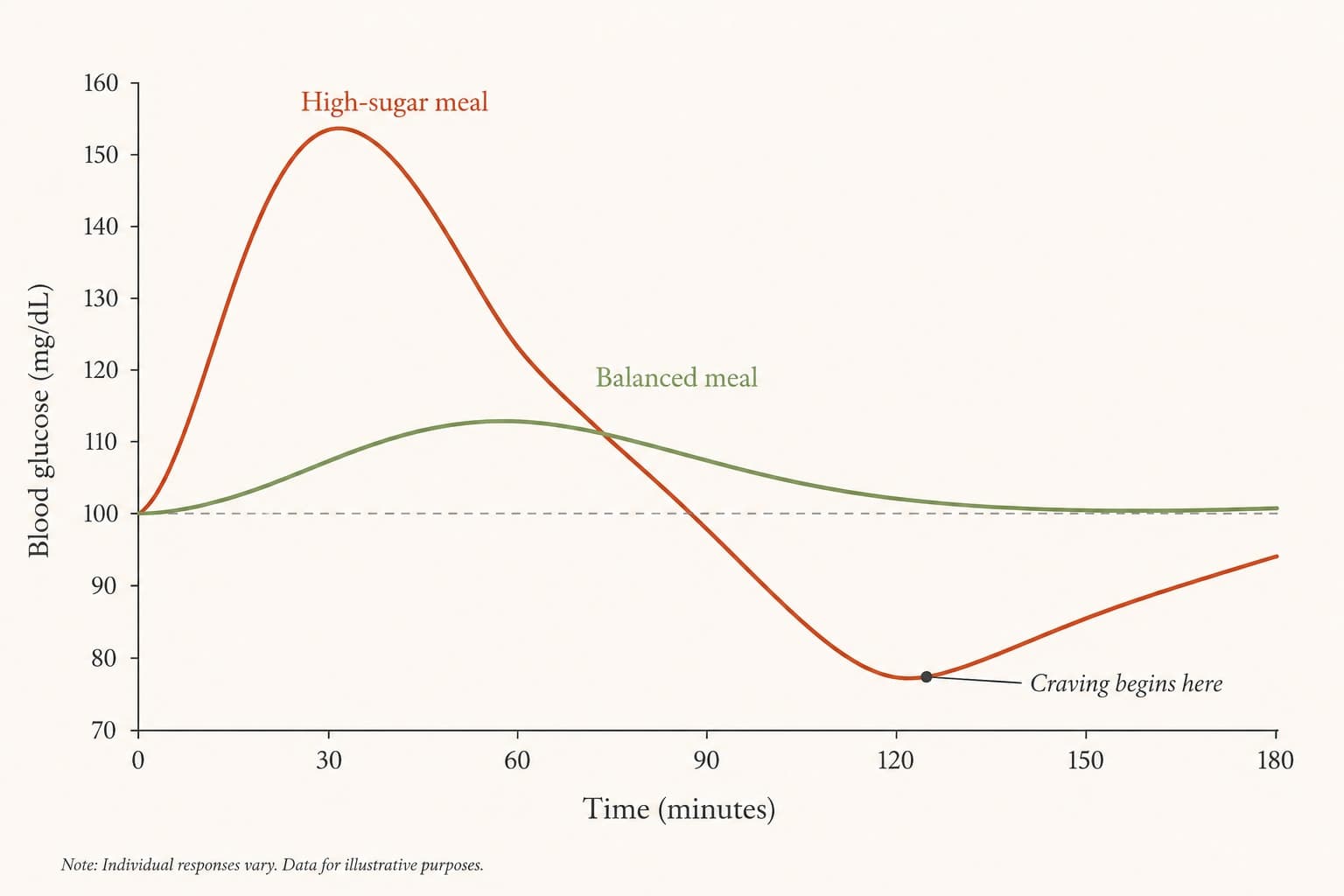
When you eat refined sugar or a high-glycemic carbohydrate, your blood glucose rises quickly and your body releases insulin to bring it back down. The insulin response often overshoots, dragging glucose below its starting level for an hour or more. Your brain reads this dip as a fuel shortage and produces an urgent craving for more of what raised your glucose in the first place. The craving feels like a personal failure. It is actually a metabolic correction signal.
Picture the timeline. At one o'clock you eat a pastry, or a glass of juice, or a handful of candy. By one-fifteen you feel good, settled, focused, the small lift of a quick energy source absorbed into your bloodstream. By two o'clock your concentration drifts. By two-thirty you are tired, slightly irritable, vaguely hungry. By three o'clock you are standing in front of the kitchen wondering what to eat. The thing you want most is more sugar.
None of this is weakness. It is biology. The craving you feel is your blood glucose asking for help.
What Your Body Did With the Sugar
When you eat sugar, especially refined sugar without protein, fat, or fiber to slow it down, the carbohydrate molecules break apart in your small intestine within minutes. Glucose floods into your bloodstream. Your pancreas detects the rising level and releases insulin, a hormone whose job is to escort glucose out of the blood and into your cells where it can be used or stored.
Insulin is precise but not perfect. When the rise is steep, the response is large. Often it is larger than necessary. The result is that thirty to ninety minutes after the meal, more glucose has been pulled out of your blood than the meal originally added. Your blood sugar drops below where it was when you started.
You finish eating. Glucose begins entering the bloodstream within five to ten minutes of swallowing.
Peak blood glucose. The lift you feel is real. Insulin is rising sharply in response.
Insulin overshoots what was needed. Glucose begins falling rapidly.
Blood glucose dips below the level it was at before you ate. The brain detects the shortfall and begins producing hunger and craving signals.
Glucose stabilizes back to baseline if you do not eat. If you eat more sugar, the cycle repeats with a sharper spike.
Each of these stages is happening below your awareness. You feel the result, not the curve. What you feel at three o'clock is not what you ate. It is what your body did with it.
The Dip That Becomes the Craving
What turns the dip into a specific craving for sugar, rather than just generic hunger, is partly metabolic and partly neural. Your brain runs almost entirely on glucose. It does not store fuel. It uses what is in the bloodstream right now. When the level falls below where the brain has settled into expecting, it interprets the drop as a fuel emergency. It releases hormones that drive hunger, including ghrelin, the hormone most associated with the feeling of needing to eat, and it activates reward circuits that pull your attention toward foods that previously delivered fast glucose.
A research team at King's College London set up a study to find out which part of the body's response to a meal best predicts how soon and how much someone wants to eat again. Around a thousand healthy adults wore continuous glucose monitors for two weeks while logging every meal and every episode of hunger or food intake, allowing the team to compare which features of the post-meal glucose curve correlated with what people did next.
“Larger postprandial glucose dips were associated with increased hunger ratings, shorter time until the next meal, and greater energy intake at the subsequent eating episode, with the dip being a stronger predictor of appetite than the size of the initial glucose peak.”
What this tells you, in plain terms, is that the meal you ate is not where the craving started. The craving started two or three hours later, when your glucose dropped further than it should have. The amount you crave at four in the afternoon is correlated less with what you ate at lunch than with how your body handled it.
Why a Dip Feels Like an Emergency
There is an evolutionary reason the system is so aggressive. For most of human history, low blood glucose was a real threat. The brain treated any drop below the expected level as a signal to eat immediately, because for our ancestors the next meal was not guaranteed. The system was built to overreact to a dip, on the principle that overreacting cost nothing and underreacting could be fatal.
What is new in the modern food environment is not the system. It is the food. The system evolved when sweet foods were rare, seasonal, and almost always packaged with fiber inside the fruit they came from. The carbohydrate was slowed down by the fiber matrix, the spike was small, the dip was small. A bowl of berries does not produce the same curve as a pastry. The brain still responds to the dip as if it were dangerous. The food just makes the dip much larger than the brain was ever calibrated for.
What Makes the Crash Smaller
The dip is not inevitable. It is the result of a steep, unaccompanied glucose spike. Anything that makes the spike less steep makes the dip less deep. The simplest interventions are not about cutting sugar. They are about changing what the sugar arrives with.
Protein, fat, and fiber all slow down the rate at which glucose enters the bloodstream. A meal that includes any of the three produces a smaller peak and a smaller subsequent dip than the same amount of carbohydrate eaten alone. The order matters too. Eating fiber or protein first and carbohydrate at the end of the meal lowers the post-meal glucose curve measurably even when the meal is identical in total composition. A pastry on its own is one curve. A pastry after eggs is a different curve. The brain reads the second curve as much less of an emergency.
The amount of sugar in a piece of fruit is not very different from the amount in a piece of candy. What is different is the fiber. The fiber slows absorption enough that the spike and the dip are both small. Same sugar. Different curve. Different craving an hour later.
The Craving Was Never About Sugar
The frame most people carry about sugar cravings is moral. They feel weak when the craving arrives. They make resolutions to be stronger next time. The resolutions usually fail because the system they are fighting against is not their willpower. It is their glucose curve. The craving at four in the afternoon was set in motion by the lunch at one o'clock, and no amount of mental effort at four can undo a dip that is already happening.
What changes things is what arrives with the sugar, what comes before it on the plate, what the meal as a whole does to the curve. The craving is a downstream signal. The signal cannot be argued with. The curve can be designed differently.
Want to understand more about nutrition science?
Read our breakdown of chrononutrition and why when you eat across the day shapes hunger and energy as much as what you eat.
Explore Nutrition ScienceGetClariSync Nutrition Desk
Editorial Research · Nutritional Science
The GetClariSync Nutrition Desk reviews research in nutritional biochemistry, metabolism, and dietary science. We read across the American Journal of Clinical Nutrition, the British Journal of Nutrition, the Journal of Nutrition, Nutrients, and Cochrane Reviews — and we are explicit about what the evidence shows and where it is weak. We do not promote restrictive diets, supplements, or single-food claims unsupported by replicated research. We are editorial researchers, not registered dietitians or physicians — please consult a qualified nutrition professional or your doctor before significant dietary changes, especially if you have a health condition, take medication, are pregnant, or are managing a chronic disease.