You finished the pasta. You said you couldn't eat another bite. The dessert menu came. You read it twice. The room you didn't have for one more bite of pasta is somehow there for chocolate cake. Nothing about you has changed in the last sixty seconds. The food in front of you has.
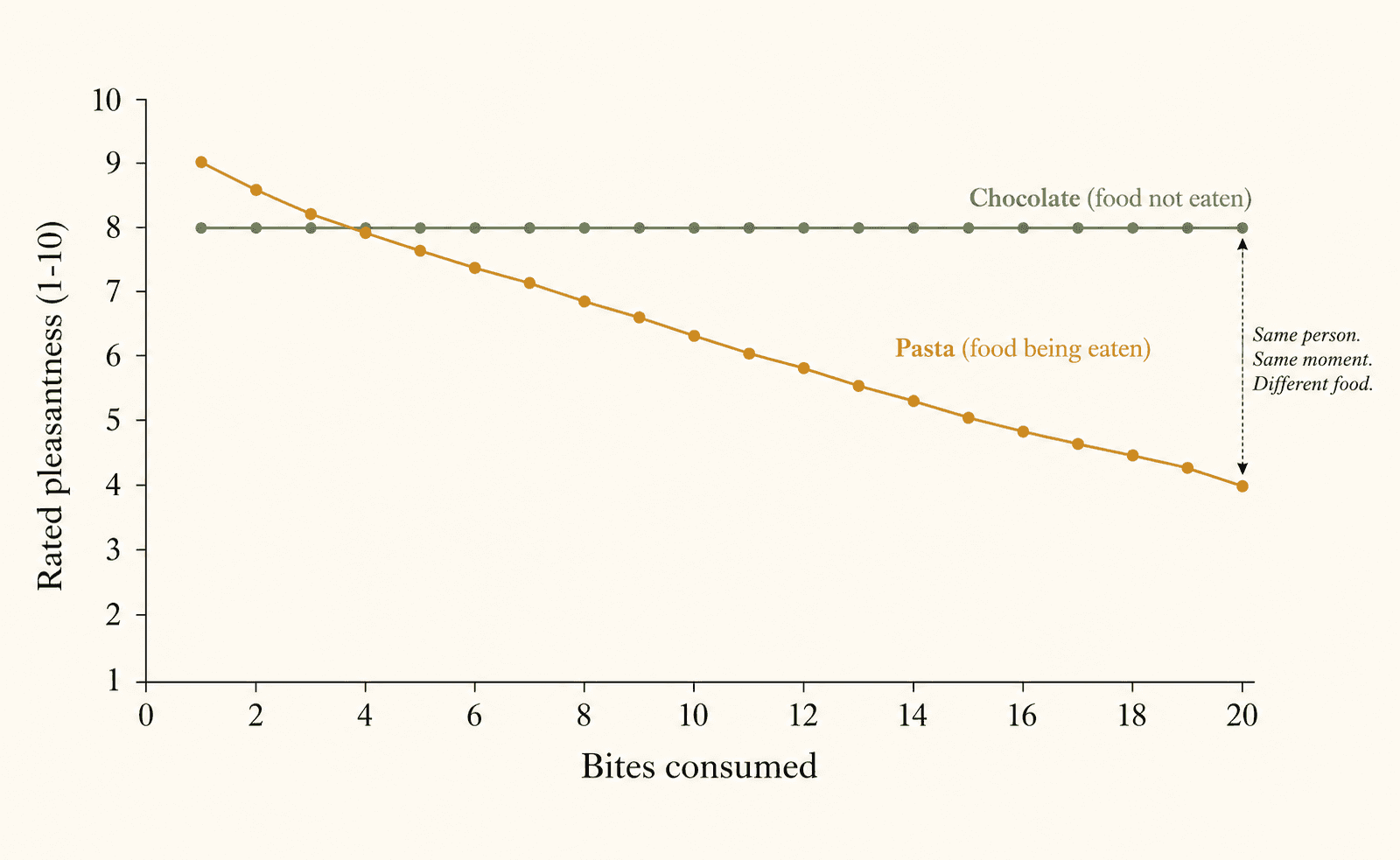
Your brain tracks fullness for each specific food separately, not for food in general. As you eat one thing, the rated pleasantness of that exact food drops with every bite. The pleasantness of foods you have not been eating stays unchanged. By the time you have finished a plate of pasta, you are full of pasta. The brain still has room for chocolate. The phenomenon is called sensory-specific satiety, and it has been measured directly in laboratories since 1981.
It happens at almost every meal. You eat the main course. You feel done. You push the plate away. You announce to yourself or to the table that you couldn't eat another bite. Then someone mentions dessert, or coffee with something sweet, or a small plate of fruit. The next minute you are reaching for it. Not begrudgingly. Genuinely. There is room you did not know was there.
Most people brush this off as a small embarrassment, evidence of weak willpower, or a metaphor about life. It is not any of those. It is a measurable feature of how the brain organizes appetite, and it has had a name in nutritional science for over forty years.
The Pleasantness Drops With Every Bite
Researchers measure this by giving people a small portion of a food, asking them to rate how pleasant it tastes, then letting them eat as much as they want, then asking them to rate the pleasantness again. The same person who rated the first bite of pasta as an eight or a nine out of ten tends to rate the pleasantness of pasta as a four or five at the end of the meal. The food has not changed. The plate has not changed. The brain's response to that specific food has changed.
What is striking is what happens if you offer the same person a different food at the end of the meal. The pleasantness of foods they have not been eating, things like chocolate, fruit, savory crackers, anything sufficiently different from pasta in taste, texture, or temperature, comes back at almost the original rating. The decline was not in general hunger. It was specific to pasta. The brain was full of pasta. It was not full of chocolate.
What the Sensory Labs Have Measured
A research team in Oxford set out in the early 1980s to find out whether appetite is controlled by one general fullness signal or whether the brain tracks the desire for different foods separately. They served participants a meal of one specific food until the participants reported being full, then offered a sequence of different foods and asked them to rate how pleasant each one would be to eat. The team was looking for whether the rated pleasantness would be uniformly low across all foods, suggesting a single fullness signal, or vary by food, suggesting something more specific.
“The pleasantness of the taste of the food that had been eaten to satiety decreased markedly more than that of foods that had not been eaten, demonstrating that satiety is at least partly specific to the sensory properties of the food just consumed.”
What the finding revealed was a distinction nutritional science had been missing. There is a general fullness signal, the one that registers gastric stretch and rising hormones over a meal, but layered on top of it is a second system, much faster and much more selective, that tracks the pleasantness of each food separately. The general signal makes you stop eating in principle. The specific signal makes you stop wanting this particular thing on the plate.
Where This Lives in the Brain
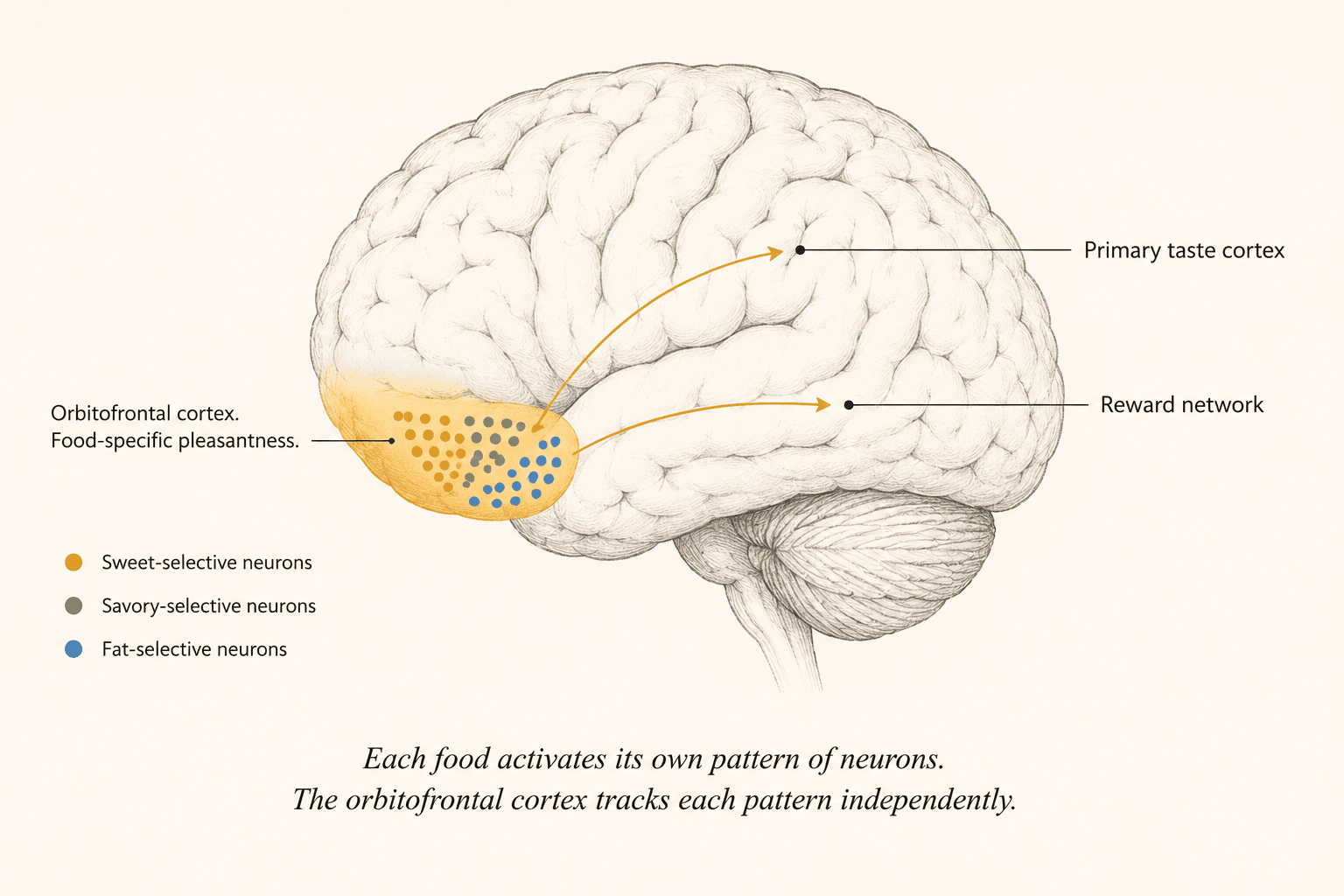
The brain region most responsible for this tracking is the orbitofrontal cortex, a thin sheet of tissue just above the eye sockets that handles the conscious experience of pleasantness, value, and reward. When neuroscientists record activity in this region during a meal, they can watch the response to a specific food decline as the meal progresses while the response to other foods stays intact. The orbitofrontal cortex is not running one signal for hunger. It is running many signals, one for each kind of food it can recognize.
This is why dessert always has room. The orbitofrontal cortex has not yet adapted to dessert. The neurons that respond specifically to the taste of sweet, the texture of soft, the temperature of cool or warm depending on the dessert in question, are still firing at full strength. They have nothing to do with the neurons that were responding to the savory main course. The brain has effectively cleared one menu and opened another.
Why the System Was Built This Way
There is a useful logic to this. No single food contains every nutrient a body needs. The hunter-gatherer who ate only berries was missing protein. The one who ate only meat was missing the vitamins in plants. The brain's solution was to make eating more of the same thing feel rapidly less rewarding while keeping the appetite for different things intact. The system is a quiet pressure toward dietary variety. Eat enough of one thing, and the brain begins to ask for something else.
If the modern food environment did not exist, this would be one of the brain's quietly elegant systems. It would push the diet toward whatever it lacked, taste by taste, until the day's nutrition was balanced without anyone having to think about it.
What the System Does in a Modern Food Environment
The same system that pushes toward dietary variety in nature pushes toward overeating in a food environment built around constant variety. A meal of one thing makes you full of one thing. A meal of many things resets the satiety signal each time you encounter something new. Variety quietly extends how much you eat without registering as eating more.
- Buffets where many distinct dishes are accessible at the same time
- Tasting menus where each course is small but sensorially different
- Snack platters with varied textures, flavors, and temperatures
- Holiday tables where multiple desserts are present at once
- Movie pairings that combine multiple distinct snack types (sweet, salty, fizzy) together
What Tends to Help
Reducing the variety of a single meal is the most direct intervention. A meal of fewer distinct foods registers as fuller more quickly than the same total calories spread across many. This is not about restricting food. It is about reducing the number of separate satiety signals that need to be triggered before the meal ends.
Slowing down between courses also helps. The general fullness signal takes about twenty minutes to fully register. If a meal serves several small courses across two hours, the gastric signal has plenty of time to land. If the same meal arrives as one large plate, the signal lands before you can finish, and the meal ends sooner with less eaten. The variety system does not override the general fullness signal. It runs underneath it. Giving the general signal time to catch up changes the math at the table.
An Old System Running in a New Kitchen
There is something almost generous in what the brain is doing when it makes room for dessert. It is not betraying you. It is doing what it has always done: keeping its options open in case the day's food had only delivered one nutrient, and the next bite might deliver the others. The system was designed for a world where variety was rare and slowly earned. It runs the same way in a world where variety is constant and the chocolate cake is two feet from the pasta.
The next time you finish a meal and somehow have room for dessert, it might be worth pausing for a second. Not to judge yourself. To notice what the brain is actually doing. It is running a quiet nutritional audit, checking that the meal contained enough kinds of things. The audit is mostly wrong about your needs in a modern grocery store. But it is doing its job.
Want to understand more about how appetite works?
Read our breakdown of why sugar cravings start hours after a meal, and what the glucose dip is asking your brain to do.
Explore Nutrition ScienceGetClariSync Nutrition Desk
Editorial Research · Nutritional Science
The GetClariSync Nutrition Desk reviews research in nutritional biochemistry, metabolism, and dietary science. We read across the American Journal of Clinical Nutrition, the British Journal of Nutrition, the Journal of Nutrition, Nutrients, and Cochrane Reviews — and we are explicit about what the evidence shows and where it is weak. We do not promote restrictive diets, supplements, or single-food claims unsupported by replicated research. We are editorial researchers, not registered dietitians or physicians — please consult a qualified nutrition professional or your doctor before significant dietary changes, especially if you have a health condition, take medication, are pregnant, or are managing a chronic disease.