Fly from New York to Paris and most people feel roughly normal by day three. Fly home from Paris to New York, cross the exact same six time zones, and the drag can stretch a full week or more. Same distance. Same number of zones. Completely different bill. If jet lag were only about how far you traveled, that asymmetry wouldn't exist. It isn't about distance. It's about direction.
Your Internal Clock Runs Slightly Long
Left alone in a room with no clocks, no windows, and no cues about what time it actually is, the human body doesn't settle into a tidy 24-hour rhythm. It runs on its own internal length, and researchers have measured that length with extraordinary precision using exactly this kind of controlled isolation.
The average came out to roughly 24 hours and 11 minutes, consistently longer than an actual day. Left to drift on its own, without morning light resetting it, your body's natural instinct is to go to bed a little later and wake up a little later, day after day. That small, built-in lean toward later is the entire reason one direction of travel feels so much worse than the other.
Why West Is a Delay and East Is a Fight
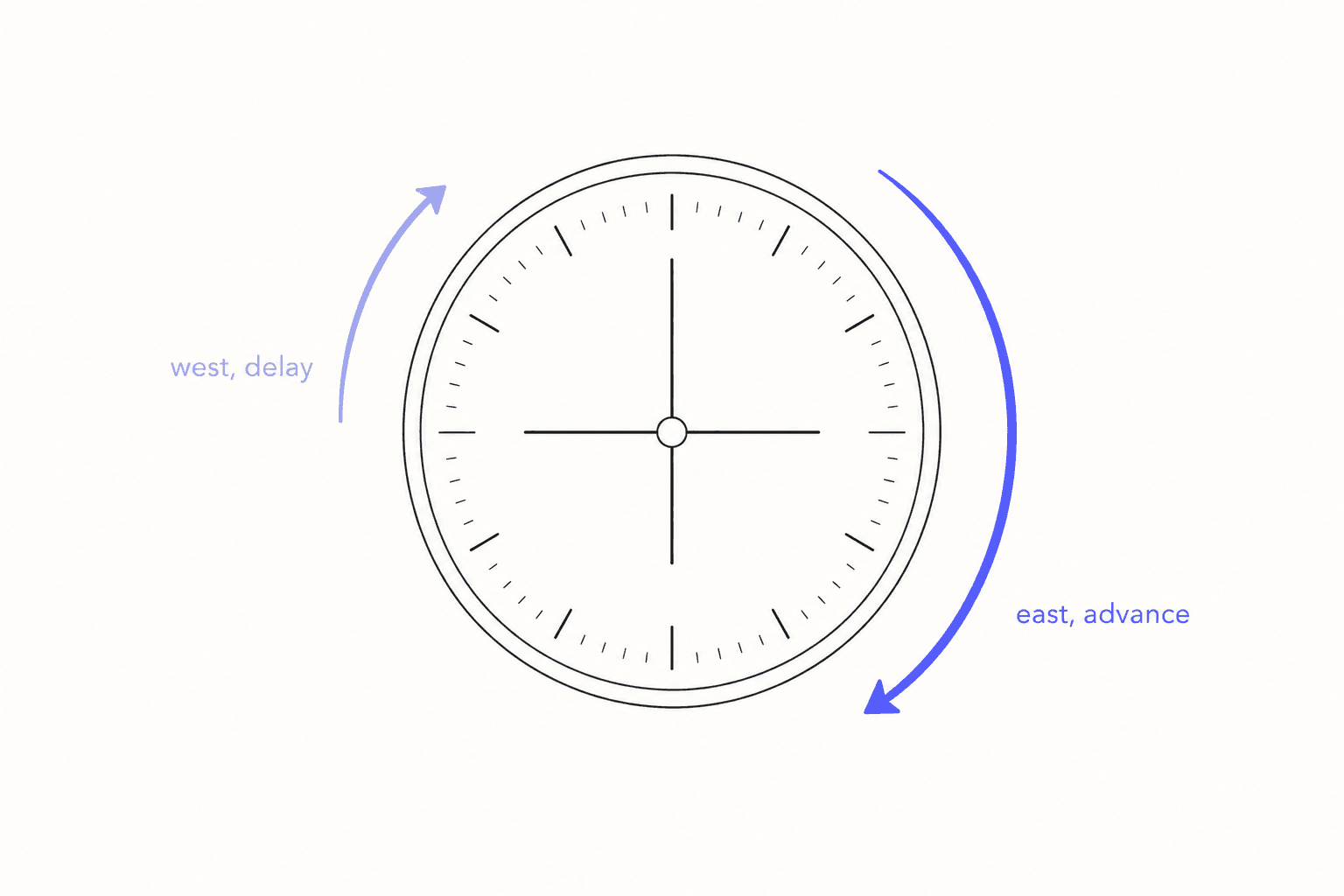
Fly west and the days on your trip effectively lengthen: your body needs to stay up later and wake up later to match local time, which is exactly the direction your internal clock already wants to drift on its own. You're not fighting your biology. You're being gently pushed along with it.
Fly east and the opposite happens. The days shorten. Your body has to fall asleep earlier and wake up earlier than it naturally wants to, forcing the clock to move in the one direction it resists hardest. That single structural difference, delay versus advance, is why the return flight home so often costs more than the flight out.
Westward travel (phase delay)
- Local days feel effectively longer
- Works with your clock's natural drift toward later
- Adjustment typically feels faster and less severe
- Evening light exposure generally helps
Eastward travel (phase advance)
- Local days feel effectively shorter
- Works against your clock's natural drift
- Adjustment typically takes longer and hits harder
- Morning light and pre-flight prep matter far more
The Protocol Before You Even Leave
Because eastward travel is the harder direction, it's also the one where preparing before departure actually changes the outcome. Researchers tested whether a few days of gradually shifting sleep and light exposure before an eastward flight could get the body partway adjusted before the plane even took off.
Shifting sleep and wake times earlier by about an hour a day for three days before departure, combined with bright light exposure right after the new, earlier wake time, measurably advanced participants' internal clocks before they ever boarded. Arriving partly pre-adjusted is a meaningfully different starting point than arriving with a clock that hasn't moved at all.
| Day before an eastward flight | Wake and sleep shift | Light action |
|---|---|---|
| 3 days out | Wake and sleep 1 hour earlier than usual | Bright light (outdoors or a light box) right after waking |
| 2 days out | Wake and sleep 1 more hour earlier | Same morning light exposure, avoid bright light in the evening |
| 1 day out | Wake and sleep 1 more hour earlier | Morning light again, start shifting meal times earlier too |
What Actually Helps Once You've Landed
Landing day checklist, eastward arrival
- 1Light
Get outside within the first hour of local daylight. Skip sunglasses if the light is tolerable.
- 2Caffeine
One normal dose before early afternoon, none after, so it doesn't compound with an already strained clock.
- 3Meals
Eat breakfast and dinner at local times even without appetite. Meal timing is a secondary cue your clock reads.
- 4Movement
A short outdoor walk beats a nap if you're fighting to stay awake until local bedtime.
Landing day checklist, westward arrival
- 1Light
Get some afternoon and evening light rather than rushing indoors, it reinforces the later local bedtime.
- 2Caffeine
Fine earlier in the day. Cut it off by mid-afternoon local time to protect the new, later bedtime.
- 3Meals
Push dinner to the local evening time rather than eating on your home schedule.
- 4Movement
Stay upright and active through the local evening rather than giving in to an early nap.
Where Melatonin Actually Fits
A systematic review pooled ten controlled trials testing melatonin against placebo for jet lag, specifically looking at flights crossing five or more time zones, to see whether the supplement's reputation held up under actual comparison.
Eight of the ten trials found a real reduction in jet lag, specifically when melatonin was taken close to the target bedtime at the destination, roughly 10pm to midnight local time, not on the plane and not on home-country time. The effect was strongest for eastward travel across five or more zones, which lines up exactly with the direction that needs the most help re-entraining.
·2009·Sleep Medicine ClinicsA Realistic Timeline
What to actually expect, direction by direction
- Westward, days 1-3Expected
Most people feel close to normal within the first few days, since the clock is drifting in its natural direction.
- Eastward, days 1-3Expected
Expect the hardest stretch here. Mornings feel like the middle of the night and evenings fight you to stay awake.
- Eastward, days 4-6Patience
With consistent morning light and correctly timed melatonin, most of the advance has usually caught up.
- Either direction, after day 7Visible result
Lingering fatigue past this point is more often ordinary travel tiredness than an unresolved circadian shift.
This is also why a long weekend in Tokyo can leave you dragging well past the following Wednesday back home, while the outbound flight barely registered. Same number of zones crossed both ways. The only thing that changed was which direction your clock had to move, and your clock has a strong, built-in opinion about which direction is easier.
None of this is a reason to dread travel. It's a reason to stop applying the same generic advice regardless of which way the plane is flying. West asks very little of you. East asks for a plan, made before you leave rather than after you land, and that plan is the entire difference between a rough first day and a rough first week.
GetClariSync Sleep Desk
Editorial Research · Sleep Science
The GetClariSync Sleep Desk reviews peer-reviewed research in sleep science, chronobiology, and circadian medicine. We focus on journals indexed in PubMed — including Sleep, Sleep Medicine Reviews, Nature Communications, the Journal of Sleep Research, and the Journal of Clinical Sleep Medicine. Each article cites its primary sources, distinguishes correlational findings from causal evidence, and is reviewed for accuracy before publication. We update articles when stronger evidence emerges and post a correction note when we change a substantive claim. We are editorial researchers, not clinicians — for medical concerns, sleep disorders, or persistent insomnia please consult a board-certified sleep physician or your primary care provider.