It happens fast. A tone in a message. A comment from someone. A silence. Now your chest is tight, your thoughts are looping, and mindfulness advice sounds like an insult.
Anxiety in the moment is not a thinking problem. It is a vagus nerve state. The vagus nerve is the longest cranial nerve in your body, and it decides in the background whether you feel safe or threatened. When it is stuck in a defensive mode, no gratitude list or mindset shift changes the physical experience. The 5 techniques below activate the vagus nerve directly through mechanisms researchers have mapped since Porges published polyvagal theory in 1994. Each takes under 3 minutes. Each is matched to a different anxious state (panic, wired, numb, overwhelmed). Read this once. Save it. Use it the next time your body flips into a state your thoughts cannot reach.
You have been told to breathe deeper. To meditate. To sit with your feelings. To journal. None of it stopped the physical experience when it was happening. You know because you tried. What no one told you is that most acute anxiety in modern life is not caused by thoughts. It is caused by your autonomic nervous system slipping into a defensive mode and getting stuck there. The thoughts come after. The physical feeling comes first. This article is about the mechanism that decides whether you feel safe or threatened, and about the five techniques that reset it more reliably than any mindset intervention because they speak the language your body is actually using.
What the vagus nerve actually is
The vagus nerve is the longest cranial nerve in your body. It runs from the base of your brainstem down through your neck, chest, and abdomen, connecting to your heart, lungs, throat, and gut. It carries information in both directions. Roughly 80 percent of the fibers are afferent, meaning they carry signals from your body up to your brain, telling your brain what your body is experiencing. Only 20 percent are efferent, carrying signals from brain to body.
This ratio is the reason your anxiety in the moment is not primarily cognitive. Your body decides whether you feel safe or threatened based on inputs it receives from your organs, your breath, your heart rate, your muscle tone, and it sends that assessment up to your brain. Your brain then generates the thoughts to match. You are not anxious because you thought yourself into it. Your body reported a threat state to your brain, and your thoughts arrived afterward to explain why.
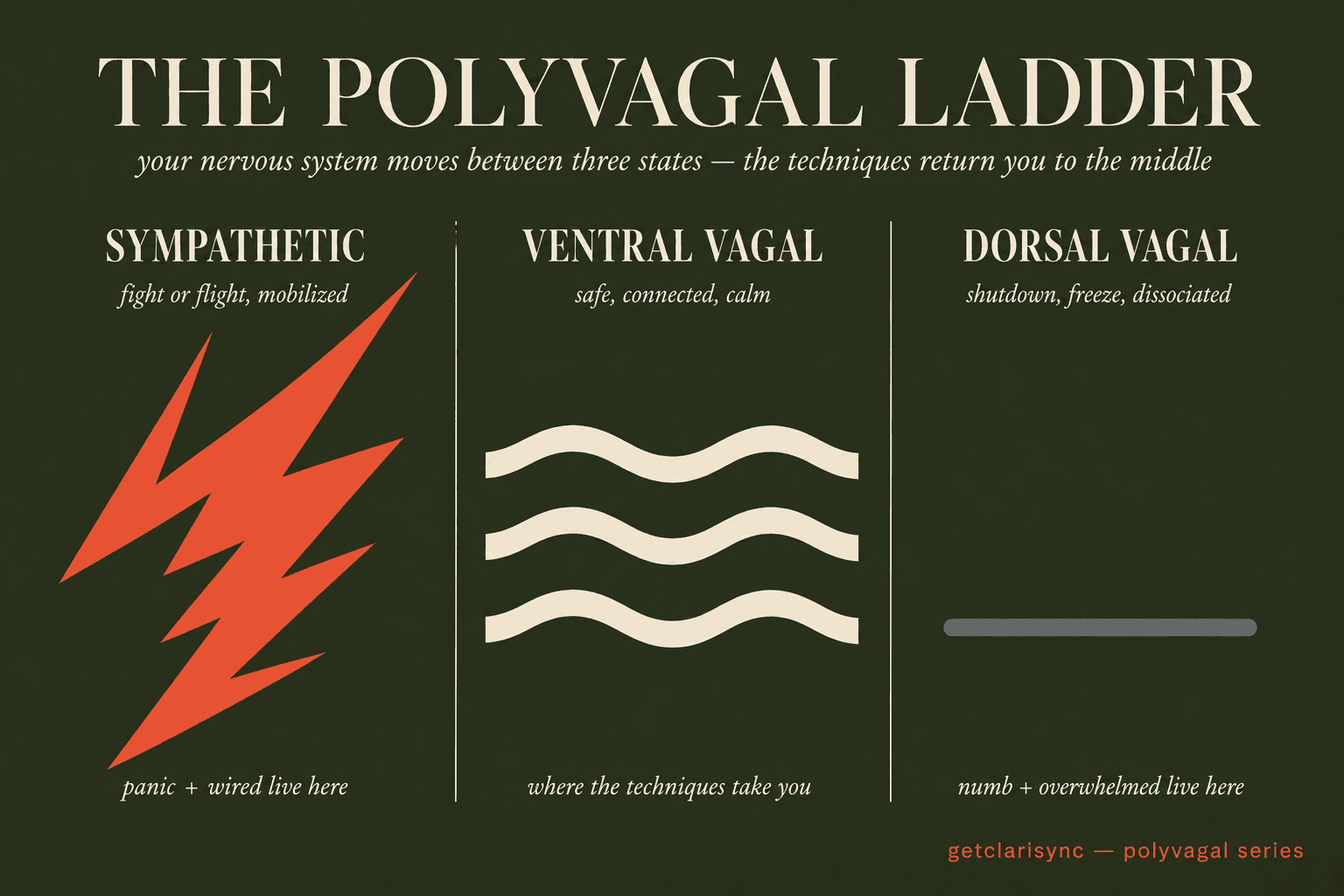
This is the central insight of polyvagal theory, published by neuroscientist Stephen Porges in 1994 and refined through three decades of research since. Your vagus nerve is not one pathway doing one thing. It is a network that can hold your body in three states: ventral vagal (safe, connected, calm), sympathetic (fight or flight, mobilized), or dorsal vagal (shutdown, freeze, dissociation). You move between these states in seconds. The techniques below shift you from a defensive state back toward ventral vagal by activating specific pathways of the nerve directly.
You are not anxious because you thought yourself into it. Your body sent a threat report to your brain, and your thoughts arrived to explain why.
The 4 nervous system states — which one are you in right now
Nervous system dysregulation shows up in more than one form. Naming the state you are in matters, because different states respond to different techniques. Read through these four. Recognize which one is happening for you. Then match it to the technique below.
Panic (acute sympathetic spike)
Rapid heart, tight chest, hyperventilation or air hunger, cold hands, feeling of impending doom, cannot catch a full breath, cannot focus, cannot think clearly. It arrived fast and it is loud.
Sympathetic activation is spiking. Adrenaline has released. Cortisol has followed. Your body is preparing for a physical threat that is not physical.
You cannot think your way out of this. Talking to yourself about how it will pass usually does not help. What helps is physically signaling safety to your brainstem, faster than your thoughts can.
Wired (chronic sympathetic tone)
Cannot sit still even when exhausted. Racing thoughts that will not quiet. Jaw clenched. Shoulders up around your ears. Cannot fall asleep even at 1 am. Not full panic, but a constant edge. Coffee makes it worse but you drink it anyway.
Not the acute spike, but the prolonged low burn of sympathetic activation. Your body has been in mobilized mode for weeks or months. The parasympathetic brake has weakened.
Your body is stuck in fight-or-flight at low volume. It does not need more stimulation, more caffeine, more input. It needs downregulation. And it needs it in small doses across the day, not one big session.
Numb (dorsal vagal shutdown)
Foggy. Disconnected. Exhausted even after sleep. Distant from your own life. Going through motions. Cannot fully feel your body. Cannot cry when you want to. Cannot celebrate when good things happen. Everything feels muted.
Dorsal vagal shutdown. When the sympathetic activation becomes too much for too long, the nervous system collapses into freeze mode as a last-resort protection. This is not depression in the psychiatric sense, though it can lead there.
You are not lazy or ungrateful. Your nervous system flipped from too much to too little because it could not sustain the mobilized state any longer. Coming back requires gentle re-engagement, not effort or willpower.
Overwhelmed (capacity exceeded)
Weight in your chest. Tears rising for reasons that do not seem proportionate. Feeling of 'too much.' Cannot process input. Need to sit down. Cannot answer another question. Low tolerance for noise, light, other people's needs.
Your window of tolerance has been exceeded. Your body is signaling that it needs downregulation before it flips into shutdown. This is the last warning.
This is not weakness. This is your body being wiser than your schedule. Respond now, gently. Do not push through. Pushing through here is what tips people into the numb state above.
The 5 techniques that actually reset the vagus nerve
Each technique below activates a specific pathway of the vagus nerve. Some are best for one state. Some work across several. Below each, the states it fits are marked. If you are in a state right now, scroll to the one that matches.
Technique 1. Extended Exhale (2:1 ratio breathing)
How: inhale through your nose for 4 counts. Exhale slowly through your mouth for 8 counts. Or use the simpler rule: whatever your inhale, make your exhale twice as long. Continue for 90 seconds to 3 minutes. Best for: panic, wired, overwhelmed. How to know it is working: heart rate slows within 60 seconds. Shoulders drop. The exhale specifically activates the ventral vagal brake on your heart through the sinoatrial node. This is the fastest technique for acute sympathetic activation.
Technique 2. Cold water on the face (mammalian dive reflex)
How: fill a bowl with cold water. Splash it on your face, particularly the area between your eyes and cheekbones. Or immerse your face for 15 to 30 seconds if you can. If cold water is not available, hold ice or a cold pack against your face for the same duration. Best for: panic, numb (dissociation), acute wired. How to know it is working: heart rate drops dramatically within 20 seconds. Wired sensation drops. Numbness lifts. This activates the mammalian dive reflex, a primal survival mechanism that instantly slows heart rate through direct vagus stimulation. It is the strongest fast-acting technique known to physiology.
Technique 3. Humming, chanting, or singing
How: hum a low tone (like 'mmm' or 'ohm') for 30 seconds. Rest for 15 seconds. Repeat 3 to 5 times. Or sing quietly. Or chant. The pitch matters less than the vibration and the extended exhale. Best for: wired, overwhelmed, general daily nervous system tone. How to know it is working: throat and chest feel warm. Face and shoulders release. The vagus nerve passes directly through the throat and vocal cords. Humming vibrates the nerve fibers mechanically. Chanting adds extended exhale. Singing adds both plus emotional engagement. This is one of the most researched vagus techniques of the last decade.
Technique 4. Rosenberg's Basic Exercise (small neck movement)
How: lie down on your back. Interlock your fingers behind your head at the base of your skull. Keep your head still. Move only your eyes to the right, holding until you sigh, swallow, or yawn spontaneously (usually 30 to 60 seconds). Return eyes to center. Rest for 30 seconds. Repeat looking left. Best for: numb, wired, chronic tension in the neck and shoulders. How to know it is working: spontaneous yawn, swallow, or deep sigh happens within a minute. This is Stanley Rosenberg's technique from The Healing Power of the Vagus Nerve. Small movements at the base of the skull re-engage the suboccipital muscles near the vagus nerve exit point.
Technique 5. Hand on heart, hand on belly (self co-regulation)
How: place one hand flat on the center of your chest over your heart. Place the other hand on your belly. Breathe slow diaphragmatic breath — belly rises on inhale, chest stays quiet, exhale longer than inhale. Stay for 2 to 3 minutes. Best for: overwhelmed, panic, numb. How to know it is working: emotional release may come. Warmth in your chest. A feeling of being held even alone. Physical touch on the heart activates ventral vagal circuits through interoception. This is one of the strongest single techniques for co-regulating with yourself, and researchers have found it approaches the calming effect of being held by someone who loves you.
Which technique to use when
If you are in the middle of a state right now, do not try to read through all five techniques. Below is the quick logic for choosing.
- If you are in acute panic: cold water on the face first (fastest). Then extended exhale to sustain.
- If you are wired but not in panic: humming for 3 minutes. Then extended exhale to complete.
- If you feel numb or dissociated: cold water on the face plus Rosenberg's neck exercise. Both help re-engage the system.
- If you feel overwhelmed and the tears are rising: hand on heart plus extended exhale. Let it come.
- If you are just checking in with no acute state: humming or hand-on-heart daily builds baseline tone.
What changes when you practice these regularly
The vagus nerve has what researchers call vagal tone. Higher tone means faster recovery from sympathetic activation. It is measurable through heart rate variability. People with higher vagal tone recover from stress faster, sleep better, digest more effectively, and engage more easily in social contact. Vagal tone is trainable.
Practicing these techniques regularly does not just calm you in the moment. It slowly raises your baseline. Over 8 to 12 weeks of consistent practice (even 5 minutes a day counts), your default state moves closer to ventral vagal. You become someone whose nervous system is more resilient. Anxiety still happens because anxiety is part of being alive. But the recovery is faster. The state feels less permanent. Your relationship with your own body changes.
What to expect over the first 3 months
- Week 1Expected
You will use one technique in an acute moment and notice it worked. Save the state name and the technique that helped. Do not judge the whole practice by day 3.
- Week 3 to 4Patience
You start recognizing states earlier — before they fully bloom. You catch 'wired' at 6 pm before it becomes insomnia at midnight. You catch 'overwhelmed' before it becomes shutdown.
- Week 6 to 8Patience
Baseline shifts. Sleep improves without you targeting sleep. Digestion improves without you targeting it. Something quieter is running underneath your day.
- Week 10 to 12+Visible result
Recovery from stressful moments becomes measurably faster. What used to take you a day now takes an hour. You do not become someone who never feels anxious. You become someone whose anxiety does not decide your day.
The mistakes that make these techniques not work
When these techniques are not the whole answer
These techniques work for most people, most of the time. They do not replace psychological support, medication when indicated, or trauma-focused therapy when trauma is present. If your nervous system dysregulation is severe or has roots in trauma, these techniques may be more effective as complements to somatic experiencing, EMDR, or other trauma-informed care rather than as standalone solutions. There is no shame in the professional route. Sometimes it is the necessary route.
→Related readingWhy you wake up anxious: the cortisol awakening response nobody explainsWhat actually changes when your vagus nerve tone rises
You will still feel anxious sometimes. Anxiety is part of being alive in a nervous system that evolved to detect threat. What changes is the relationship. Anxiety used to arrive and decide the rest of your day. Now it arrives and leaves. You recognize it. You name the state. You reach for the matched technique. You come back. The recovery, which used to take hours or days, takes minutes. Your body has become someone you can negotiate with instead of someone who runs you.
You do not become someone who never feels anxious. You become someone whose anxiety does not decide the day.
One nervous system regulation article every week.
Next in this series: the polyvagal ladder mapped for daily life, the difference between rest and regulation, and the four situations where cold water is the wrong tool.
Join the newsletterGetClariSync Mind Desk
Editorial Research · Cognitive Science
The GetClariSync Mind Desk follows research in cognitive neuroscience, behavioral psychology, and stress physiology. We track findings from peer-reviewed journals including Nature Neuroscience, Cognition, Psychological Science, Frontiers in Psychology, and the Journal of Cognitive Neuroscience. Every claim is traced back to a primary source, and we mark the evidence quality — meta-analyses and replicated studies are weighted above single-lab findings. Our content is informational; it does not replace therapy, psychiatric care, or assessment by a licensed mental health professional. If you are struggling with your mental health, please reach out to a qualified clinician, your physician, or a crisis line in your country.