
You just paused mid-sentence. You know the word. You cannot find it. Again.
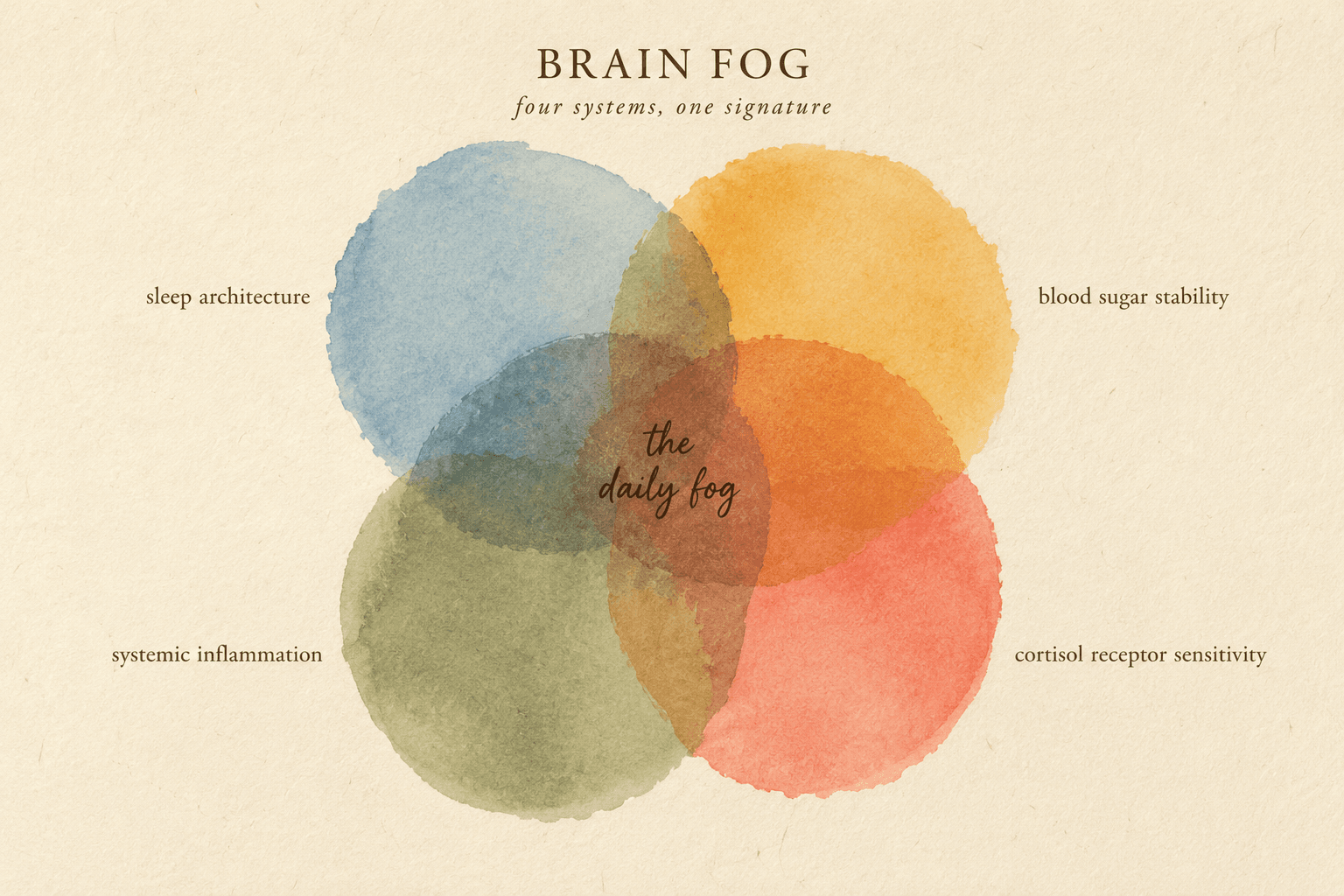
Brain fog is not one symptom. It is four systems failing at the same time. Sleep architecture. Blood sugar stability. Systemic inflammation. Cortisol receptor sensitivity. Any one of them produces some fog. All four together produce the daily fog that has been quietly ruining your work for months. This is why no single supplement fixes it. The reset is a four-week protocol, one system per week, in the order that actually works.
It happens mid-sentence. In a meeting. During a call. Sometimes while making a coffee. You reach for a word you have used ten thousand times in your life and it is not there. You feel yourself pause. You watch your own mouth wait for the word. It arrives, eventually, from somewhere below the surface. Or it does not, and you switch to a lesser word and hope no one noticed. This is not aging. This is not laziness. This is not just one bad night of sleep. This is brain fog, and the reason it never fully clears is that almost every article you have read treats it as one thing. It is not.
What brain fog actually is
Brain fog is not the primary problem. It is the visible symptom of four upstream failures. Each one, on its own, can produce foggy thinking. When two or three overlap, the fog becomes daily. When all four run together, thinking becomes a job that used to be automatic.
This is why the same person can have brain fog on a Tuesday after eight hours of sleep and clear thinking on a Wednesday after six. Sleep alone did not decide the fog. The other three systems weighed in. The reason nothing you have tried fixes it long term is that you have been treating one system while three others quietly kept the fog running.
Brain fog is not a symptom. It is the sound of four systems failing at the same time.
The four systems, and the signature each one leaves
Each system produces a slightly different flavor of fog. Learning to tell them apart is the beginning of fixing them.
1. Sleep architecture
The number of hours you sleep is only half the story. The other half is where you spend those hours. Deep sleep, concentrated in the first two cycles of the night, does the memory consolidation work. REM sleep, concentrated in the last cycles, does the emotional integration and pattern-finding. When you fall asleep late but wake on time, you lose more REM than deep. When you wake at three in the morning, you truncate late REM. Either way you get the hours, and you still wake foggy. The clue: fog that is worst in the morning and slowly clears with movement.
2. Blood sugar stability
The brain runs almost entirely on glucose. When blood sugar swings, brain function swings with it. The overlooked pattern is not the high spike, which most people notice, but the reactive dip that follows sixty to ninety minutes later. After a carb-heavy breakfast without much protein, glucose crashes below baseline mid-morning, and cognitive performance measurably drops in that window. The clue: fog that hits like a wall late morning or mid-afternoon, after meals, and lifts after some protein.
3. Systemic inflammation
This is the harder one to feel. Chronic low-grade inflammation, the kind you cannot point to and name, releases cytokines that cross into the brain and interfere with neurotransmitter signaling. Not the flu-like acute inflammation. The kind that stays quietly in the background for months, driven by stress, poor sleep, ultra-processed foods, or a low-grade gut disturbance. The clue: fog that improves after intense exercise (which temporarily suppresses inflammation) or that dropped noticeably when you accidentally cut out a particular food group for a week.
4. Cortisol receptor sensitivity
The deepest layer. When cortisol has been chronically elevated for months, the receptors in the prefrontal cortex and hippocampus become less sensitive. Blood cortisol may look normal. The tissues that manage attention and memory are hearing a different signal. This is the fog that comes with sustained work stress, prolonged caregiving, unresolved anxiety, or the years after a major life transition. Sleep and glucose and inflammation may all be fine. The fog stays. The clue: fog that persists even when everything measurable is good, that came on gradually with a stressful chapter, and that responds slowly rather than fast to any intervention.
Which one dominates in your fog
Most people have all four contributing. One usually dominates. Reading the four patterns below and recognizing your own is the beginning of fixing the fog in the right order.
Sleep-dominant fog
Fog is worst in the morning, gradually lifts through the day, comes back if you push a late night. You feel it more on days you woke up too early or fell asleep too late.
Deep sleep or late REM has been repeatedly truncated. Memory consolidation and pattern integration are running below capacity.
You do not need more sleep. You need to protect the specific windows where deep and REM concentrate.
Glucose-dominant fog
Fog hits like a wall around 10 or 11 am, or in the early afternoon after lunch. Coffee helps briefly. A small protein snack helps more.
Postprandial glucose swings are producing reactive low-glucose windows in which cognitive performance measurably drops.
You are not tired. You are running the brain on unstable fuel. The fix is meal composition, not more energy.
Inflammation-dominant fog
Fog is diffuse and constant rather than time-linked. It lifts noticeably after intense exercise, or after a week when you cut out something (dairy, alcohol, wheat) without planning to.
Chronic low-grade inflammation is producing cytokines that cross into the brain and interfere with neurotransmitter signaling.
The fog is not from your brain. The fog is from your body sending noise to your brain. The lever is downstream.
Cortisol-dominant fog
Fog is persistent regardless of sleep, meals, or exercise. It came on during or after a stressful period. Standard labs are normal. Nothing you try produces fast change.
Cortisol receptors in prefrontal cortex and hippocampus have become less sensitive after chronic elevation. High blood cortisol produces low tissue effect.
This one takes weeks, not days. You are not stuck. You are working on the deepest layer.
The 4-week reset, one system per week
The order matters. Each week you address one system before layering the next. Doing all four at once fails because the sleep and glucose foundations have to be in place before the inflammation and cortisol work can register. Below is the sequence.
The four-week arc
- Week 1Expected
Sleep architecture. Protect the deep sleep window (the first three hours after sleep onset) and the late REM window (the last two hours before wake). Nothing else this week.
- Week 2Expected
Blood sugar stability. Change meal composition, not calories. Protein and fat at every meal. Never carbs alone. Fog windows begin to shrink.
- Week 3Patience
Inflammation. Remove one probable trigger for the full week (alcohol, ultra-processed foods, or one suspect food group). Notice what changes.
- Week 4Visible result
Cortisol receptor sensitivity. Layer in evening cortisol drop protocol, morning light exposure, and one adaptogen if desired. This is the week you feel the deep fog start to lift.
Why this exact order works
Sleep is week one because bad sleep raises the other three overnight. Poor deep sleep raises next-day cortisol. Poor REM raises inflammatory markers. Poor sleep also destabilizes glucose. If you fix sleep first, the other three become easier. If you leave sleep for later, everything you do in weeks two through four is running uphill.
Glucose is week two because glucose swings amplify cortisol reactivity. A blood sugar crash is read by the body as a stress event and triggers a small cortisol release. Stabilizing meals in week two reduces the stress background against which weeks three and four have to work.
Inflammation is week three because it changes slowly. You need at least seven consecutive days without a trigger to notice a shift, and you need weeks one and two calm enough to see it. Inflammation trial-and-error in week one would be lost in the noise.
Cortisol receptor sensitivity is week four because it is the deepest layer. Receptor sensitivity only restores when the upstream noise from sleep, glucose, and inflammation has quieted. Trying to work on receptors first is like trying to whisper in a room where three people are yelling.
The actual practice each week
Week by week, what to actually do
- 1Week 1 — Sleep architecture
Bed by the same time every night. No screens the hour before. Bedroom cool and dark. No alcohol within three hours of sleep. Track how you feel on waking. That is the only variable this week.
- 2Week 2 — Glucose stability
Every meal has protein and fat before carbs. Breakfast has 25 to 30 grams of protein within an hour of waking. No naked snacks. A small handful of nuts before coffee is better than coffee alone.
- 3Week 3 — Inflammation
Remove one probable trigger for the full seven days. Most reliable candidates: alcohol, ultra-processed foods, or (if suspected) dairy or gluten. Notice the fog quality by day five.
- 4Week 4 — Cortisol receptor sensitivity
Ten minutes of morning sunlight within thirty minutes of waking. Evening cortisol drop routine after 6 pm (dim lights, walk, warm shower). Optional: 300 mg of ashwagandha for the week. Notice which fog remains and which has lifted.
What most people get wrong about brain fog
When brain fog is something else
The protocol above is designed for the slow, chronic, day-to-day fog that has resisted single-lever interventions. It is not designed for sudden fog with medical urgency. When in doubt, see a physician. There is no protocol that replaces a proper workup when a proper workup is what the situation needs.
→Related readingThe cortisol brain: how chronic stress rewrites memory and attentionWhat actually changes after the four weeks
By the end of week four, the fog is not eliminated. It is measurable. You know when it comes. You know why. You know which system triggered it that day. This is what most people who complete the four weeks describe: not the disappearance of fog, but the loss of its mystery. You stop being ambushed by your own thinking. The fog becomes a signal you can read, and signals you can read are signals you can respond to.
For many, the deep cortisol layer keeps improving into weeks five, six, and seven. Fog that had been present for years takes months to fully quiet, and there is no way to shortcut that. What changes fastest is the daily fog. Week one usually shifts sleep-linked fog. Week two shifts meal-linked fog. Week three shifts diffuse fog. Week four begins the slower shift in the persistent baseline.
Brain fog stops being a mystery when you stop asking it to be one thing.
One cognitive systems article every week.
Next in this series: the specific deep-sleep protection window, the glucose meal-composition guide, and the four adaptogens that respect receptor recovery timelines.
Join the newsletterGetClariSync Mind Desk
Editorial Research · Cognitive Science
The GetClariSync Mind Desk follows research in cognitive neuroscience, behavioral psychology, and stress physiology. We track findings from peer-reviewed journals including Nature Neuroscience, Cognition, Psychological Science, Frontiers in Psychology, and the Journal of Cognitive Neuroscience. Every claim is traced back to a primary source, and we mark the evidence quality — meta-analyses and replicated studies are weighted above single-lab findings. Our content is informational; it does not replace therapy, psychiatric care, or assessment by a licensed mental health professional. If you are struggling with your mental health, please reach out to a qualified clinician, your physician, or a crisis line in your country.