
The conversation ended at four o'clock. You replayed it at five. You replayed it at seven. You replayed it again before sleep. You did not choose to. Your brain decided the conversation was not finished.
Replaying conversations in your head has a name. Psychologists call it post-event processing, and it is one of the most studied patterns of self-referential thought in the human brain. Your brain runs a background process that scans recent social interactions for signs of misstep, looking for what you might have said wrong, what someone might have meant, what could have gone differently. The system evolved to keep ancestral humans tightly connected to small groups whose approval was a matter of survival. In modern life, it runs on conversations whose stakes are much smaller, and it has no reliable way to know when to stop.
It comes back without permission. A casual conversation at lunch, a phone call with a parent, a meeting that ended fine. Hours later you are washing dishes and the conversation runs through your head again. You said this. They said that. You should have said the other thing. The replay is detailed, vivid, edited slightly each time. By the third replay you are no longer remembering what happened. You are remembering your last replay.
Most people experience this. Most people also assume something is wrong with them because it happens. Both can be true at the same time. The replay can be a normal feature of how the human brain processes social information, and it can also become a problem when it stops being useful and starts running on its own.
The Replay Has a Name
What you are doing has been studied for decades under the name post-event processing. The term refers to a specific pattern of repetitive thought that follows a social interaction, often hours or days later, in which the mind reviews what was said, scans for possible negative impressions, and constructs alternative versions of the exchange. The process is involuntary. It runs on its own.
It is more pronounced in some people than others. It is more pronounced after some conversations than others. The replay is most active after interactions the brain reads as ambiguous, as unfinished, or as carrying social risk. A conversation where the other person's reaction was unclear pulls the replay system harder than a conversation that ended in obvious warmth. The brain is not random in choosing what to replay. It is looking for something it could not finish reading in the moment.
Why Your Brain Runs This Process
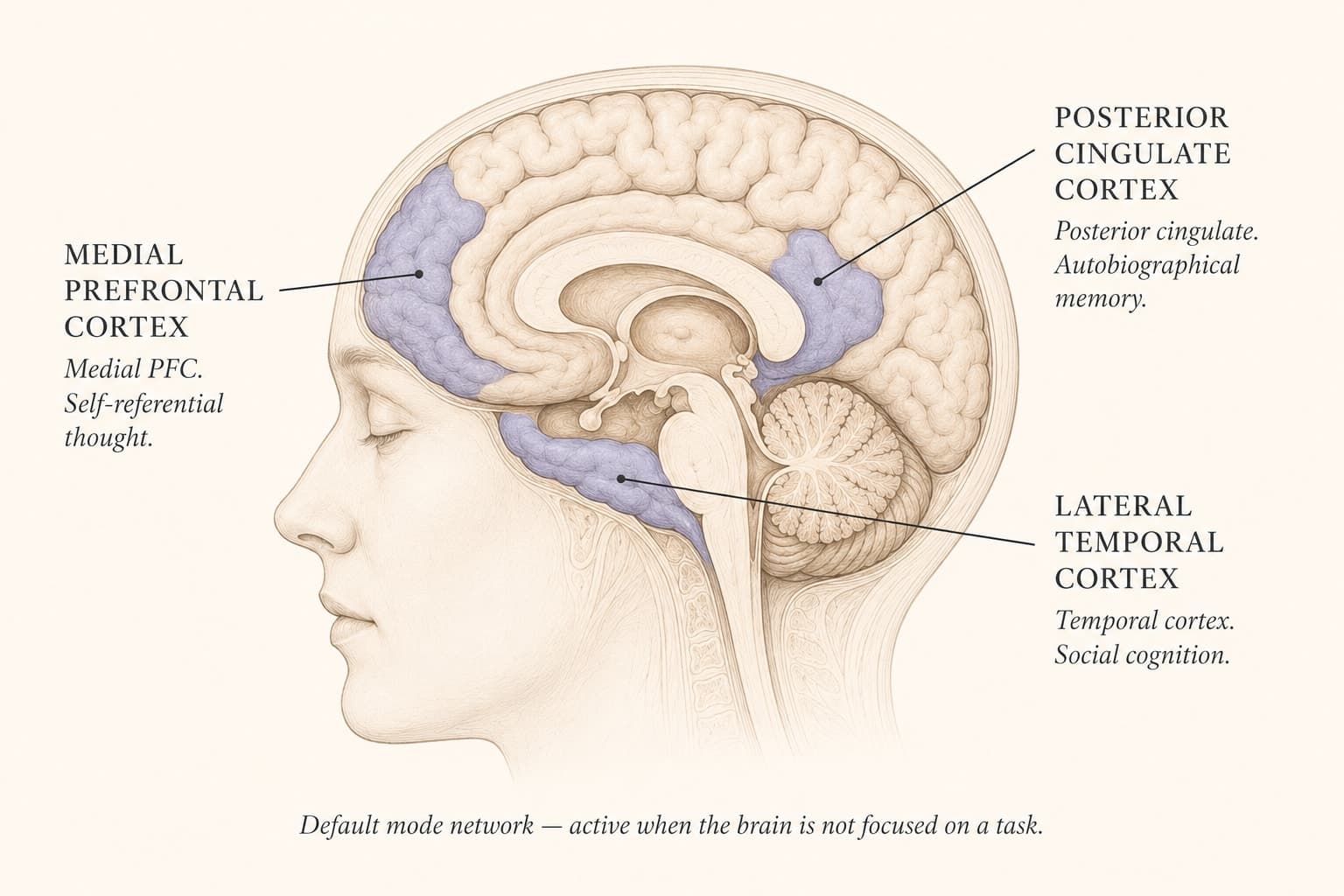
When you are not actively focused on a task, your brain does not go quiet. A specific set of regions, the default mode network, becomes active and runs what neuroscientists call internal mentation. This network is the substrate for daydreaming, autobiographical memory, planning, and self-referential thought. It is also the system that hosts the replay. The conversations you cannot stop reviewing are running on the same circuits that handle your sense of self.
A review of neuroscience research on the default mode network examined what this group of regions is doing during the long stretches of time when the brain is not engaged with an external task. The researchers asked whether the activity in this network during rest is meaningful or simply background noise, and which functions it might be supporting if the activity carried structure.
“The default network supports a range of internally directed cognitive processes, including remembering the past, envisioning the future, considering the perspectives of others, and constructing simulations of social interactions, indicating an active and adaptive role in human social cognition.”
What this means in practical terms is that replaying a conversation is not a glitch. It is a core function of the most active brain network during rest. The same circuits that imagine your weekend, remember your childhood, and consider what someone else thinks of you are running the replay. It is part of how the brain maintains its model of the social world.
Why the Replay Sticks on Some Conversations and Not Others
The brain replays what it has not finished evaluating. A conversation that ended clearly, with obvious warmth or obvious distance, gets filed away quickly. A conversation that ended ambiguously, with a slight pause, an unreadable expression, a comment that could be taken two ways, stays open. The system holds the interaction in active memory until it can decide whether something went wrong.
For ancestral humans, the stakes of getting this right were extreme. Being misread or disliked by a small group could mean exclusion, and exclusion could mean death. The brain evolved to take social ambiguity very seriously, to keep reviewing it, to keep constructing alternative readings until one of them felt safe. The same system runs in modern conversations. The stakes have changed. The system has not.
When the Replay Becomes a Problem
Replaying conversations occasionally, briefly, and with some new perspective each time is normal. The system is doing its job. When the replay becomes prolonged, when it intensifies anxiety rather than processing it, when it focuses on imagined negative impressions rather than realistic ones, and when it makes you avoid future interactions, the process has shifted into something else.
A comprehensive review of post-event processing examined how the pattern relates to social anxiety. The researchers asked what makes the replay become harmful in some people while staying within normal limits in others, looking at the content of the replay, the memory it produces, and what happens to the person's self-image as the replay repeats.
“Post-event processing in social anxiety is characterized by selective focus on negative aspects of the interaction, the construction of biased autobiographical memories, and a tendency to reinforce negative self-impressions rather than update them, distinguishing it from ordinary reflection.”
The line between healthy reflection and harmful rumination is not always sharp. Replay that brings new information, leads to a clearer understanding, and fades over time tends to be useful. Replay that intensifies, distorts memory toward the negative, and persists past the point of being informative is the pattern most associated with social anxiety and rumination-related conditions. Recognizing which one you are in is the first practical question to ask.
The version of the conversation you remember after the fifth replay is not the version that happened. The brain edits social memory through the act of reviewing it. The replay you are running is partly a memory of the original interaction and partly a memory of your last replay.
What Tends to Help
The most consistently effective interruption to the replay loop is shifting brain activity out of the default mode network and into a system that requires external focus. The replay tends to fade when the brain is actively engaged with something concrete: a physical task, a conversation with someone present, a focused activity that requires attention. The shift does not have to be long. Even ten or fifteen minutes of external focus often quiets the loop enough that it does not pick back up immediately.
Name the process as it happens
Recognizing the replay as post-event processing rather than as a meaningful thought changes how the brain treats it. Saying internally 'this is the audit running' creates enough distance to choose whether to engage with the content or let it pass. The replay does not need to be silenced. It needs to be seen as a process rather than as a true reading of what happened.
High impactWriting the conversation down once, accurately, also tends to reduce the loop. The brain replays what it has not finished processing. The act of putting the interaction into language, including what was unclear, what was uncertain, what you might never know, gives the system a way to mark the conversation as complete. The replay loses its purpose.
The Audit Was Built for a Smaller World
There is something quietly humane in understanding what your brain is doing when it replays a conversation. The system is not broken. It is not a personal weakness. It is a piece of ancient social machinery built for tight-knit groups where every interaction was high stakes, running in a modern world where most conversations do not matter the way the system thinks they do.
You will probably keep replaying conversations. That part is unlikely to change much. What can change is how you read the replay when it starts. Not as evidence that something is wrong with you. As a sign that an old part of your brain is doing what it has always done, taking social interactions seriously, looking after the relationships it thinks could decide your fate. It is mostly mistaken about the stakes. It means well.
Want to go deeper on the mind?
Read our breakdown of why your best ideas tend to arrive in the shower, and what the default mode network is doing while you are not focused on anything.
Explore Mind ScienceGetClariSync Mind Desk
Editorial Research · Cognitive Science
The GetClariSync Mind Desk follows research in cognitive neuroscience, behavioral psychology, and stress physiology. We track findings from peer-reviewed journals including Nature Neuroscience, Cognition, Psychological Science, Frontiers in Psychology, and the Journal of Cognitive Neuroscience. Every claim is traced back to a primary source, and we mark the evidence quality — meta-analyses and replicated studies are weighted above single-lab findings. Our content is informational; it does not replace therapy, psychiatric care, or assessment by a licensed mental health professional. If you are struggling with your mental health, please reach out to a qualified clinician, your physician, or a crisis line in your country.