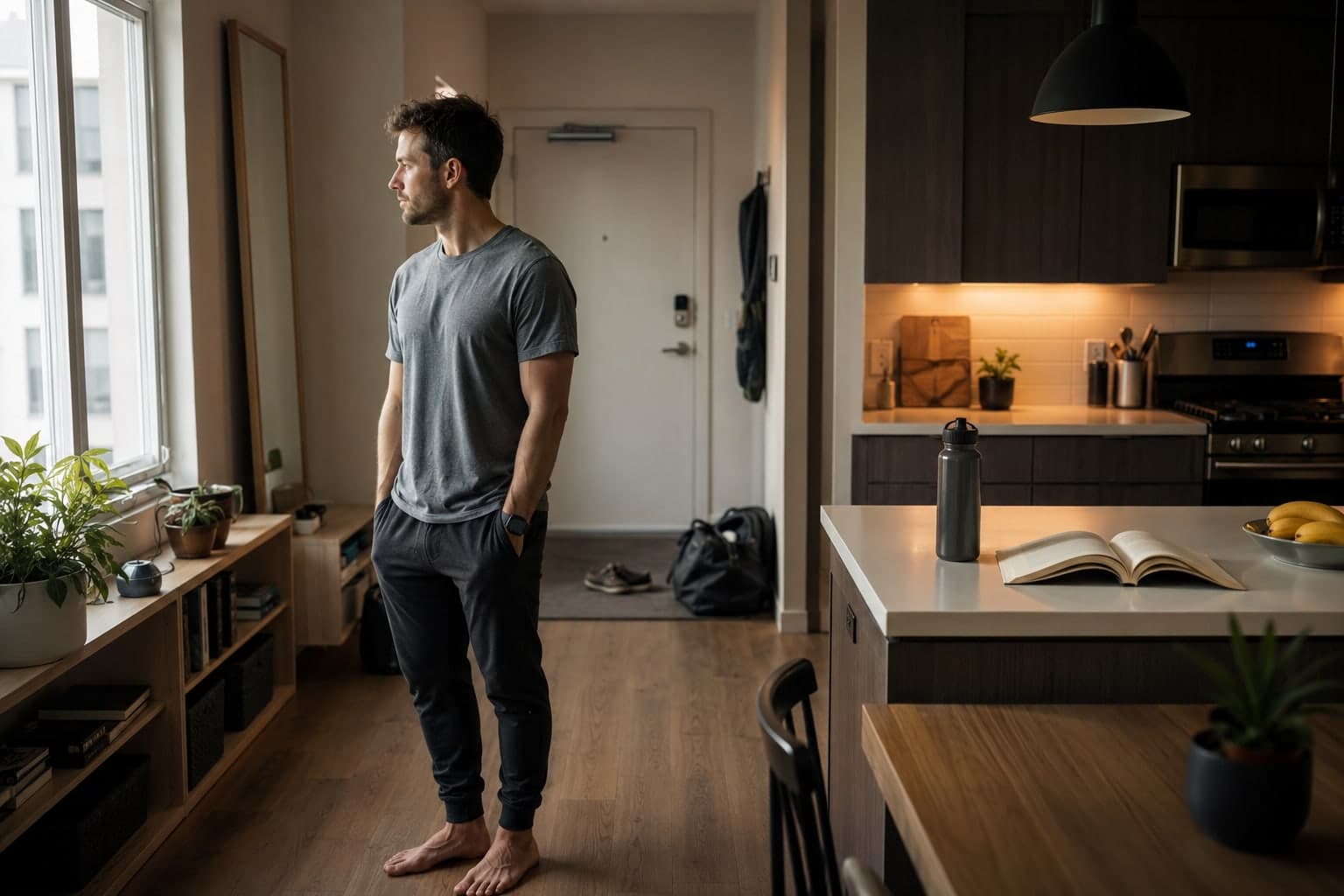
It is Sunday, four thirty in the afternoon. You have done nothing wrong. And yet.
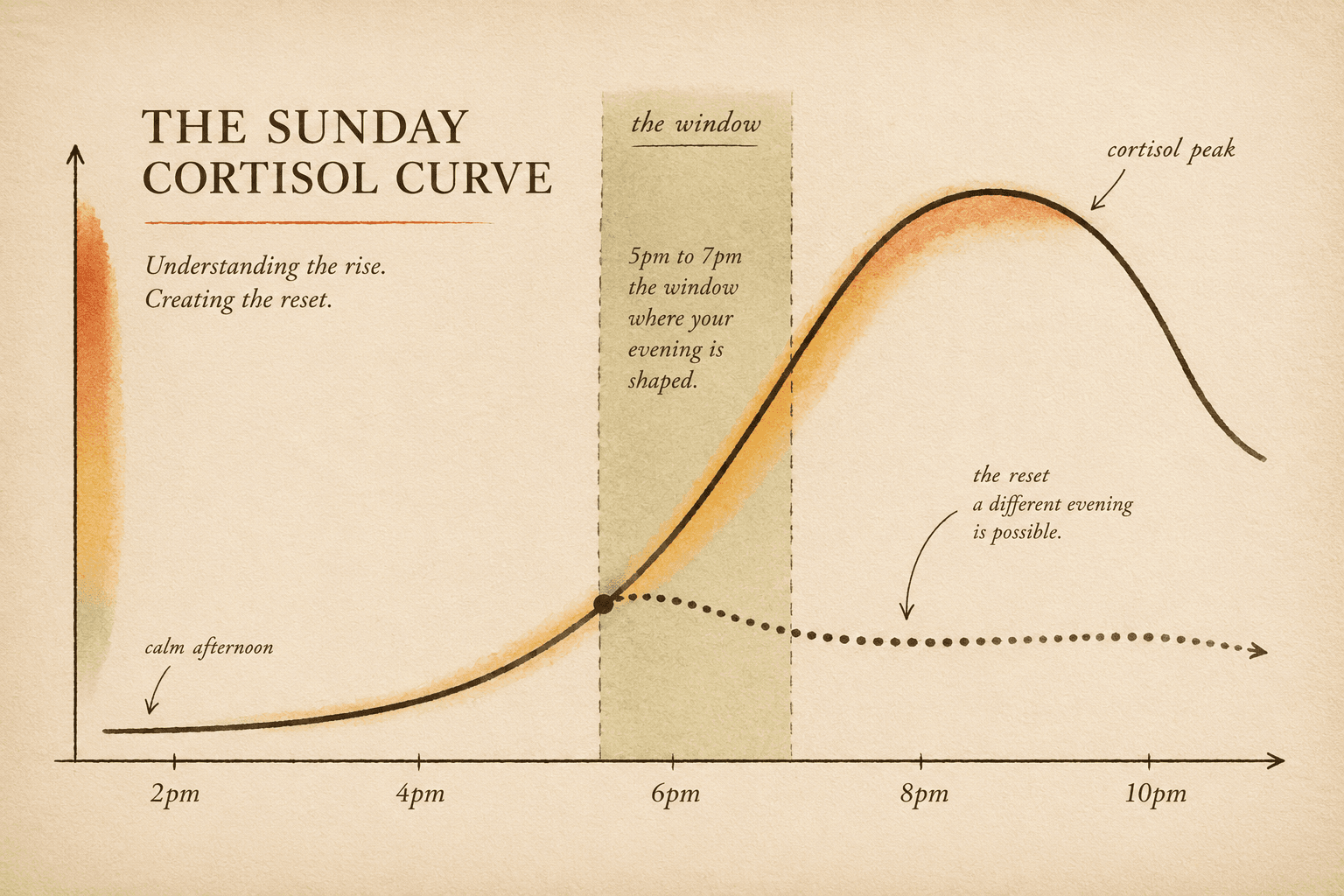
The Sunday afternoon feeling is not anxiety. It is your body starting the workweek without asking you. A stress hormone begins to rise around three, ramps through the evening, and peaks right when you are trying to relax. This is why meditation does not touch it. Why the bath does not fix it. Why going to bed early makes it worse. The good news is that the rise happens on a schedule, which means it can be interrupted on a schedule. Ninety minutes between five and seven, done four Sundays in a row, changes the shape of the evening.
You know the exact moment it arrives. Usually around three. Nothing has happened. The weekend was fine. There is no email, no calendar alert, no fight with anyone. And yet a small door closes somewhere in your chest and you know Sunday is over even though ten hours of Sunday remain. You try the usual things. A walk. A bath. That comedy you have watched twice. Everything works for about forty minutes and then the door closes again a little harder. By nine you are in bed telling yourself to sleep because tomorrow is early, and the more you tell yourself, the more awake you become. You are not broken. You are not weak. You are watching a hormone do exactly what it evolved to do, at exactly the wrong time.
The thing you have been trying to think your way out of has a name
Your body has two big cortisol events every day. The first is the one everyone talks about, the morning surge that gets you out of bed. The second one is less famous and it is the one that ruins your Sunday. It is called anticipatory cortisol, which is a fancy way of saying your body prepares for things it knows are coming, whether you want it to or not.
This is not new science. Stress researchers have been measuring it since the 1990s. What they consistently find is simple. When your body has learned that a demanding stretch is coming, it starts mobilizing hours in advance. Athletes show it before a game. Students show it before an exam. And working adults show it on Sunday afternoon, because the body has learned that Monday morning is a Monday morning.
You did not choose this. You cannot decide out of it. You did not become this way because you have a bad job or a bad attitude. The people who never feel Sunday afternoon are the people whose weeks are genuinely low-stakes, which is a much smaller group than the internet pretends. For everyone else, the Sunday rise is a signature that the week ahead is real. It is the price of caring about your work.
You have been trying to reason your way out of a hormone.
This one line is worth sitting with. Because it explains why every mindset trick you have tried has failed. Cortisol does not respond to reframing. It does not care about your gratitude list. It cannot be talked down. It is a chemical event, and chemical events answer to other chemical events, not to explanations.
Why the advice you keep reading keeps failing you
Open any article on the Sunday scaries and you will find the same list. Prepare tomorrow's clothes. Meal prep. Go to bed early. Take a bath. Delete the work app. If those worked, you would not still be reading. They fail for reasons the mechanism makes obvious. Below are the three that fail the hardest, and why.
None of the standard advice is wrong. It is just being deployed at the wrong hour, for the wrong reason, without understanding what the body is actually asking for. When you get the timing and the reason right, the same interventions work beautifully. When you get them wrong, they make Sunday longer.
The ninety-minute window that changes everything
Here is the thing about anticipatory cortisol. It is a curve. It rises, it peaks, it falls. The curve is where all the leverage is. Trying to lower cortisol after it has already peaked at nine in the evening is like trying to slow a car that has already hit the wall. But interrupting the rise while it is still climbing, between five and seven, changes the entire shape of the evening. Everything after seven is easier because the peak never gets to be a peak.
The ninety minutes that follow are not a wellness routine. They are four specific things done in a specific order, each one talking to a different piece of the mechanism. You do not need equipment. You do not need an app. You do not need a specific room or a specific outfit or a specific mood. You need the four phases, done in sequence, four Sundays in a row.
The ninety-minute Sunday reset
- 15:00 to 5:20 — Change the room
Dim the main lights. Close the laptop and put it out of sight. Move any work object off the visible surfaces. This is not decoration. You are telling your eyes that the week is over, and your body listens to your eyes.
- 25:20 to 5:40 — Empty your head onto paper
Get a notebook. Write for twenty minutes without stopping, by hand, everything you are worried about for the week ahead. Do not organize. Do not make a plan. Just transfer the weight. When it is on paper your brain stops rehearsing it in the background.
- 35:40 to 6:30 — Move slowly, in your body
Fifty minutes of one calm physical thing. A walk at an easy pace. A shower and then some gentle stretching. Cooking something that has nothing to do with Monday. The requirement is that it is physical and slow. Not reading. Not television. Your nervous system needs body input, not more thinking.
- 46:30 to 6:30+ — Close the day, always the same way
One small ritual you do every single Sunday and never on any other day. A specific tea. A specific playlist. A specific book. It does not have to be relaxing on Sunday one. Over four weeks it becomes the signal that means Sunday is closed.
The writing part is doing more than you think
If any part of the protocol sounds unnecessary, it is probably the second one. You have journaled before. It did not fix your life. This is not journaling. This is a specific thing psychologists have been studying since the 1980s, and the mechanism is almost embarrassingly simple. When a worry is in your head, your brain treats it as unfinished business and keeps running the loop in the background, even when you are watching a movie, even when you are eating dinner, even when you are trying to sleep. When you write it down, your brain stops running the loop as hard. It is that simple.
This is why the writing has to be by hand, and it has to be messy, and it cannot be a to-do list. To-do lists organize. Organizing reactivates the demand system. Continuous handwriting, twenty minutes, ugly and repetitive and rambling, is the exact intervention. If you have never done this before, the first Sunday will feel strange. By the third Sunday it will feel like the most important twenty minutes of the week.
The closure ritual is not what you think either
The last twenty minutes look tiny compared to everything before. They are actually doing the heaviest work for the long term. What you are building here is a Pavlovian response, which is a fancy word for a very human thing. Your body learns to associate specific sensory inputs with specific internal states, and once the association is built, the input alone triggers the state. This is why the smell of coffee wakes some people up before they drink it. Same idea.
So you pick one tea. One book. One playlist. Something you do only on Sunday evening, never at any other time. It does not have to relax you the first time you try it. It has to become the thing that means Sunday is finished. Four to six weeks of consistency and the ritual works on its own. That is what everyone who has done this a long time knows. Eventually, the tea does most of the job.
What you will notice, week by week
- Sunday oneExpected
The rise still happens. The protocol takes some of the edge off but you will still feel Sunday. Do not judge the whole thing on the first attempt. That is a mistake you will regret in six weeks.
- Sunday threePatience
You will start noticing the anticipation of the protocol itself around four in the afternoon. That is a good sign, not a bad one. It means your body is starting to expect the closure signal.
- Sunday sixPatience
The shape of the evening changes. Some Sundays remain hard. Others become quiet in a way you had almost forgotten was possible on a Sunday. Do not need every Sunday to be quiet. Track the average, not the exception.
- Sunday ten and beyondVisible result
The closure ritual works as its own signal. Some evenings the full ninety minutes matter less because the tea and the book alone tell your body Sunday is closed. This is the point of the whole thing.
One more thing the protocol quietly fixes
Sunday evening cortisol does not stay in Sunday. It disturbs the deepest sleep phases, which are packed into the first cycles of the night. Poor sleep on Sunday raises Monday morning cortisol independently of anything Monday actually contains. A stressful Monday morning primes a stressful week, which raises next Sunday's rise a little bit more than the last one. The loop feeds itself. You have been living inside it for years. Interrupting Sunday evening is not just a Sunday project. It is one input pulled out of a system that has been running unopposed since the last time you actually looked forward to a Monday.
→Related readingWhy you wake up at three in the morning, mapped through the cortisol sleep loopWhy this hits some people harder than others
The Sunday rise is not identical for everyone. Some people show a steep climb starting mid-afternoon. Others barely register anything until Monday morning itself. Two things explain most of the difference. The first is how reactive your stress system is at baseline, which is largely set early in life and only partly under your control. The second is how genuinely demanding your week ahead actually is. A high-reactivity person in an evaluative, deadline-heavy job will have a big Sunday. A low-reactivity person in a routine job might have almost none.
Neither profile is a problem. Neither means anything about your character. If your Sundays are hard, the protocol will do more for you. If they are mild, the protocol will still calibrate the closure signal, which pays off during the harder weeks that occasionally happen even in easy jobs. Everyone can use the same four phases. The intensity adjusts itself.
When Sunday feelings are not Sunday scaries
The point of this list is not to scare you. It is to say clearly what this article is and what it is not. Anticipatory cortisol is a normal physiological event in response to a real demand. Anxiety disorders, panic, and depression are different things with different biology. If the list above sounds like your experience, the right next step is a professional, not a longer version of this protocol. There is no protocol that replaces care when care is what the situation needs.
What actually changes after twelve Sundays
The honest answer is that Sunday does not become Saturday. Sunday becomes Sunday. The tightening still arrives around three but it registers as information now, not as dread. The evening acquires a shape. You know what is happening. You know what to do about it. And most importantly, Sunday closes when you close it, rather than staying open in the background until you fall asleep at midnight with your jaw clenched.
Sunday should not feel like Saturday. Sunday should feel closed.
That is the whole aim. Not a Sunday without a hormone. A Sunday you know how to end on time.
One weekly rhythm article every Sunday morning.
Next in the series: the Monday morning cortisol curve, the evening protocol for high-reactivity chronotypes, and the four practices that stack with the ninety-minute reset.
Join the newsletterGetClariSync Habits Desk
Editorial Research · Behavioral Science
The GetClariSync Habits Desk studies behavioral science, habit formation, and applied performance psychology. We distill peer-reviewed research from journals like the European Journal of Social Psychology, Psychological Bulletin, the Journal of Personality and Social Psychology, and Behaviour Research and Therapy. We separate findings replicated in pre-registered studies from popular but underpowered effects, and we cite the original papers — not secondary write-ups. Our coverage is informational, not coaching or therapy; for behavioral health concerns please consult a licensed therapist or evidence-based behavioral health professional.