You were doing well. You were holding the new habit. Then stress hit. By the end of the day you were back to what you used to do. It felt like everything you built had collapsed. Nothing collapsed. A different part of your brain just took over.
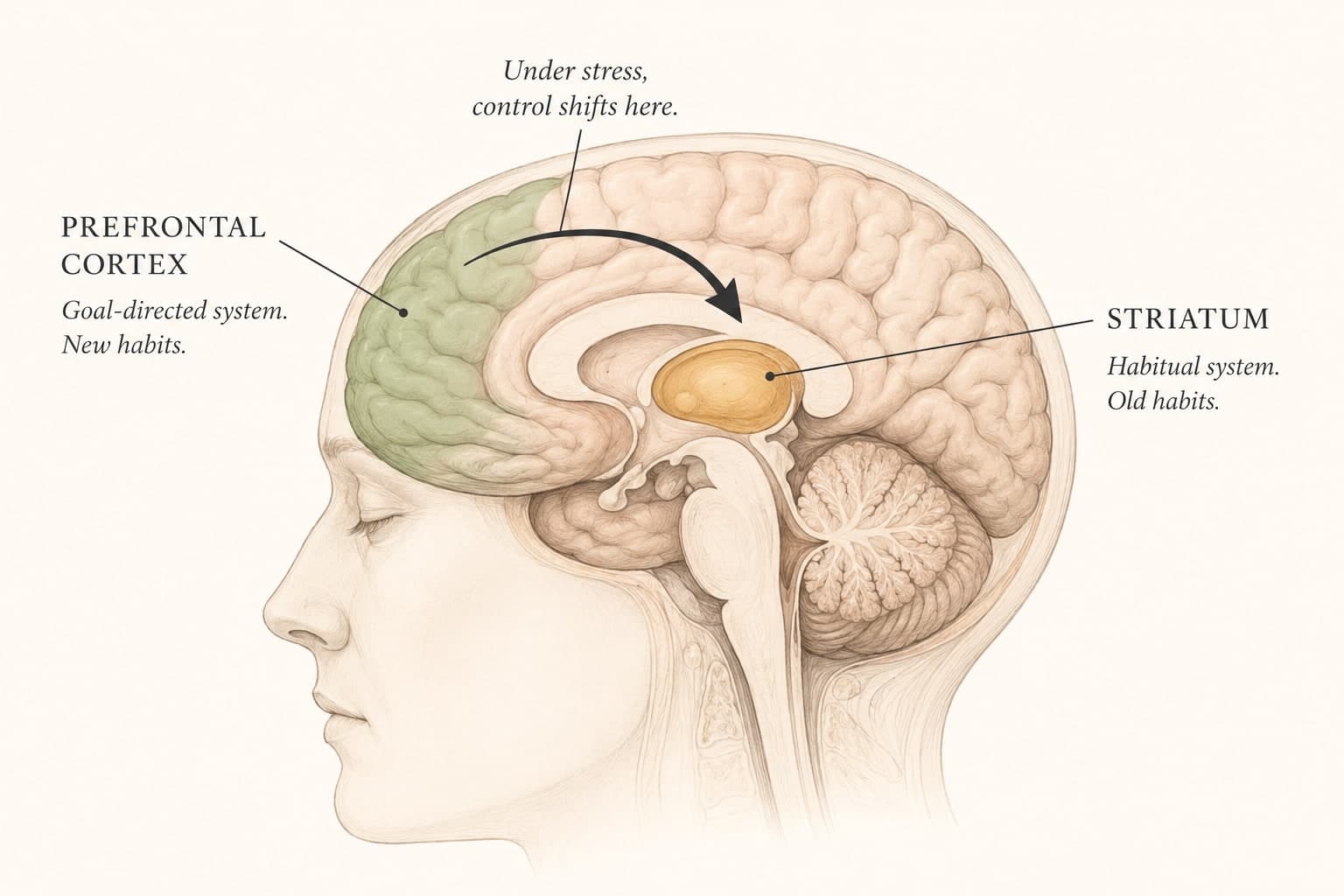
Your brain uses two separate systems for behavior. One is goal-directed: slow, deliberate, focused on what you want to achieve. The other is habitual: fast, automatic, focused on what you have done before. Under stress, the brain shifts control from the goal-directed system to the habitual one. The newest habits you have been building are still in the goal-directed system. The old habits you replaced are deeply encoded in the habitual one. Stress brings them back not because your willpower failed, but because the brain switched systems.
Everyone has a version of this story. You started running in the mornings. You stopped drinking after dinner. You were keeping the new routine for three weeks. Then your boss called with bad news, or a relationship turned, or you slept badly for three nights in a row. By the end of the week you were not running, you were drinking, you were eating what you used to eat. The new habits felt like something you had imagined.
Nothing was imagined. Nothing was lost. What happened is that the part of your brain managing the new habits stepped aside, and another part of your brain, the one that knows the old routines very well, took the wheel.
The Two Systems Your Brain Uses for Behavior
Behavior in the brain is not handled by a single system. It is handled by two systems running in parallel, each with its own logic and its own anatomy. The goal-directed system lives in areas of the prefrontal cortex, the part of the brain just behind your forehead that handles planning, deliberation, and choices oriented toward an outcome. The habitual system lives deeper in the brain in structures called the striatum, regions specialized for running automatic, well-rehearsed sequences of action.
Goal-directed system
- Located in the prefrontal cortex
- Slow, deliberate, conscious
- Focused on outcomes and rewards
- Sensitive to changes in what works
- Used by the new habits you are building
- Easy to disrupt under stress
Habitual system
- Located in the striatum
- Fast, automatic, unconscious
- Focused on cues and triggers
- Insensitive to whether the outcome still works
- Used by the old habits you spent years building
- Active by default under stress
Both systems are always running. The goal-directed system wins control when you are calm, rested, and paying attention. The habitual system wins when you are stressed, depleted, or distracted. This is not a flaw in the design. It is the design, because under threat the brain is built to use what it knows works rather than weighing options it has not had time to test.
What Stress Does to the Switch
When you experience stress, your body releases cortisol. The cortisol interacts with brain regions in a way that suppresses prefrontal activity. The goal-directed system goes quiet. The striatum, less affected by stress hormones, keeps running at full volume. Whichever system has the loudest signal at the moment of action wins. Under stress, that signal comes from the habitual system, and the habitual system reaches for whatever sequence has been rehearsed the most.
A team of researchers at the University of Trier set up an experiment to find out whether stress changes which brain system controls behavior during decision-making, not just how well people decide. They trained participants on a food-reward task where the best choice could change once a food was made unappetizing through over-consumption. Some participants were then exposed to a standardized stress procedure before being tested again. The researchers compared whether stressed and unstressed participants adjusted their behavior to the new value of the food, which would indicate goal-directed control, or kept making the original choice automatically, which would indicate habitual control.
“Stress shifts the balance between goal-directed and habit learning toward habits. Stressed participants continued to choose foods that had been devalued, indicating that their behavior was no longer guided by current outcome value but by previously learned stimulus-response associations.”
What this tells you is that the shift is fast. The stress in the experiment lasted minutes. The change in behavioral control was measurable immediately after. You do not need weeks of chronic stress to lose access to your goal-directed system. A bad morning is enough.
What Chronic Stress Does to the Same Switch
Acute stress flips the switch temporarily. The system returns when the stress lifts. Chronic stress, the kind that lasts weeks or months, does something different. It changes the structures themselves.
A research group studying the structural effects of long-term stress mapped the brain regions of rats exposed to chronic stress over twenty-one days, comparing their behavior on choice tasks with the structural state of their prefrontal and striatal regions afterward.
“Chronic stress led to atrophy of the medial prefrontal cortex and hypertrophy of regions of the dorsolateral striatum, producing a behavioral shift from goal-directed to habit-based decision making that persisted independently of acute stress exposure.”
The implication for human behavior is direct. Sustained periods of stress, even without a specific stress event in the moment, shift the brain toward habitual control as a default. The goal-directed system literally gets smaller while the habitual system gets larger. Old habits return not because of a particular bad day but because the brain has been remodeled to favor them.
Why Old Habits Specifically, and Not Random Behaviors
The habitual system does not invent behavior in the moment. It plays back what has already been deeply rehearsed. A habit you spent years building has been encoded in the striatum thousands of times. The new habit you have been building for three weeks has been encoded a few dozen times at most. When the switch flips and the striatum takes over, it reaches for what it knows best, and what it knows best is whatever you have been doing the longest.
The new habit you are building does not erase the old one. Both exist in parallel inside the striatum, with the older pattern much more strongly encoded. Stress does not damage the new habit. It just gives the older, deeper one the microphone.
What Actually Helps When the Switch Has Flipped
The first thing that helps is recognizing what is happening in the moment. The system shift is not a moral event. It is a neurological one. Asking yourself for more willpower at the moment of the switch is asking the prefrontal cortex to do work it cannot currently do. The system that needs to come back online takes a little time.
Sleep, brief calm, and removing yourself from the cue that triggered the old habit are more effective than mental effort. The shift back from habitual to goal-directed control happens as the stress signal fades, and stress signals fade fastest when the prefrontal cortex has space to recover. A short walk works better than an internal lecture. Forty minutes between the stressful event and the moment of decision can be enough to restore some goal-directed control. The new habit returns when the system that runs it does.
The New Habit Was Not Lost
What this changes, if you let it, is how you react to the next slip. You are not collapsing every time you fall back into something old under stress. You are watching one system go quiet and another take over. The new habit is still inside you. It is just waiting for the conditions that let it speak.
The work that matters is not punishing the slip. It is creating fewer of the conditions that flip the switch. Less stress where possible. More sleep. Fewer cues that pull up the old pattern. Each time the goal-directed system gets to drive again, the new habit encodes a little more deeply. Eventually it becomes deep enough that stress can no longer override it.
Want to go deeper on habit science?
Read our breakdown of why two consecutive missed days is where the neuroscience of habit recovery actually gets interesting.
Explore Habit ScienceGetClariSync Habits Desk
Editorial Research · Behavioral Science
The GetClariSync Habits Desk studies behavioral science, habit formation, and applied performance psychology. We distill peer-reviewed research from journals like the European Journal of Social Psychology, Psychological Bulletin, the Journal of Personality and Social Psychology, and Behaviour Research and Therapy. We separate findings replicated in pre-registered studies from popular but underpowered effects, and we cite the original papers — not secondary write-ups. Our coverage is informational, not coaching or therapy; for behavioral health concerns please consult a licensed therapist or evidence-based behavioral health professional.