
You sat down on the couch. You opened your phone. You scrolled for three minutes. You closed your phone. None of these actions felt like decisions. They were not. By the time you noticed the phone was in your hand, the brain had already finished the sequence.
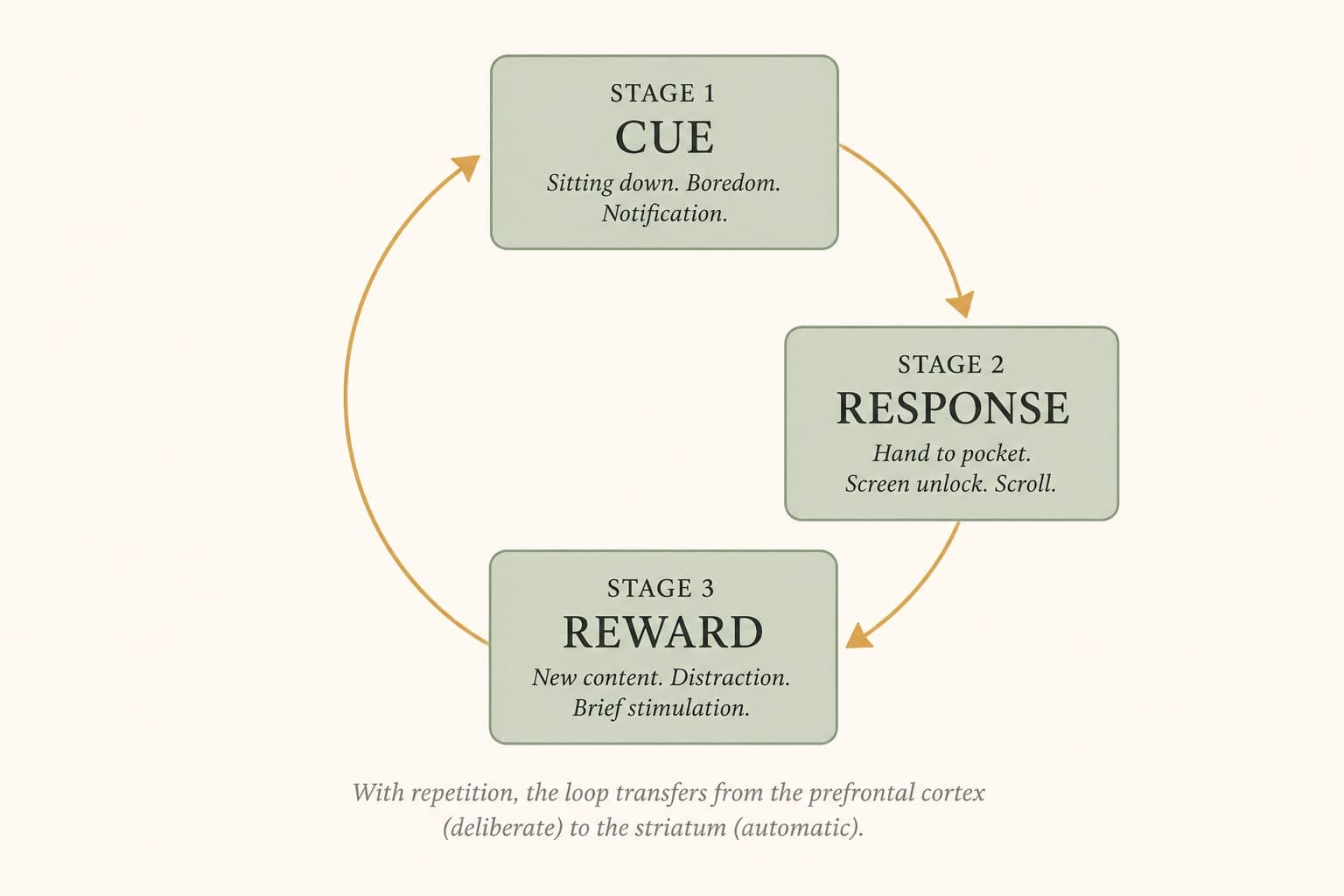
Reaching for your phone without deciding to is not weakness, distraction, or addiction in the moral sense. It is the brain doing what it does best with any behavior you have rehearsed a few thousand times: executing it through the striatum, the deep brain region that handles automatized action sequences, without consulting the prefrontal cortex that would normally weigh whether to do it. The cue can be boredom, sitting down, a notification, even entering a specific room. The response was learned so thoroughly that the conscious mind is no longer in the loop.
It happens dozens of times a day. You are in line at the store. The kettle starts whistling on the stove. You sit down in a chair. The phone is in your hand. You do not remember reaching. You do not remember deciding. The screen is unlocked, the app is open, and you are scrolling. The thinking part of the brain shows up a few seconds later, slightly puzzled about how it got there.
This is not a failure of attention. It is a feature of how the brain handles anything it has done enough times to stop needing supervision.
What Happens When a Behavior Becomes a Habit
Behaviors that you repeat in the same context, over and over, get transferred over time from one brain system to another. The prefrontal cortex handles them at first, when you are still figuring out what to do, when each choice feels deliberate. After enough repetitions, the striatum, a set of structures deep in the brain that handle motor sequences and learned routines, takes over. The action becomes automatic. The cue arrives, the response runs, the conscious mind is no longer consulted. This is what makes driving a familiar route feel effortless. It is also what makes reaching for the phone feel like nothing at all.
The behavior is still happening. The neurons are still firing. What has changed is that the prefrontal cortex, the part of the brain that would normally weigh whether the behavior is worth doing right now, has been bypassed. The striatum does not check. It runs the sequence. The hand goes to the pocket, the screen unlocks, the app opens, the scroll begins. None of it requires your conscious attention.
What the Research on Phone Habits Has Actually Found
A research team set out to find out whether smartphone use, which most people describe as a series of intentional choices to check messages or look something up, is actually driven by deliberate decisions or by something more automatic. They tracked 136 users across multiple devices, logging every phone interaction with timestamps, and analyzed the patterns to see whether use was distributed in a way consistent with intentional behavior or with habitual cue-response.
“Smartphone use is largely habitual rather than intentional. Users engage in brief, frequent checking behaviors with no specific information goal in mind, characterized by short usage sessions triggered by environmental and internal cues rather than by deliberate decisions.”
What this means in plain terms is that most phone pickups are not decisions. They are responses. The user did not consciously evaluate whether to check the phone, weigh the benefit against the alternative, and choose to act. The cue arrived (a moment of inactivity, a sense of boredom, a vibration, sitting down) and the body executed the action without involving the deliberation system at all. The brain is doing exactly what it was built to do with well-learned behavior.
Why This Particular Habit Is Harder to Break Than Others
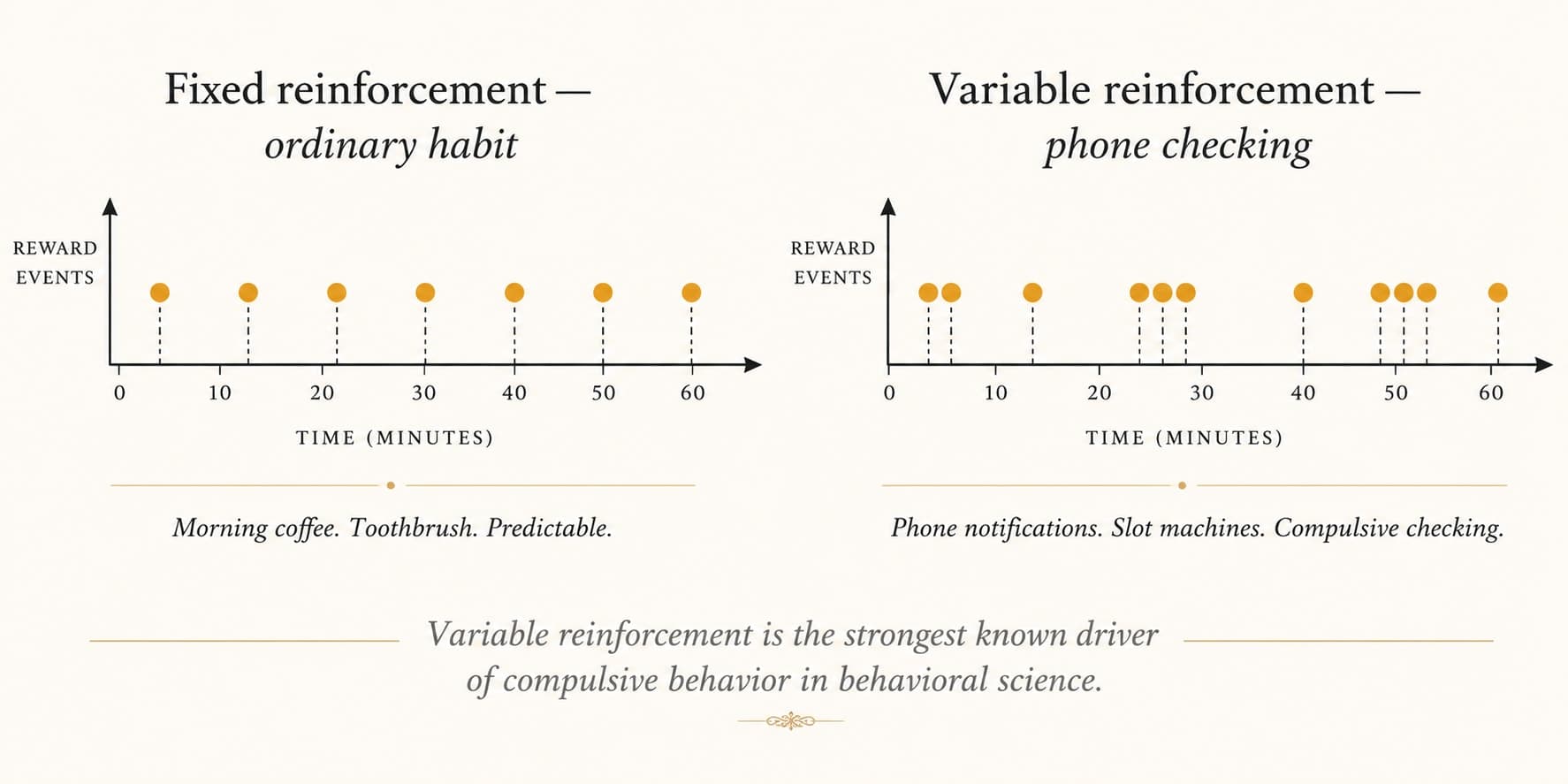
Most habits run on predictable rewards. The morning coffee arrives every morning. The toothbrush feels the same every night. The brain learns these sequences, executes them on cue, and the reward is consistent. Phones operate on a different reinforcement schedule entirely. The reward, a new message, an interesting post, a notification worth responding to, comes unpredictably. Sometimes the phone has something. Sometimes it has nothing. The user has no way to know in advance.
This is the most powerful kind of conditioning known in behavioral science. It is the same schedule that drives slot machines and other compulsive-checking behaviors. The brain learns that the next check might be the one that pays off, and the anticipatory dopamine response, the chemistry that drives the seeking behavior, becomes wired to the moment of reaching for the phone rather than to any specific reward. The reaching itself becomes the rewarding act. Whether the phone has anything new on it is almost beside the point.
What the Cues Actually Are
The cues that trigger phone reaching are surprisingly specific and consistent within each person. They tend to be environmental (sitting on the couch, walking into a particular room, getting into the car), social (being alone, being with someone who is also on their phone, an awkward silence), internal (boredom, anxiety, transition between tasks, a moment of unstructured time), or technical (a vibration, a flash, a notification sound). The same person tends to have the same cues triggering the same response across days. The cue list is shorter than most people would guess. It is often the same five or six situations repeating.
Identifying your own cues is more useful than counting your pickups. The number of times you check the phone is downstream of the cues. The cues are the upstream lever.
The reaching is happening before the reaching feels like a decision. By the time you notice the phone is in your hand, the habit sequence has already finished. The conscious mind catches up afterward, sometimes with a flash of mild surprise, sometimes with no awareness at all.
What Tends to Help
Willpower is the least effective intervention because the prefrontal cortex was not involved in the habit in the first place. Trying to use it to stop the habit is asking a system that is currently offline to override one that is currently running. The interventions that work are upstream of the cue.
Removing the phone from places where the habit reliably runs (the couch, the bedside table, certain rooms) interrupts the cue-response loop more reliably than any decision in the moment. Adding friction (longer passcode, app moved off home screen, account logged out) gives the prefrontal cortex a small window to come back online before the sequence completes. Pairing the cue with a different response (the moment of sitting down becomes the moment of picking up a book that lives on the couch) retrains the striatum on a different action. The work is structural, not motivational.
A System That Learned Too Well
There is a useful way to think about all of this. The reaching for the phone is not weakness, distraction, or moral failure. It is the brain doing exactly what it was designed to do with anything you do often enough: automate it. The same system that lets you walk through your house in the dark without thinking is the system that puts the phone in your hand when you sit down. The brain learned the sequence because you repeated it. It is now running on the brain's deepest set of skills.
The phone is not the problem. The brain is not the problem. The match between an unpredictable-reward device and a brain perfectly designed to automate everything is the problem. Changing the environment, changing the cues, changing the response that comes after the cue, are the levers that work because they speak the language of the system that learned the habit in the first place. The conscious mind is not where the answer lives. The conscious mind only gets to watch.
Want to go deeper on habit science?
Read our breakdown of why stress reliably brings back old habits even when your new ones were holding strong.
Explore Habit ScienceGetClariSync Habits Desk
Editorial Research · Behavioral Science
The GetClariSync Habits Desk studies behavioral science, habit formation, and applied performance psychology. We distill peer-reviewed research from journals like the European Journal of Social Psychology, Psychological Bulletin, the Journal of Personality and Social Psychology, and Behaviour Research and Therapy. We separate findings replicated in pre-registered studies from popular but underpowered effects, and we cite the original papers — not secondary write-ups. Our coverage is informational, not coaching or therapy; for behavioral health concerns please consult a licensed therapist or evidence-based behavioral health professional.