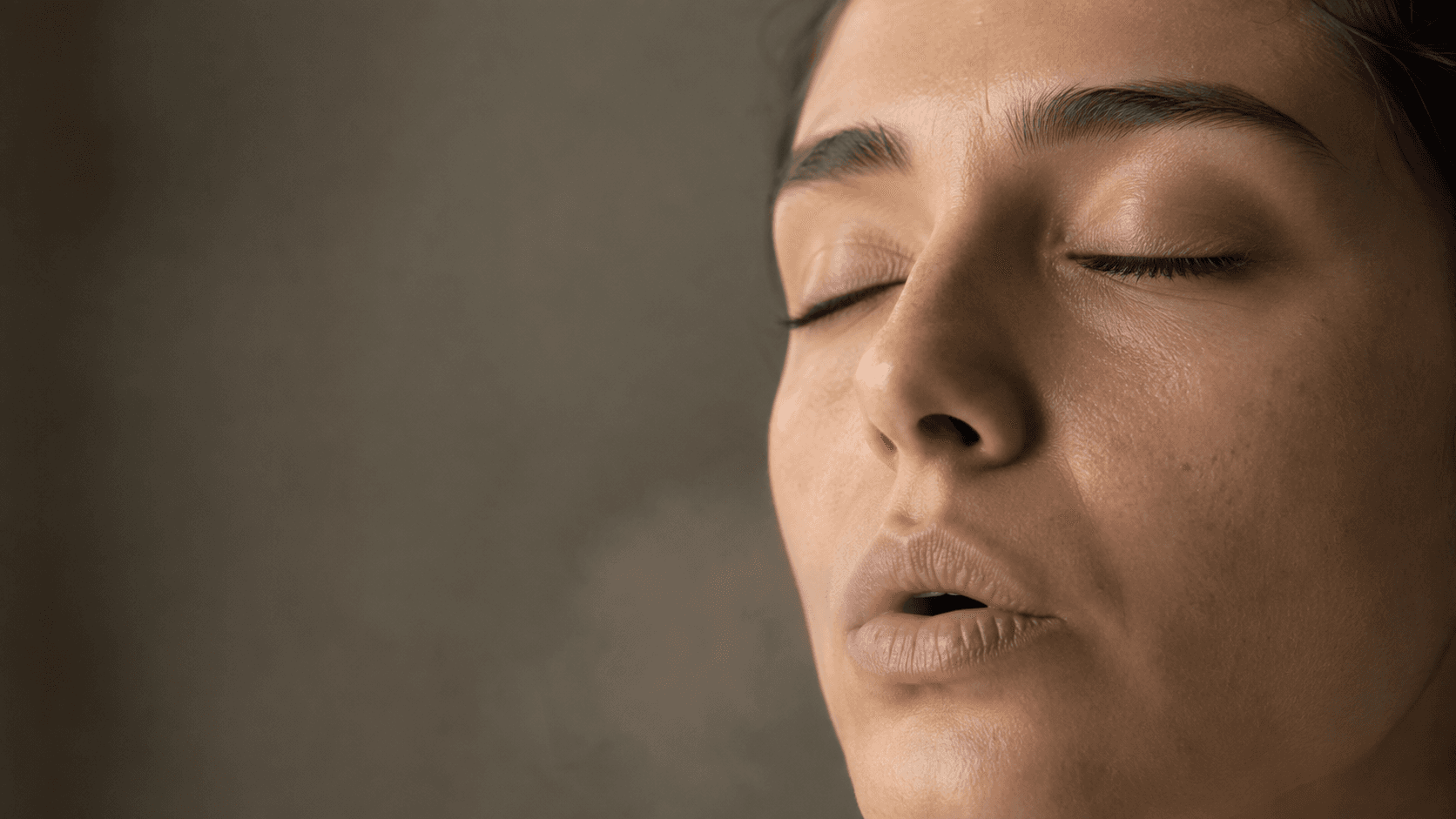
Stanford researchers tested four ways to calm down. One of them beat meditation, box breathing, and a hyperventilation technique combined. It takes one double inhale and a long exhale.
The physiological sigh is a breathing pattern involving two inhales through the nose, a short deep inhale immediately followed by a second, sharper top-up inhale, then one long, slow exhale through the mouth. A 2023 Stanford study compared this pattern, called cyclic sighing when repeated, against box breathing, a hyperventilation-focused technique, and mindfulness meditation, with participants practicing five minutes daily for a month. Cyclic sighing produced the largest improvement in mood and the greatest reduction in breathing rate of all four groups, outperforming meditation specifically. It also works as an immediate, in-the-moment tool, not only as a daily practice, because of how quickly it shifts the body's physiological state.
Just breathe. It is the most repeated advice in the entire wellness vocabulary, and one of the least specific. Breathe how. For how long. Through the nose or the mouth. In what pattern. Most people default to one long, deep inhale, hold it, then let it go, an approach that feels intuitive and, according to a research team at Stanford, is not actually the most effective option available.
What they found instead was a pattern almost nobody uses on purpose, even though the body performs a rough version of it involuntarily, in the sighs that escape during a long day without anyone deciding to make them happen.
What a Physiological Sigh Actually Is
The pattern has three parts, done in one continuous motion. First, a deep inhale through the nose, filling the lungs most of the way. Second, without exhaling, a short, sharp second inhale through the nose, on top of the first one, pushing the lungs slightly fuller. Third, a long, slow, complete exhale through the mouth, roughly twice the length of the inhale phase.
That second inhale is the detail most breathing advice skips entirely, and it is the part that gives the technique its name and its function. Picture inflating a balloon that already has a small amount of air trapped inside it. The first breath does most of the work, but the balloon does not round out fully until a small second puff tops it off. Only then does letting go release the air in one smooth, complete stream rather than an uneven one.
Inside the lungs, something similar happens at a microscopic scale. The tiny air sacs responsible for gas exchange, called alveoli, gradually collapse during shallow or stressed breathing. A single inhale does not fully reopen all of them. The second, smaller inhale does, which is what allows the exhale that follows to release an unusually large amount of carbon dioxide in one go, the signal most directly tied to the body's shift toward calm.
The Study That Tested It Against Everything Else
A research team at Stanford wanted to know which of several popular breathing and mindfulness techniques actually produced the largest measurable shift in mood and physiological arousal, tested head to head rather than studied in isolation the way most breathing research treats a single method.
“Cyclic sighing resulted in the greatest improvement in positive affect and the greatest reduction in respiratory rate compared with box breathing, cyclic hyperventilation, and mindfulness meditation, following daily five-minute practice over one month.”
Every group in the study improved somewhat over the month, which is itself a useful finding, structured daily practice of almost any kind seems to help. But cyclic sighing pulled ahead of the others specifically, and it did so while also producing the largest drop in resting breathing rate, a physiological marker that does not simply reflect how someone reports feeling.
Why It Outperformed Meditation Specifically
Meditation, as practiced in the study, asked participants to passively observe their breath without trying to change it. Cyclic sighing, box breathing, and cyclic hyperventilation all asked participants to actively control the breath in a specific pattern. That distinction, active control versus passive observation, appears to matter for how quickly the body's physiological state actually shifts.
Cyclic sighing (active control)
- Directly manipulates the exhale-to-inhale ratio
- Produces a fast, measurable drop in breathing rate
- Effects are noticeable within the same session
- Requires no prior training or practice to start
Mindfulness meditation (passive observation)
- Observes the breath without directing it
- Benefits build more gradually across sessions
- Requires sustained attentional control, a separate skill
- Still improved mood, just less than active techniques in this trial
This is not a case against meditation, which has decades of separate research behind it for different outcomes. It is a specific finding about which approach shifts breathing rate and momentary mood fastest, in a head-to-head test where the two were finally compared directly instead of studied apart.
Two Different Uses: Right Now, and Every Day
The Stanford trial measured a daily, cumulative practice, five minutes a day for a month, building toward a gradual shift in baseline mood. That is not the only way the technique gets used in practice. Because a single physiological sigh produces a fast physiological response, it also functions as an immediate tool, something reached for in the middle of a stressful moment rather than scheduled in advance.
Using It in the Moment
One to three repetitions, right where you are
Two inhales through the nose, the second one shorter and sharper than the first, then one long, slow exhale through the mouth. Repeat once or twice more if the moment still feels tense. This does not require lying down, closing your eyes, or stepping away from a conversation.
High impactLet the exhale run longer than feels natural
The instinct under stress is to cut the exhale short. Deliberately extending it, aiming for roughly twice the length of the double inhale, is what drives the carbon dioxide release responsible for the calming effect. A rushed exhale blunts most of the benefit.
High impactUsing It as a Daily Practice
Five minutes, same time each day, for at least a month
This is the protocol the research actually tested: repeated cycles of the double-inhale, long-exhale pattern for five continuous minutes, once daily, sustained for four weeks. Anchoring it to an existing habit, right after brushing your teeth or right before opening a laptop, removes the need to remember it as a separate task.
High impactMistakes That Quietly Cancel the Effect
- Exhaling through the nose instead of the mouth, which slows and restricts the carbon dioxide release the technique depends on
- Making the second inhale as large as the first, rather than a smaller top-up, which turns it into ordinary deep breathing
- Holding the breath at the top instead of moving straight into the exhale
- Rushing the exhale to match the length of the inhale, instead of letting it run roughly twice as long
- Treating it as a single-use fix for a chronic problem instead of a tool for individual moments or a daily practice
When Breathing Techniques Aren't Enough
A breathing pattern that shifts physiological arousal in seconds is a genuinely useful tool. It is not a treatment for a diagnosed anxiety disorder, panic disorder, or a respiratory condition, and it is not a substitute for professional care when those are present.
Used within those boundaries, the appeal of this particular technique is its lack of ceremony. No app, no quiet room, no ten minutes set aside. A pattern the body already knows how to perform, deliberately repeated at the moment it is needed, or scheduled daily for the version of the effect that builds over weeks rather than seconds.
The body already knew how to do this. It just never did it on command until someone asked it to.
Science-Backed Wellness, Weekly
Research summaries on focus, stress physiology, and mental clarity: the mechanisms most wellness content skips over.
Get the weekly dispatchGetClariSync Mind Desk
Editorial Research · Cognitive Science
The GetClariSync Mind Desk follows research in cognitive neuroscience, behavioral psychology, and stress physiology. We track findings from peer-reviewed journals including Nature Neuroscience, Cognition, Psychological Science, Frontiers in Psychology, and the Journal of Cognitive Neuroscience. Every claim is traced back to a primary source, and we mark the evidence quality — meta-analyses and replicated studies are weighted above single-lab findings. Our content is informational; it does not replace therapy, psychiatric care, or assessment by a licensed mental health professional. If you are struggling with your mental health, please reach out to a qualified clinician, your physician, or a crisis line in your country.